

Need to submit photographs as claim evidence? A “Letter for Submitting Photographs as Claim Evidence” is your official document. Its purpose is clear: to formally present your photographic evidence to support your claim. This letter helps ensure your photos are properly considered.
We get it. Writing these letters can be tricky. That’s why we’re here to help. This article provides letter samples! We’ll give you templates and examples to guide you. Use these to easily craft your own letter.
Our goal is to make it simple. We want to empower you. You can confidently submit your photographs with well-written supporting letters. We want to make it easy to submit photos and prove your claims!
[Your Name/Law Firm Letterhead (if applicable)]
[Your Address]
[Your Phone Number]
[Your Email Address]
[Date]
[Insurance Company Name/Recipient Name]
[Insurance Company Address/Recipient Address]
Subject: Submission of Photographic Evidence – Claim [Your Claim Number, if applicable]
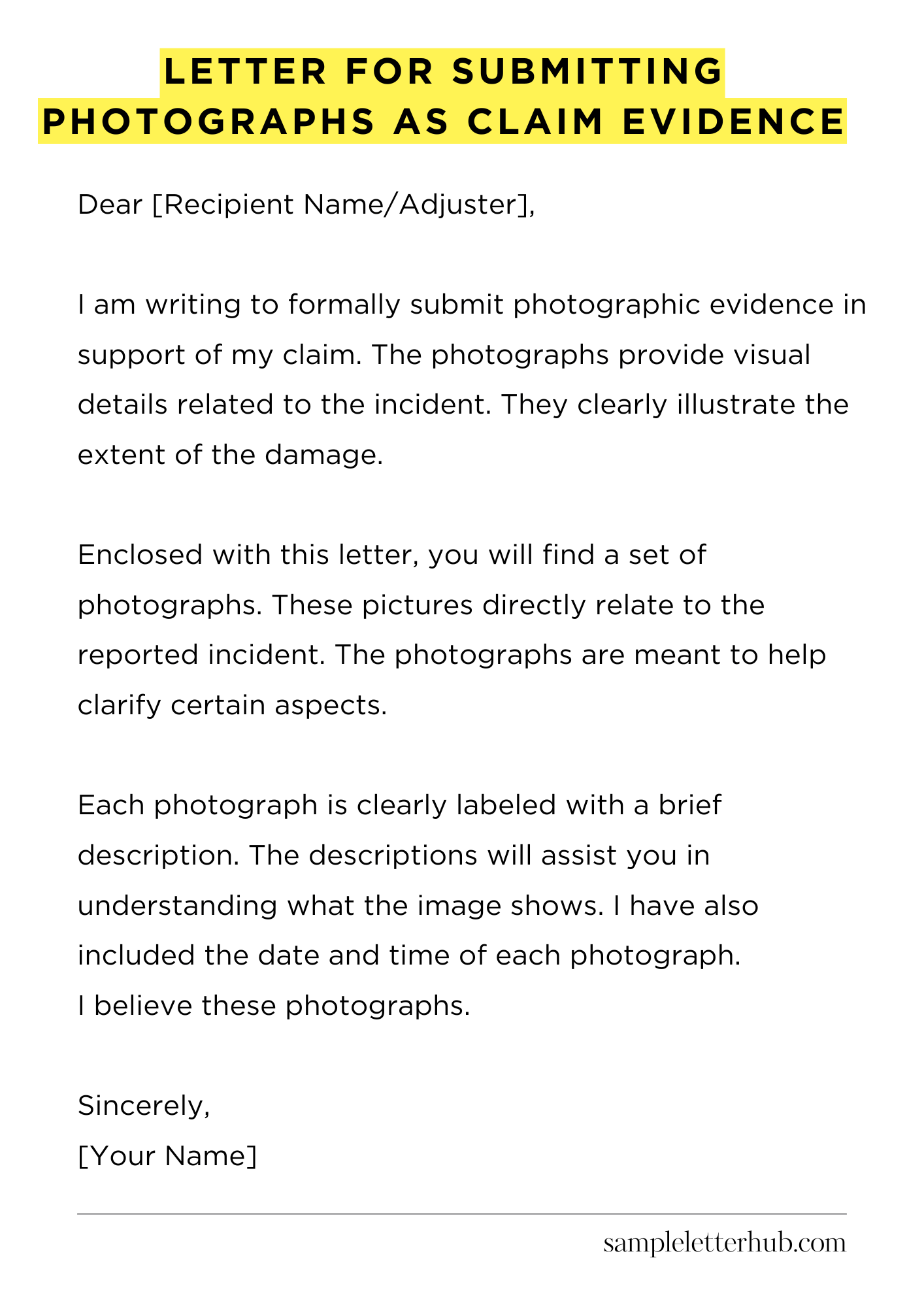
Dear [Recipient Name/Adjuster],
I am writing to formally submit photographic evidence in support of my claim. The photographs provide visual details related to the incident. They clearly illustrate the extent of the damage.
Enclosed with this letter, you will find a set of photographs. These pictures directly relate to the reported incident. The photographs are meant to help clarify certain aspects. They aim to show precisely what occurred.
Each photograph is clearly labeled with a brief description. The descriptions will assist you in understanding what the image shows. I have also included the date and time of each photograph.
I believe these photographs will be useful in your assessment. I believe these images provide significant context. The evidence will help in the evaluation of my claim.
Please review these photos at your earliest convenience. I am available to answer any questions. Please contact me if you require further information.
Thank you for your time and attention to this matter. I appreciate your prompt consideration.
Sincerely,
[Your Name]
How to Write Letter for Submitting Photographs as Claim Evidence
Submitting photographic evidence can be a critical element in substantiating a claim. This is especially true when legal or insurance matters are involved. A well-crafted letter accompanying your photographs can bolster your case, ensuring the recipient understands the context and significance of the images.
1. Commence with a Cogent Salutation
Begin your letter with a formal salutation. Address the intended recipient correctly using their title and name (e.g., “Dear Mr. Smith,”). Ensure accuracy to show that you have taken the necessary due diligence. This establishes professionalism from the outset and sets a tone of respect.
2. Clearly State the Purpose of the Missive
In the opening paragraph, unequivocally state the letter’s purpose: to submit photographic evidence related to a specific claim. Succinctly indicate the claim’s nature (e.g., “property damage claim,” “personal injury claim,”). Make this delineation crystal clear to the reader, avoiding ambiguity.
3. Detail the Incident or Event Depicted
Provide a comprehensive description of the incident or event captured in the photographs. Include the date, time, and location. Be explicit. Elaborate on the circumstances leading to the images, including any relevant actions or observations. This contextualization provides essential background for understanding the visual evidence.
4. Enumerate Each Photograph with Meticulous Descriptions
List each photograph individually, providing a brief but precise description of its contents. Employ a structured numbering or labeling system (e.g., “Photograph 1: Shows the broken window…” “Photograph 2: Depicts the interior damage…”). This organized approach enhances clarity and allows the recipient to easily reference specific images.
5. Highlight the Relevance to the Claim
Explain how each photograph supports your claim. Connect the images directly to the key points of the incident, addressing any specific damages, injuries, or circumstances. For instance, correlate a photograph of a damaged vehicle with the cost of repairs. Emphasize the evidentiary value of each image and how it supports your position.
6. Conclude with a Call to Action and Proper Adieu
Conclude the letter with a clear call to action, if needed. For example, you might request acknowledgement of receipt. Express your availability for any follow-up questions or clarifications. End with a professional closing, such as “Sincerely,” or “Respectfully,” followed by your full name and contact information.
7. Scrupulous Review and Submission Logistics
Before submitting, rigorously proofread the entire letter for any typographical errors or grammatical infelicities. Ensure the photographs are of high quality and clearly labeled.
Make copies of both the letter and the photographs for your records. Submit the documents via a traceable method (e.g., certified mail, email with a read receipt) to maintain a record of delivery.
FAQs about Letter for Submitting Photographs as Claim Evidence
What is the primary purpose of a letter submitting photographs as claim evidence?
The primary purpose is to formally present photographic evidence to support a claim, whether it be for insurance, legal proceedings, or any situation where visual documentation is required to establish facts or corroborate statements.
This letter serves as a written record accompanying the photographs, providing context, identifying the photographs, and outlining their relevance to the claim.
What essential information should be included in a letter for submitting photographs?
A well-crafted letter should include: the sender’s details (name, address, contact information); the recipient’s details (name, address, title); a clear reference to the claim or case; a description of the photographs (date, location, subject matter); a statement of their relevance to the claim; a clear indication that the photographs are original or copies.
What is the proper format for submitting photographs with a supporting letter?
Generally, you should include a cover letter along with the photographs. The letter should be printed on appropriate stationary or typed. You can then attach the photographs, which should be clearly labeled or referenced in the letter. Photographs can be submitted in either digital format (CD, USB drive, or email) or as physical prints.
The method depends on the recipient’s preferences and the nature of the claim. Always follow any specific instructions given by the recipient regarding the submission of evidence.
Can I submit photographs as evidence if I didn’t take them myself?
Yes, you can submit photographs you did not take yourself, but you must clearly identify the photographer and, if possible, how you obtained the photographs. The letter should indicate that you are submitting the photographs and, if necessary, clarify their chain of custody. It is always important to provide as much context as possible.
The weight given to the evidence might be affected if the origin is unclear. Ensure that you have the rights to use the photos.
How can I ensure the photographs are admissible as evidence?
To increase the likelihood of admissibility, ensure the photographs are authentic, relevant, and accurately represent the scene or subject. Take clear, well-lit photos. Include the date and time the photograph was taken, and label the photographs accordingly.
The letter should describe the photographs, their relevance, and, if applicable, the context in which they were taken. Chain of custody is important so if possible keep them secure. It is also good practice to consult with a legal professional to ensure the photographs meet the necessary evidentiary requirements in your specific situation.
Related:
Resignation letter due to rude boss
Resignation letter moving to another state
Resignation letter due to illness of family member
Resignation letter due to study