

Dealing with rejected documents? It happens. A letter to resubmit rejected documents is your way to fix it. It tells the recipient why you’re sending it again. The goal? To correct errors and ensure your documents get accepted. This can be for anything. From applications to legal filings.
Ready to make writing those letters easy? This article has you covered. We’re sharing templates. Find samples of letter formats. We have examples for various situations. These letter to resubmit documents examples will help you. They’ll simplify the process.
Need a letter to resubmit? Want to avoid future rejections? Explore our templates. They will help you craft perfect letters. You’ll find samples of letter formats. Let’s get your documents approved! Let’s get started.
[Your Name/Your Company Name]
[Your Address]
[Your City, Postal Code]
[Your Email]
[Your Phone Number]
[Date]
[Recipient’s Name/Company Name]
[Recipient’s Address]
[Recipient’s City, Postal Code]
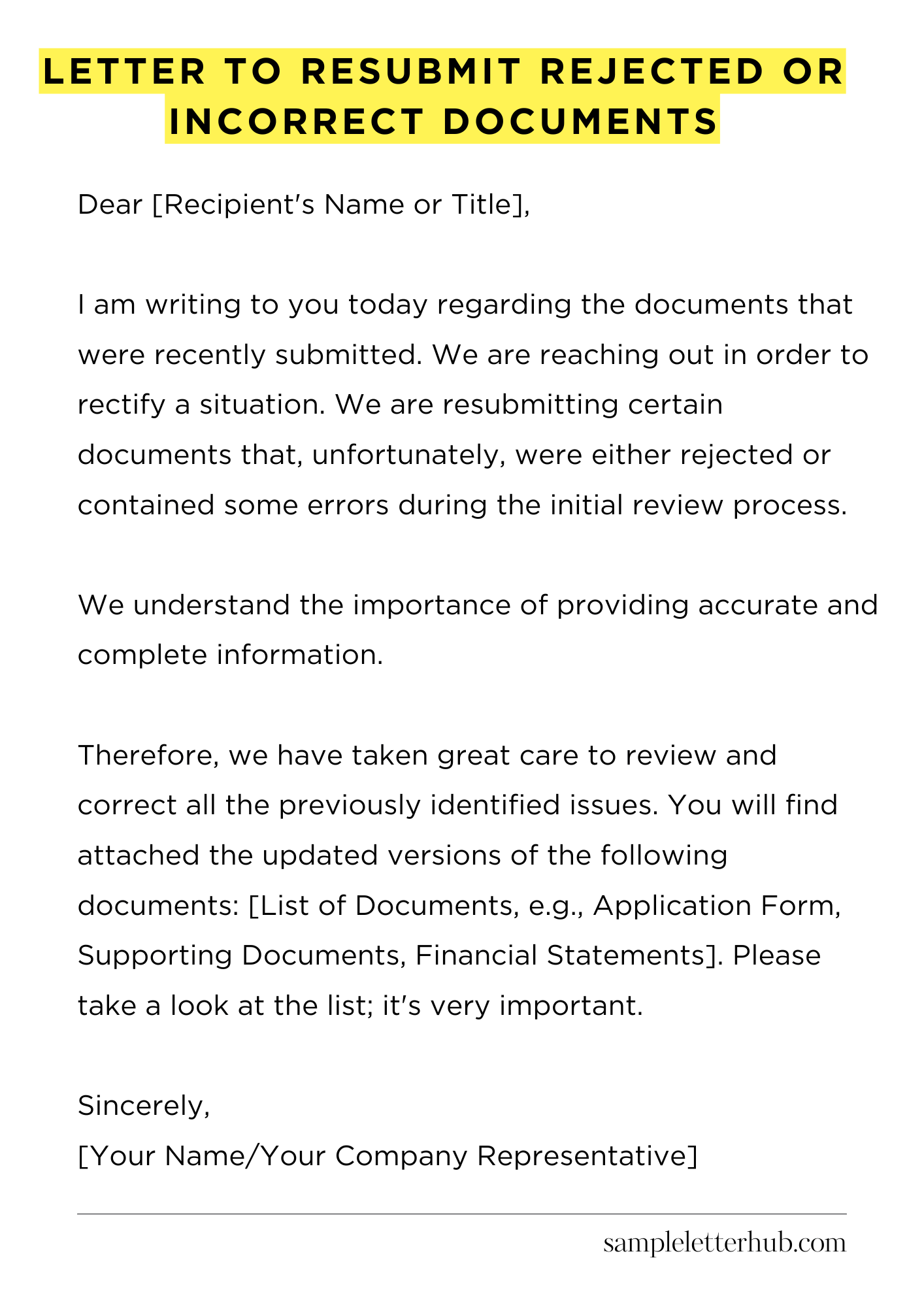
Dear [Recipient’s Name or Title],
I am writing to you today regarding the documents that were recently submitted. We are reaching out in order to rectify a situation. We are resubmitting certain documents that, unfortunately, were either rejected or contained some errors during the initial review process.
We understand the importance of providing accurate and complete information.
Therefore, we have taken great care to review and correct all the previously identified issues. You will find attached the updated versions of the following documents: [List of Documents, e.g., Application Form, Supporting Documents, Financial Statements]. Please take a look at the list; it’s very important.
Specifically, we have addressed the following points: [Briefly list the corrections made, e.g., corrected spelling errors, included missing signatures, provided updated financial details].
The changes made are intended to ensure all requirements are met. We have made sure to take the necessary steps to make sure it will be right this time.
We are confident that these revised documents now meet all the necessary criteria. We are hoping for a quick approval this time. Please do not hesitate to contact me if you require any further information or clarification.
You can reach me by phone or email. We appreciate your time and consideration in this matter. Thank you for your assistance.
Sincerely,
[Your Name/Your Company Representative]
How to Write Letter to Resubmit Rejected or Incorrect Documents
Encountering document rejection can be a harrowing experience. It’s frustrating to have your submission deemed deficient. But do not despair! A well-crafted resubmission letter can be your lifeline.
You must approach it with meticulous attention to detail and a strategic mindset. Let’s delve into the art of constructing a persuasive letter of resubmission.
1. Understanding the Edifice of Rejection
Before composing your letter, scrutinize the rejection notice. Decipher the precise reasons for rejection. Identify every deficiency mentioned, no matter how trivial they appear.
Was the document improperly formatted? Were crucial details omitted? Perhaps there’s an issue with the supporting documentation? Make copious notes to ensure a comprehensive understanding of the situation.
Comprehending the basis of the rejection is paramount. Failure to grasp the underlying issues will render your resubmission futile.
2. The Genesis of a Resubmission Letter: Format and Salutation
The initial step involves structuring your letter professionally. Begin with your contact information. This typically includes your full name, address, phone number, and email address. Next, include the date.
Follow this with the recipient’s information. It must be identical to the original submission, to help the recipient easily identify and cross-reference your letter. The salutation sets the tone; it must be formal. Use “Dear [Recipient’s Name],” or if the name is unknown, “Dear Sir/Madam.”
3. A Succinct Prolegomenon: The Introduction
The introduction sets the stage. State your intention concisely. Specify the document you are resubmitting. Reference the original submission’s date and, crucially, the reference number.
Briefly mention the reason for resubmission, alluding to the initial rejection. Keep it brief. You must immediately indicate that you are aware of the problem at hand, showing your understanding and your attempt to rectify it.
4. Adhering to Rectification: Address the Deficiencies
This is the substantive core of your letter. Methodically address each point of rejection. For each deficiency, clearly state the corrective action you’ve taken. Be precise.
Specify which documents have been amended or replaced. Consider numbering each point to maintain clarity. Provide any updated information or supporting documentation that remedies the original errors. For example, “The incorrect date has been rectified on page 3. The updated version is attached.”
5. Augmenting the Narrative: Explanations and Justifications
Sometimes, the rejection stems from misunderstanding or lack of context. In these cases, offer concise explanations. Provide clarifying information. Justify any discrepancies.
Use this section judiciously. Avoid excessive explanations. Be factual and to the point. Focus on providing additional information that directly addresses the rejection rationale.
6. A Plea for Expediency: The Closing
Conclude your letter with a polite request. Reiterate your commitment to rectifying the issues. Express your anticipation of a positive outcome.
Consider including a sentence like, “I have diligently addressed the concerns and trust that the resubmitted documents meet your requirements.” Include a final, formal closing, such as “Sincerely” or “Respectfully.” Sign your name above your typed name.
7. Verifying Before Transmission: Proofreading and Submission
Before submission, rigorously proofread your letter. Check for grammatical errors, typos, and formatting inconsistencies. Ensure the tone is professional and respectful.
Double-check all contact information and reference numbers. Confirm that you have attached all necessary documents.
Review the original submission guidelines for submission methods (email, postal mail, or online portal) and adhere to them precisely. Remember, a flawlessly executed letter increases your likelihood of a successful resubmission.
FAQs about Letter to Resubmit Rejected or Incorrect Documents
Why is it necessary to write a letter to resubmit rejected or incorrect documents?
A letter of resubmission serves several crucial purposes. Primarily, it formally acknowledges receipt of rejection or identified errors in previously submitted documentation.
It provides an opportunity to clarify misunderstandings, offer corrections, and demonstrate a proactive approach to resolving the issue. This communication ensures a clear and documented trail of communication, which is vital for any formal process.
What key information should be included in a letter to resubmit documents?
Essential components include a clear reference to the original submission, the specific reason(s) for the rejection or identified errors (as provided by the recipient), detailed corrections or revised information, and any supporting documentation.
How should the tone of the letter be structured?
The tone of the letter should be professional, courteous, and concise. It’s crucial to remain objective and avoid any accusatory language. Start by acknowledging the rejection or errors, then provide clear explanations and corrections. Maintain a respectful tone throughout the letter, which can help ensure a favorable outcome.
What is the appropriate format for a letter to resubmit documents?
Adhere to a formal business letter format. This typically includes your contact information, the recipient’s contact information, the date, a clear subject line indicating the purpose of the letter, a formal salutation (e.g., “Dear [Recipient Name]”), a body that addresses.
What are some common mistakes to avoid when writing a letter to resubmit documents?
Common pitfalls include failing to clearly identify the original submission, neglecting to address each point of rejection or error, omitting supporting documentation, using unprofessional language, and not providing clear contact information.
Thoroughly proofread the letter before sending it to ensure accuracy and professionalism. Another common mistake is submitting documents that are not correctly named or clearly labeled.
Related:
Resignation letter due to rude boss
Resignation letter moving to another state
Resignation letter due to illness of family member
Resignation letter due to study