


Submitting medical bills to your insurance company can feel overwhelming. A “Letter to Submit Medical Bills for Insurance Claim” is a formal way to do this. It’s a key tool in getting your medical expenses covered. This letter formally requests your insurance to review and pay your medical bills.
Don’t worry about the writing part. This article will help. We’ve got you covered with a variety of letter to submit medical bills for insurance claim templates. These are samples of letters you can adapt. Need a medical bill submission letter? We have options! Writing a letter to insurance company for medical bills is now simpler.
Our medical claim letter samples will guide you. Find the perfect letter format for medical bills submission. Use these examples of letters to submit medical bills to streamline the process. Get your claims processed faster and easier.
[Your Name/Your Address]
[Your Phone Number]
[Your Email Address]
[Date]
[Insurance Company Name/Address]
Subject: Submission of Medical Bills for Insurance Claim – [Your Policy Number]
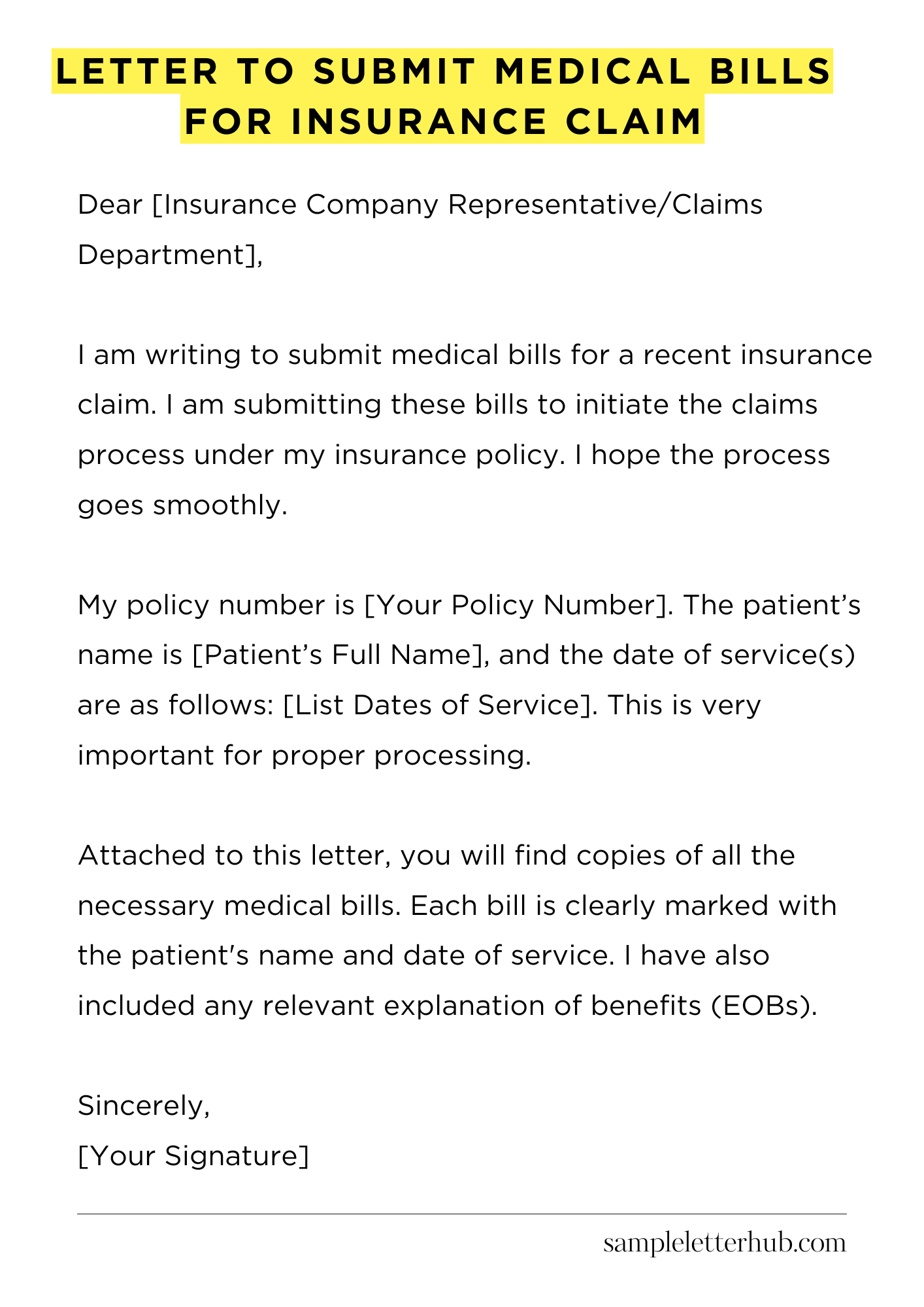
Dear [Insurance Company Representative/Claims Department],
I am writing to submit medical bills for a recent insurance claim. I am submitting these bills to initiate the claims process under my insurance policy. I hope the process goes smoothly.
My policy number is [Your Policy Number]. The patient’s name is [Patient’s Full Name], and the date of service(s) are as follows: [List Dates of Service]. This is very important for proper processing.
Attached to this letter, you will find copies of all the necessary medical bills. Each bill is clearly marked with the patient’s name and date of service. I have also included any relevant explanation of benefits (EOBs), if applicable. Please review them carefully.
I have included documents from the following: [List the providers – e.g., Doctor’s Office, Hospital, etc.]. The documentation should provide the care details. The billing is itemized as well.
I would appreciate it if you could process my claim as quickly as possible. Please let me know if you require any additional information from me. I am readily available if you need further clarification. You can reach me by phone or email.
Thank you for your time and attention to this matter. I look forward to receiving confirmation of the claim’s status.
Sincerely,
[Your Signature]
How to Write a Letter to Submit Medical Bills for Insurance Claim
Submitting medical bills for insurance reimbursement can be a daunting process. However, a well-crafted letter can significantly streamline the claim process, increasing your chances of prompt and accurate payment. This comprehensive guide will equip you with the knowledge to draft a compelling letter, ensuring your medical expenses are handled efficiently.
1. Commence with Precise Identification
Your missive’s initial paragraphs are crucial. Begin by clearly stating the purpose of your communication: the submission of medical bills for an insurance claim. Following this, furnish all vital identifying information.
This typically includes your full name, address, date of birth, and policy number. Additionally, if the claim is related to an accident or injury, succinctly state the date and nature of the incident. This preliminary section establishes a clear foundation for your claim.
2. Detail the Service Rendered
The core of your letter should accurately depict the medical services received. Provide a chronological account of each medical encounter. Include dates of service, the names of the healthcare providers (physicians, specialists, etc.), and a concise description of the services received.
For instance, “October 26, 2024: Consultation with Dr. Emily Carter, Dermatologist, for suspected skin condition.” Such specificity is important; it leaves no room for ambiguity. If you received multiple services, use bullet points or numbered lists for enhanced clarity.
3. Enclose Supporting Documentation Adequately
Your letter must be accompanied by comprehensive documentation. Be certain to include copies of all relevant medical bills, itemized statements, and any supporting documentation requested by your insurance provider.
Thoroughness is key. Make several copies of everything. If you are submitting via postal service, it is advisable to send everything via certified mail with a return receipt requested. This provides proof of delivery and receipt, which is beneficial.
4. Articulate the Claim’s Magnitude
Calculate and clearly state the total amount of your medical bills. This figure, often the aggregate of all enclosed invoices, provides the insurance company with a singular, unambiguous financial obligation.
Explicitly state the total amount at the end of your detailed listing of services. Be precise. If you have already made any payments, be sure to note this and subtract the payment from the total amount due.
5. Highlight Crucial Policy Stipulations
Although you are not required to provide legal analysis, it is to your benefit to briefly reference the pertinent sections of your insurance policy that pertain to your claim.
If, for instance, your policy covers specific types of treatments or services, cite these sections to reinforce the validity of your claim. This preemptive measure can often expedite the approval process and reduce the likelihood of denial.
6. Request Explicit Action and Contact Information
The closing paragraph of your letter should explicitly request a specific action from the insurance provider: the prompt processing of your claim and subsequent reimbursement.
Provide your preferred method of contact: phone number and email address. Offer all pertinent contact information to facilitate communication. Make it simple for them to reach out.
7. Finalize with a Professional Sign-off
Conclude your letter with a professional and polite sign-off. Options include “Sincerely,” “Yours faithfully,” or “Respectfully.” Following the sign-off, type your full name.
It’s recommended that you print the letter and then sign it by hand. This demonstrates a level of seriousness and attention to detail. Before mailing or submitting electronically, proofread your letter meticulously to eliminate any errors in grammar, spelling, or punctuation. A flawless letter conveys professionalism and increases your chances of a successful claim.
FAQs about Letter to Submit Medical Bills for Insurance Claim
What information should I include in the letter?
Your letter should include your full name, address, policy number, and the date of service for the medical bills you are submitting. Clearly state that you are submitting medical bills for a claim and provide a brief description of the medical services received.
Always include copies of the original medical bills and any relevant documentation, such as Explanation of Benefits (EOB) from other insurance companies if applicable.
How do I format the letter?
The letter should be professional and easy to read. Use a standard business letter format, including the date, the insurance company’s address, and a clear subject line such as “Medical Bill Submission – Claim [Your Claim Number or Policy Number]”.
Keep the tone polite and concise, stating your purpose and providing necessary details. Proofread the letter carefully for any errors before sending it.
Where should I send the letter and medical bills?
Send the letter and medical bills to the address specified by your insurance company for claims submission. This information is typically found on your insurance card, in your policy documents, or on the insurance company’s website.
If you are unsure, contact your insurance company’s customer service to confirm the correct mailing address. Always keep a copy of the letter and bills for your records and send the documents via certified mail with return receipt requested to have proof of mailing and delivery.
What happens after I submit the letter and medical bills?
After you submit your letter and medical bills, the insurance company will review your claim. They may contact you for additional information if needed. You will receive an Explanation of Benefits (EOB) from the insurance company, which will detail the medical services, the charges, how much the insurance paid, and what you are responsible for.
It is important to review the EOB carefully to ensure accuracy. If you disagree with the insurance company’s decision, you typically have the right to appeal.
What if the insurance company denies my claim?
If your claim is denied, the insurance company should provide a reason for the denial in the EOB. Review the denial carefully to understand the reason. You typically have the right to appeal the decision.
Follow the instructions provided by the insurance company for the appeals process, which may include submitting additional documentation, providing more information, or requesting a review. Keep records of all communication and documentation throughout the appeals process.
Related:
Resignation letter due to rude boss
Resignation letter moving to another state
Resignation letter due to illness of family member
Resignation letter due to study
Resignation letter due to long commute