

Dealing with insurance claims can be tricky. Sometimes, you need to submit more documents. That’s where a “Letter for Submitting Pending Claim Documents” comes in.
The purpose is simple: To officially provide the necessary paperwork to support your insurance claim. It helps keep the process organized. It ensures your claim is complete and is processed efficiently.
We understand writing these letters can feel daunting. That’s why we’re here to help! We’ve created a collection of helpful templates. You’ll find different Letter for Submitting Pending Claim Documents examples. These are designed to guide you. Use these samples as a starting point.
Our goal is to make things easy. Need a letter for claim documents? We have you covered. Looking for sample letters for claim submission? Explore our examples. With our pending claim document submission letter samples, composing your letter is a breeze. Let us simplify the claims process for you!
[Your Name/Company Name]
[Your Address]
[Your Phone Number]
[Your Email Address]
[Date]
[Insurance Company Name/Recipient Name]
[Insurance Company Address/Recipient Address]
Subject: Submission of Pending Claim Documents – [Your Claim Number/Policy Number]
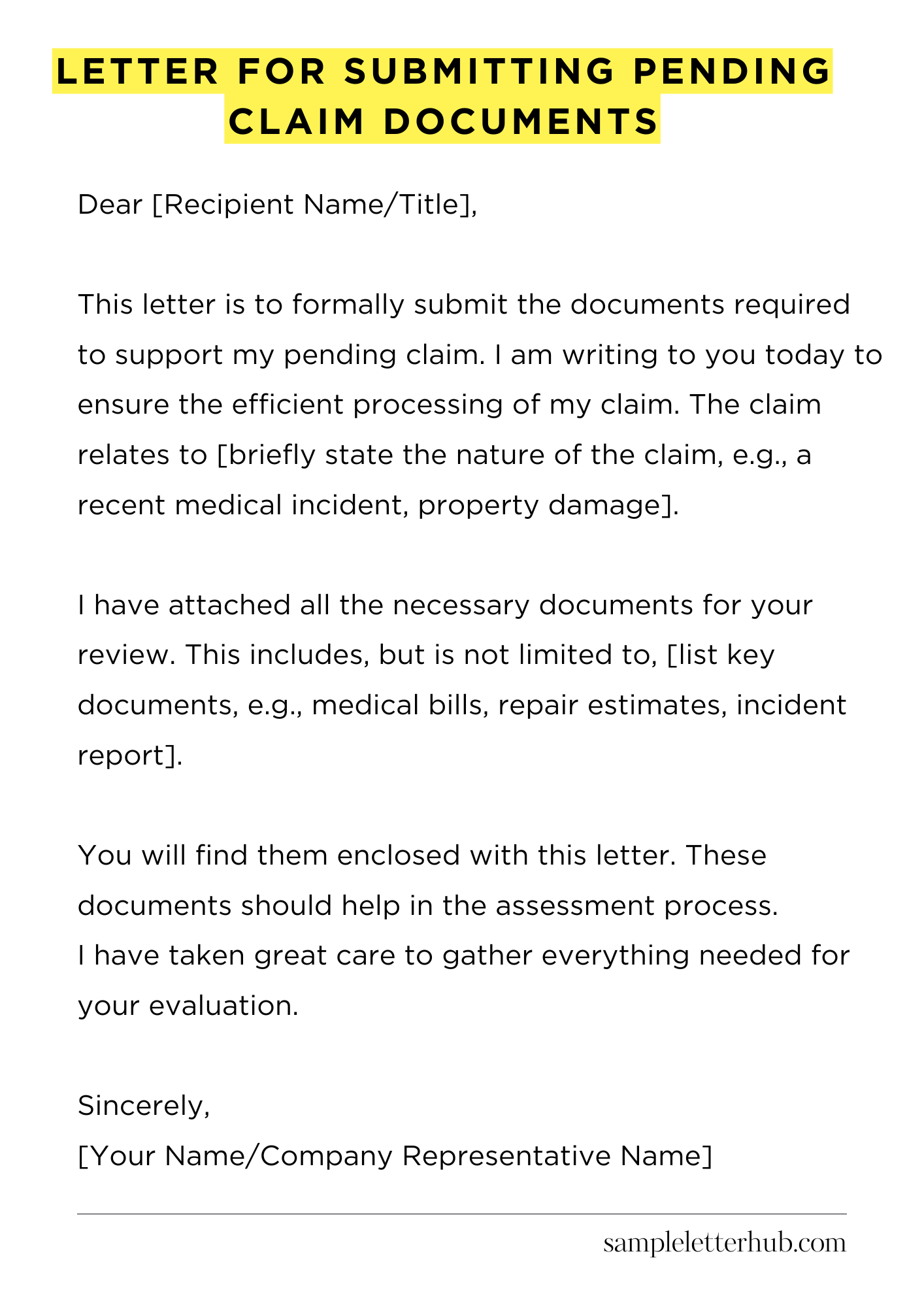
Dear [Recipient Name/Title],
This letter is to formally submit the documents required to support my pending claim. I am writing to you today to ensure the efficient processing of my claim. The claim relates to [briefly state the nature of the claim, e.g., a recent medical incident, property damage].
I have attached all the necessary documents for your review. This includes, but is not limited to, [list key documents, e.g., medical bills, repair estimates, incident report].
You will find them enclosed with this letter. These documents should help in the assessment process.
I have taken great care to gather everything needed for your evaluation. I understand the importance of providing all relevant information. Furthermore, I hope that the documents provided are clear and complete.
If you require any further information or clarification, please do not hesitate to contact me. You can reach me by phone or email at the contact information provided above. I am readily available to answer any questions.
Thank you for your time and attention to this matter. I appreciate your prompt consideration of my claim. I look forward to hearing from you soon regarding the status of my claim.
Sincerely,
[Your Name/Company Representative Name]
How to Write Letter for Submitting Pending Claim Documents
Submitting claim documents can sometimes be a labyrinthine process. Ensuring everything is in order is critical for prompt processing.
Crafting a cogent letter to accompany your documents is a crucial step that can often expedite the entire affair. Let’s delve into the minutiae of composing a letter that not only conveys the necessary information but also presents your case in a professional and compelling manner.
1. Identifying the Recipient and Purpose
Before you even think about penning a single sentence, you must ascertain your audience. Who exactly are you addressing? Is it a claims adjuster, a specific department, or a general intake team?
Identifying the correct recipient is paramount. Next, unequivocally define your purpose. Are you submitting initial documentation, providing supplemental materials, or following up on a previously submitted claim? This clarity will dictate your entire approach.
2. The Salutation and Introductory Prolegomenon
Begin with a professional salutation. “Dear Mr./Ms./Mx. [Last Name]” is generally appropriate unless you possess a more specific contact.
Immediately after the salutation, present a brief, yet impactful introductory paragraph. State your name, the claim number, and a concise summary of the documents being submitted.
For example, “This letter accompanies the following documents pertaining to claim number 1234567: [List of Documents].” Don’t over-embellish; keep it terse and to the point.
3. Enumerating the Enclosures: A Meticulous Inventory
This is where precision reigns supreme. Provide a comprehensive and itemized list of all the documents you are including. Each document should be clearly identified, using the official title if possible.
Ensure that this list mirrors the order in which you’ve physically assembled the documents. This allows the recipient to swiftly cross-reference the submitted materials, minimizing potential confusion or delays.
4. Providing Pertinent Context: Illuminating the Narrative
This section allows you to provide crucial context. Explain why these documents are being submitted. If the documents address a specific request, reference that request explicitly.
If they resolve outstanding issues, succinctly articulate that fact. If you are submitting additional information that you feel is important, briefly explain its relevance to the claim. Keep the language direct, eliminating jargon. The goal is to inform and clarify.
5. Expressing Gratitude and a Request for Action
Politeness is crucial, especially when dealing with bureaucratic processes. Express your gratitude for their time and attention. A simple “Thank you for your assistance” can suffice.
Then, conclude with a clear request. If you need confirmation of receipt, explicitly ask for it. If you have any further questions or require additional information, politely state that you are available. Providing your preferred method of contact is always a good practice.
6. The Formal Closure and Signature: The Denouement
Close your letter with a formal sign-off. “Sincerely,” or “Respectfully,” are both acceptable. Below the closing, type your full name, and then sign the letter manually.
If you are sending an electronic version, consider adding your digital signature or creating a scanned image of your physical signature to lend authenticity and ensure credibility. Be sure to include your contact information (phone number and email address) below your typed name.
7. Proofreading and Delivery: Ensuring Perfection and Promptness
Before dispatching your letter, proofread it meticulously. Check for grammatical errors, typos, and inconsistencies. Verify that all the information, including the claim number, recipient’s address, and your contact details, is accurate. It’s also important to confirm that the letter addresses are correct.
Choosing the correct mode of delivery is important. Send the letter via certified mail with a return receipt requested. This provides proof of delivery and ensures accountability. With these steps, your letter, and your claim, are on the best path to success.
FAQs about Letter for Submitting Pending Claim Documents
What is the primary purpose of a letter for submitting pending claim documents?
The primary purpose of a letter for submitting pending claim documents is to formally communicate with the relevant party (e.g., an insurance company, a government agency) that you are providing the necessary documentation required to support your claim.
This letter serves as a record of your submission, ensuring clarity and transparency in the claims process. It helps to keep track of what you have submitted and when, providing a reference point for both you and the recipient.
What key information should be included in a letter for submitting pending claim documents?
A well-crafted letter should include several crucial pieces of information. This typically includes your full name, address, and contact information, along with the claim number (if applicable).
You should clearly state the type of claim you are addressing (e.g., insurance claim, medical reimbursement).
A detailed list of the documents being submitted is essential, including their names and any identifying information (e.g., date of document, reference numbers). It is also important to include the date the letter is written and your signature.
How should I format the list of documents within the letter?
The list of documents should be formatted in a clear and organized manner. Consider using a bulleted or numbered list for easy readability.
For each document, provide the document’s name, the date it was issued (if applicable), and any other relevant identifying information.
This ensures there’s no confusion about what is being submitted. Make sure the list mirrors the actual documents, and that all the documents are easily understood by the recipient.
What is the best way to send the letter and supporting documents?
The best way to send the letter and supporting documents often depends on the recipient’s preferred method and the sensitivity of the information.
For many insurance and government claims, sending it by certified mail with return receipt requested provides proof of delivery and confirmation that the documents were received.
This offers a level of security. If the recipient allows it, you may send electronically (email or an online portal). Always retain a copy of both the letter and the supporting documentation for your records.
What should I do if I receive no response after submitting the documents?
If you have not received a response within a reasonable timeframe (e.g., 30-60 days, depending on the claim type), you should follow up with the recipient.
This can involve sending a follow-up letter, making a phone call, or checking their online portal for claim status updates. Refer to your copy of the initial submission letter, and mention the date you sent the documents.
If your claim continues to stall, it may be time to seek legal advice or further assistance from the relevant authority.
Related:
Resignation letter due to rude boss
Resignation letter moving to another state
Resignation letter due to illness of family member
Resignation letter due to study