

You’ve got this!
Sometimes, paperwork gets lost. Life happens. A Cover Letter for Submission of Missing Documents is your lifeline. Its purpose? To officially submit those missing pieces. You tell the recipient what you are sending. You explain why the documents were missing initially.
Dealing with missing documents can be stressful. We understand. This article provides a collection of cover letter templates. Consider them your starting point. Use our cover letter examples to tailor your communication. We’ve got you covered with a variety of cover letter samples.
Whether it’s a passport, application, or tax form, we have a template for you. Our missing document cover letter examples are designed to be easy to modify. Let us help you navigate the process smoothly!
[Your Name]
[Your Address]
[Your Phone Number]
[Your Email Address]
[Date]
[Recipient Name]
[Recipient Title]
[Company/Organization Name]
[Recipient Address]
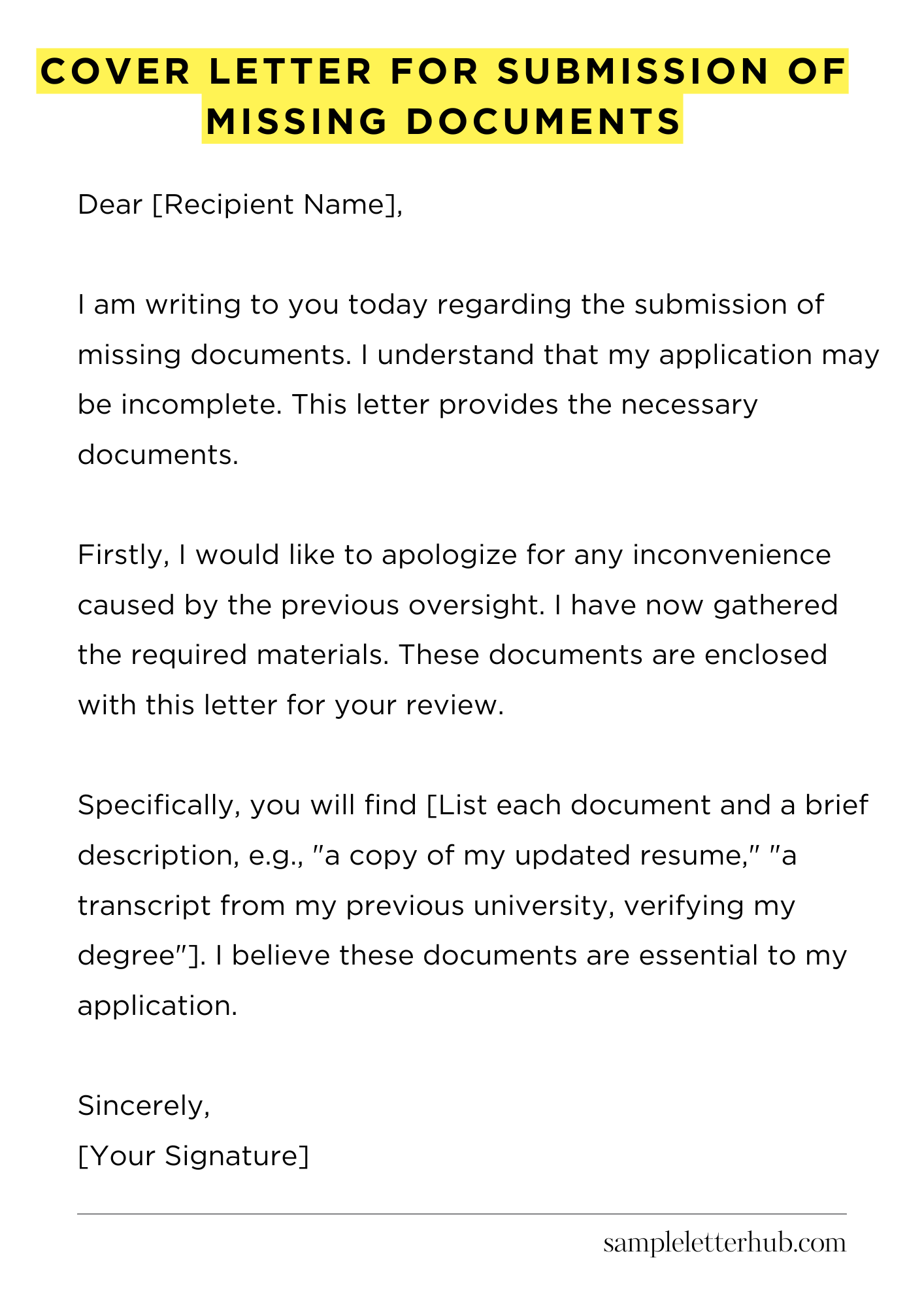
Dear [Recipient Name],
I am writing to you today regarding the submission of missing documents. I understand that my application may be incomplete. This letter provides the necessary documents.
Firstly, I would like to apologize for any inconvenience caused by the previous oversight. I have now gathered the required materials. These documents are enclosed with this letter for your review.
Specifically, you will find [List each document and a brief description, e.g., “a copy of my updated resume,” “a transcript from my previous university, verifying my degree”]. I believe these documents are essential to my application. They provide a more comprehensive view of my qualifications.
I have taken great care to ensure the completeness and accuracy of these submissions. Please let me know if you require any further information. I am happy to assist you in any way possible.
Thank you very much for your time and consideration. I am excited about the opportunity and look forward to hearing from you soon.
Sincerely,
[Your Signature]
How to Write Cover Letter for Submission of Missing Documents
1. Initiate the Correspondence with Precision
You must commence your cover letter with the utmost formality. Begin by penning the date in the upper right-hand corner. Directly beneath this, provide the recipient’s full name, their official title (if known), and their organizational affiliation.
Finally, include the complete postal address of the individual or institution. This rigorous formatting sets a professional tone from the very genesis of the document. This is how you start to capture the reader’s attention.
2. The Salutation: A Crucial Overture
The salutation is your introductory gambit. Always address the recipient formally. A simple “Dear Mr./Ms./Mx. [Surname]” is the safest route. If the name is unknown, opt for a professional alternative like “To Whom It May Concern.”
Avoid casual greetings; they can undermine the gravity of your request. This introduction is an opening for you to put forward your case.
3. Clearly State the Objective: The Corpus of the Matter
The opening paragraph must concisely state the purpose of the letter. This is where you disclose the missing documents you are submitting. Specify what documents are missing. A clear and direct statement prevents any ambiguity.
Immediately mention any reference numbers or case IDs associated with the original request. The faster you get to the point, the better.
4. Deliberate Elaboration: Contextualize the Circumstances
In the subsequent section, furnish contextual details. Briefly, yet definitively, explain why the documents were initially absent. This requires a delicate balance; avoid excessive detail, yet provide sufficient information to justify the delay or omission. Be honest. Be transparent. This is your chance to offer clarity and explanation.
5. The Document Arsenal: Precise Enumeration
Precisely list each document being submitted. This isn’t the time for verbosity; simplicity is key. Use bullet points or numbered lists. Be absolutely specific. Mention the document’s official name, the date it was issued (if applicable), and any other identifying information (e.g., file number, version). Accuracy is paramount at this stage.
6. The Formal Closure: Finalizing the Proclamation
Conclude the letter with a formal closing. Employ a phrase such as “Sincerely,” or “Respectfully,” followed by your full name and signature. If submitting electronically, your typed name suffices.
If mailing a hard copy, personally sign the document above your typed name. This is where you seal the deal.
7. The Postscript: A Further Enhancement
A postscript (P.S.) can be included to reiterate a critical piece of information. This is a subtle yet effective technique to underscore a key point.
This may include a reiteration of your contact information or a final plea for swift processing. This extra touch can subtly strengthen your claim.
FAQs about Cover Letter for Submission of Missing Documents
What is the primary purpose of a cover letter for missing documents?
The primary purpose of a cover letter for missing documents is to formally communicate to the recipient that you are providing the missing documentation. It serves to identify the documents being submitted, explain why they were initially missing (if applicable, and if you are comfortable doing so).
What essential information should be included in this type of cover letter?
Essential information includes the date, the recipient’s name and title, the specific documents being submitted (clearly listed), any relevant reference numbers or case IDs, a brief explanation for the missing documents (if necessary), an assurance of the documents’ accuracy, your contact information (name, address, phone number, and email), and a professional closing.
Should I explain why the documents were missing?
Whether or not to explain why the documents were missing depends on the situation and your comfort level. If the reason is straightforward and won’t negatively impact your case, providing a brief explanation can be helpful.
However, if the reason is sensitive or could potentially harm your position, it might be better to simply state that you are now providing the missing documents. Always be truthful.
How should I format the cover letter?
The cover letter should be formatted professionally, similar to a standard business letter. Use a clear and concise tone. Include your contact information at the top (or in the letterhead) and the recipient’s information.
Maintain a formal tone and use proper grammar, spelling, and punctuation. The body of the letter should be concise, outlining the missing documents and their purpose.
Can this cover letter be used for any type of missing document?
Yes, the general principles of a cover letter for missing documents apply across various situations. It can be used for any type of missing documentation, such as applications, financial records, legal filings, or medical records. The specifics of the document and the context of the submission will influence the details included.
Related:
Resignation letter due to rude boss
Resignation letter moving to another state
Resignation letter due to illness of family member
Resignation letter due to study