

Sometimes, insurance companies need more information from you. A missing documents submission letter to insurance company is a formal way of sending the requested documents. Its main purpose is to notify the insurer that you’re fulfilling their request. It helps ensure your insurance claim gets processed smoothly.
Dealing with insurance paperwork can be tedious. That is why we are here to help. We understand the importance of clear communication with your insurance provider. We’ve got you covered. In this article, you will find letter templates and examples.
Get ready for easy drafting. These sample letters will make writing your own missing documents letter a breeze. Use these to simplify communication. Get your insurance claims moving forward today!
[Your Name/Your Company Name]
[Your Address]
[Your Phone Number]
[Your Email Address]
[Date]
[Insurance Company Name]
[Insurance Company Address]
Subject: Missing Documents for Claim [Claim Number]
Dear [Insurance Adjuster Name or “Claims Department”],
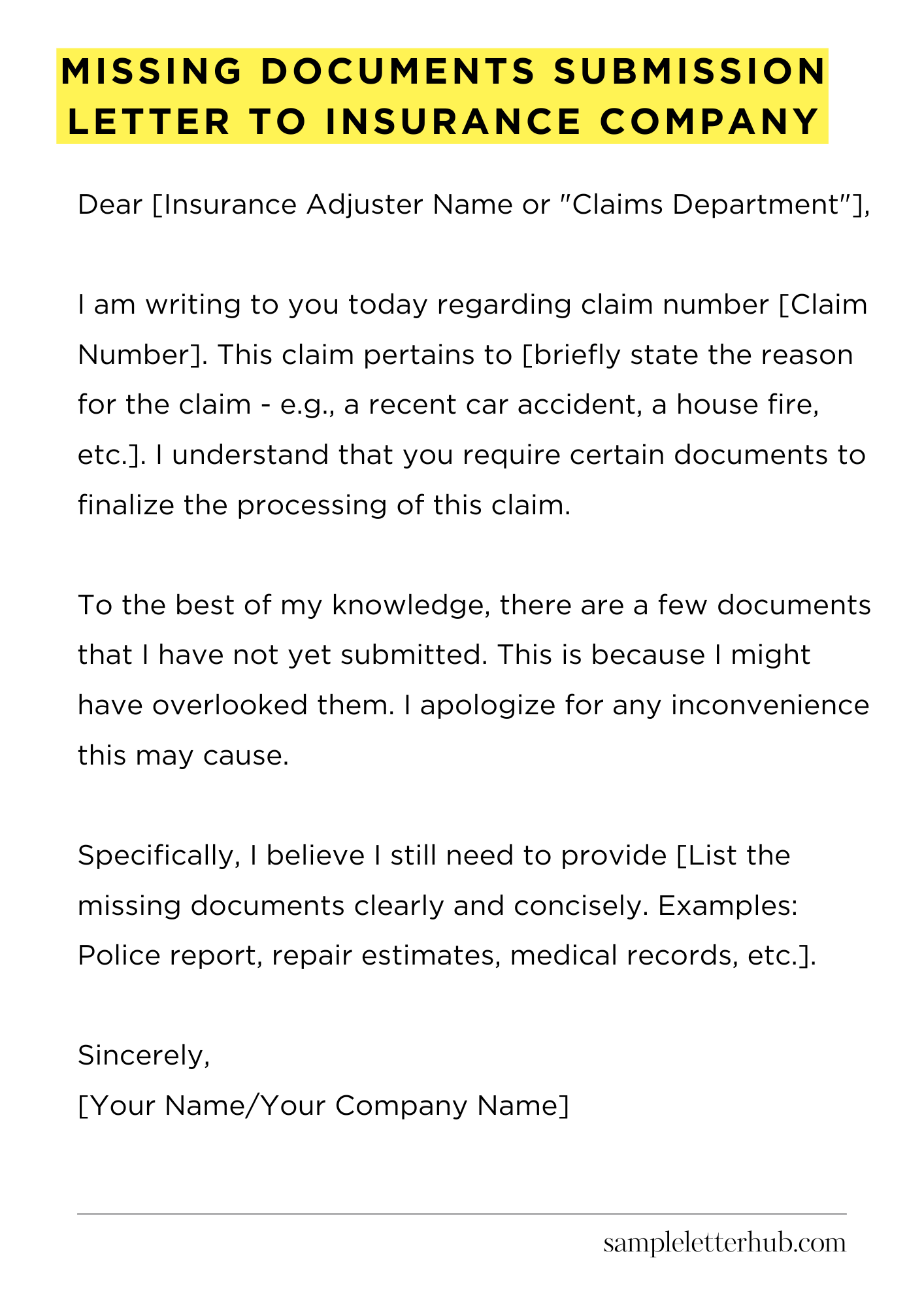
I am writing to you today regarding claim number [Claim Number]. This claim pertains to [briefly state the reason for the claim – e.g., a recent car accident, a house fire, etc.]. I understand that you require certain documents to finalize the processing of this claim.
To the best of my knowledge, there are a few documents that I have not yet submitted. This is because I might have overlooked them. I apologize for any inconvenience this may cause.
Specifically, I believe I still need to provide [List the missing documents clearly and concisely. Examples: Police report, repair estimates, medical records, etc.]. Please confirm if these are the only outstanding items needed.
I am working diligently to gather these documents. I anticipate being able to send them to you by [Date you expect to send the documents]. However, if I need more time, I will contact you immediately.
I understand the importance of providing all necessary information promptly. I appreciate your patience and assistance in this matter. Providing all the required information is really important.
Please let me know if you have any questions or if you require any further clarification from my end. I can be reached by phone or email, as mentioned above.
Thank you very much for your time and your help. I look forward to hearing from you soon.
Sincerely,
[Your Name/Your Company Name]
How to Write Missing Documents Submission Letter to Insurance Company
Submitting a letter to your insurance company for missing documents can seem daunting. It is however, an essential process to ensure your claim is processed expeditiously.
This guide elucidates the nuances of crafting a persuasive and effective letter. Follow these guidelines to avoid unnecessary delays and expedite a positive outcome.
1. Initiate with Precision: The Salutation & Recipient Details
Your missive should begin with a formal salutation. It should specifically address the individual or department handling your claim. Always include the insurance company’s official name and the relevant policy or claim number.
This initial segment establishes your identity and provides the foundational context for the rest of your communication. Do not miss any information. These details serve as the initial identifier for the insurance company.
2. The Imperative Opening: Statement of Purpose
This is where you clearly state the purpose of your letter. It should unambiguously declare that you are submitting missing documents for claim consideration. Mention the claim’s nature (e.g., medical, property damage, etc.) along with the date of the incident or claim initiation. This concise opening immediately informs the recipient of the letter’s objective, setting a clear tone.
3. Delineation of Documents: The Inventory
Provide an exhaustive, itemized list of all the documents you are submitting. Be meticulous. Include each document’s name, the date it was issued (if applicable), and a brief description of its contents.
This comprehensive listing ensures that the insurance company can readily locate and review the enclosed materials. This is the crux of the letter; accurate and complete documentation is crucial.
4. The Contextual Narrative: Providing Additional Clarity
At this stage, provide a succinct narrative that supplements the documents. Explain any circumstances that might provide context or justification for your claim.
This might involve elaborating on the events leading to the incident, the impact of the incident, or the reasons behind any discrepancies in the documentation. This section adds substance to your submission. Keep it concise, focused, and professional. It provides the narrative behind your claim.
5. The Affirmation: Explicit Request for Action
Explicitly request the insurance company to review the enclosed documents. Politely, but firmly, ask for confirmation of receipt and acknowledgement of the action the company is going to take.
State the desired outcome of the review—whether it is the approval of your claim or the request for further information. Make it clear what you expect from them. Your expectations must be clearly articulated.
6. The Formal Closure: Gratitude and Contact Information
Conclude the letter with a professional closing. “Sincerely” or “Respectfully” are suitable options. Include your full name, address, phone number, and email address.
This section ensures the insurance company can easily contact you for clarification or further information. Proper contact information is absolutely indispensable.
7. The Ultimate Check: Proofreading and Delivery
Prior to dispatch, meticulously proofread your letter for any grammatical errors, spelling mistakes, and factual inaccuracies. Ensure that the tone is professional, the language is clear, and the content is accurate.
Always retain a copy of the letter and the submitted documents for your records. Consider sending the letter via certified mail or another tracked delivery method to confirm receipt. Finalize the process by sending your letter through the proper channels.
FAQs about Missing Documents Submission Letter to Insurance Company
What is the primary purpose of a “Missing Documents Submission Letter” to an insurance company?
The main objective of this letter is to formally inform your insurance provider about the documents you are submitting to fulfill their request for missing information.
It serves as a record of your actions, helping to ensure that the insurance company acknowledges receipt of the documents and can process your claim or application correctly. It also helps to prevent any delays caused by the insurance company not receiving the necessary information.
What specific details should be included in a Missing Documents Submission Letter?
A well-crafted letter should include your full name, policy or claim number, and the date. You should clearly list each document you are submitting, potentially mentioning the date and brief description of the document (e.g., “copy of medical report dated October 26, 2023”). It’s crucial to specify the reason for the submission (e.g., requested by the insurer).
Consider including a statement confirming that all required documents are enclosed, and maintain a copy for your records.
How should the Missing Documents Submission Letter be sent to the insurance company?
You can typically send the letter and documents via mail, email, or through the insurance company’s online portal, if available. For mail submissions, using certified mail with return receipt requested is highly recommended.
This provides proof of delivery and ensures the insurance company acknowledges receiving your documents. When sending electronically, confirm receipt with the company. Keep a copy of the sent email or upload confirmation.
What happens if the insurance company claims they didn’t receive the documents I submitted?
If the insurance company claims they didn’t receive your submission, you’ll need to provide proof of submission. If you sent the letter via certified mail or email with a read receipt, provide those as evidence.
If you sent the documents via the company’s online portal, then provide the submission receipt. If you have a copy of the letter you sent, and any supporting documentation.
Are there any legal implications if I fail to submit the requested documents?
Failing to submit requested documents can significantly impact your claim or application. The insurance company might delay processing, deny your claim, or void your policy.
Policy documents usually have clauses regarding the timeliness and completeness of document submissions, and failing to adhere to those stipulations could have adverse legal consequences. Always review your policy and any specific requests from your insurer to understand the potential implications of non-compliance.
Related:
Resignation letter due to rude boss
Resignation letter moving to another state
Resignation letter due to illness of family member
Resignation letter due to study