

[Your Name/Company Name]
[Your Address]
[Your Phone Number]
[Your Email Address]
[Date]
[Insurance Company Name]
[Insurance Company Address]
Dear Sir/Madam,
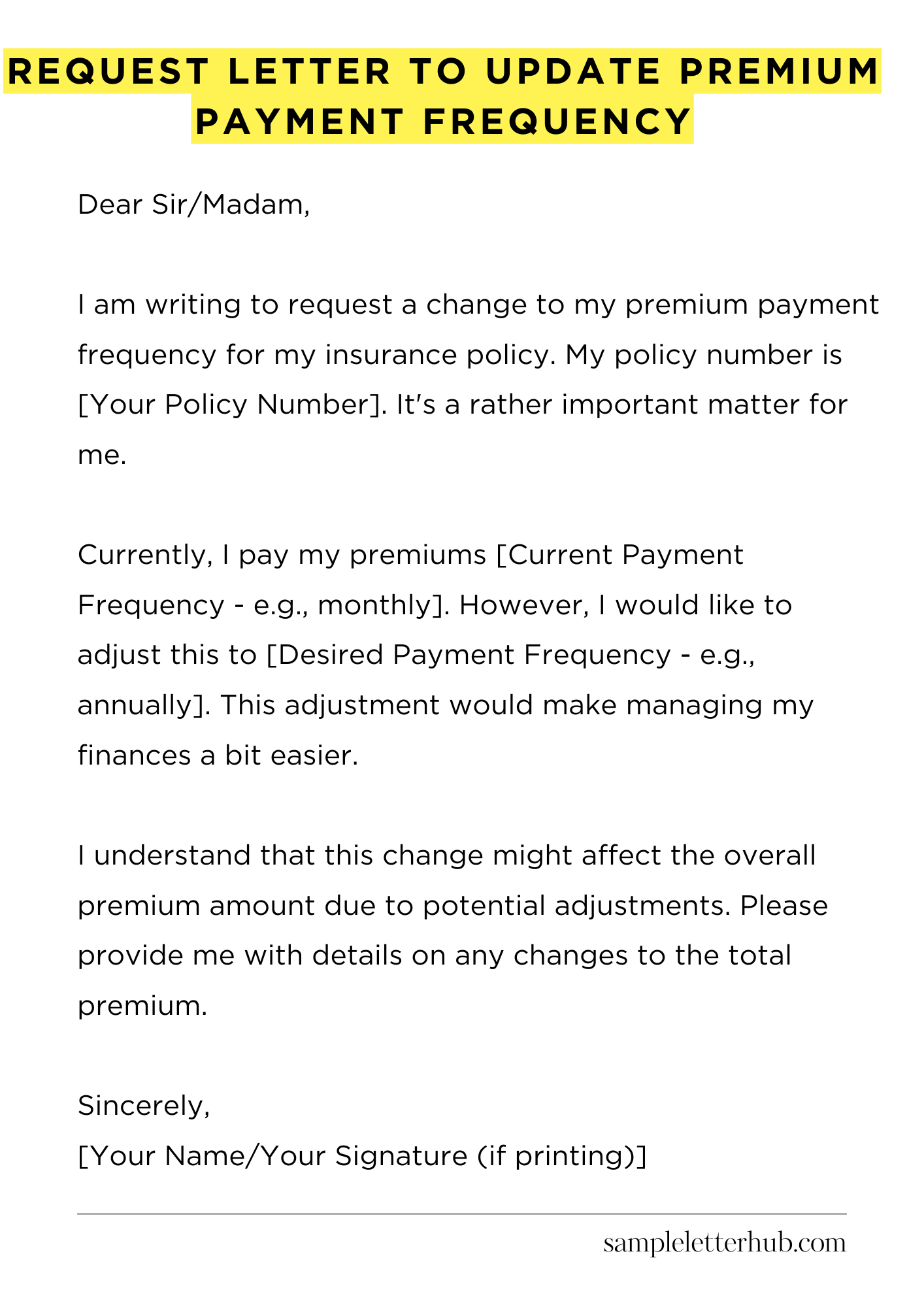
I am writing to request a change to my premium payment frequency for my insurance policy. My policy number is [Your Policy Number]. It’s a rather important matter for me.
Currently, I pay my premiums [Current Payment Frequency – e.g., monthly]. However, I would like to adjust this to [Desired Payment Frequency – e.g., annually]. This adjustment would make managing my finances a bit easier.
I understand that this change might affect the overall premium amount due to potential adjustments. Please provide me with details on any changes to the total premium or any other associated fees related to this new payment plan. I want to be fully aware of my obligations.
Could you kindly confirm the effective date of this change? I want to ensure I make payments accordingly. Please let me know how I can confirm that the change has been successfully processed. I appreciate your swift attention to this request.
Thank you for your time and assistance. I look forward to hearing from you soon.
Sincerely,
[Your Name/Your Signature (if printing)]
How to Write Request Letter to Update Premium Payment Frequency
Adjusting your premium payment frequency is a fairly common need. It provides flexibility and aligns your payments with your budget.
Crafting a cogent request letter to your insurance provider is paramount to ensuring a seamless transition. Follow these steps to prepare a letter that is both perspicacious and effective.
1. Commence with Salutations and Identification
Begin your letter with a formal salutation. Address the correct department or individual, if known, to whom the letter is directed. After the salutation, unequivocally identify yourself. Include your full name, policy number, and any other relevant identifying information.
This initial clarity averts any confusion and allows the recipient to immediately grasp the context of your missive. This is important to ensure your request is directed to the appropriate department.
2. Declare Your Precise Intent
Articulate your specific request immediately. State clearly that you are seeking to modify your premium payment frequency. Be explicit in declaring your desired change.
For instance, if you are currently paying monthly and wish to switch to quarterly payments, state this explicitly. Avoiding ambiguity is crucial to avert any misinterpretations or processing errors.
3. Furnish Supporting Justification (Optional, but Recommended)
Though not always mandatory, providing a concise justification for your request can prove beneficial. Briefly explain the reason behind your desired change. Are you streamlining your budget?
Do you anticipate receiving a lump sum payment that would make a different payment schedule more advantageous? A brief, professional explanation can lend credence to your request. However, keep this section concise and avoid elaborate justifications.
4. Specify the Desired Commencement Date
Clearly indicate when you would like the new payment frequency to take effect. This is a critical detail. This is because it helps your insurance provider with processing.
Be precise in stating the date or the payment period that should be subject to the updated frequency. This leaves no room for conjecture and ensures your request is processed according to your timeframe.
5. Review and Confirm Policy Implications
Acknowledge that you understand and accept any potential implications of changing your payment frequency. This might include changes to the total premium amount, due dates, or any fees associated with the new schedule.
Demonstrating this understanding reinforces your awareness and responsibility in making this financial decision. Confirm the payment method you’ll be using.
6. Conclude with Professionalism
End your letter with a professional closing, such as “Sincerely” or “Respectfully.” Provide your full name, contact information (phone number and email address), and your signature (if sending a physical letter).
This provides the recipient with a facile way to reach you if any clarification is needed. Ensure that the letter is free of typographical errors and grammatical errors before dispatching. Proofreading is very important!
7. Delivery and Follow-Up
Choose your method of delivery. Most insurance companies accept requests via mail, email, or their online portals. Choose the method suggested by your insurer. If sending via mail, consider using certified mail with return receipt requested to confirm delivery.
After submitting your request, follow up with your insurance provider within a reasonable timeframe (e.g., one to two weeks) to confirm receipt and inquire about the status of your request. This proactive approach ensures your request is promptly addressed.
FAQs about Request Letter to Update Premium Payment Frequency
What is a “Request Letter to Update Premium Payment Frequency,” and why is it needed?
A “Request Letter to Update Premium Payment Frequency” is a formal written communication sent to an insurance provider. It is used to change how often you pay your insurance premiums (e.g., from monthly to annually, or vice-versa).
This is needed to accommodate changes in your financial situation, to streamline payments, or to take advantage of any discounts that might be offered for less frequent payments.
What information should I include in a request letter to change my payment frequency?
Your letter should include your full name, policy number, current payment frequency, the desired new payment frequency, and the effective date for the change. You should also clearly state the reason for the change, if you want to include it.
It’s often helpful to include your contact information (phone number and email address) for the insurer to reach you if necessary. Make sure to sign and date the letter.
How do I know the correct address to send the request letter?
The correct address to send the request letter can usually be found on your insurance policy documents, on your insurance provider’s website, or on your recent premium payment statements.
If you’re unsure, you can also contact your insurance provider’s customer service department to inquire about the correct mailing address or if they accept digital submission options.
How long does it typically take to process a request to change payment frequency?
The processing time can vary depending on the insurance company and their procedures. However, it generally takes between one to four weeks for your request to be processed.
For an accurate timeframe, check with your insurance provider. Also, consider the timeline for when your next payment is due. Aim to submit your request well in advance of your next payment due date to ensure the change is effective for that payment.
Are there any potential consequences or considerations when changing premium payment frequency?
Yes. Changes in payment frequency may affect the total premium you pay. For example, some insurers offer discounts for paying annually. Conversely, more frequent payments might involve administrative fees.
Be sure to understand the financial implications, including any changes to your total premium amount, and the potential impact on your policy before making the change. Additionally, if you have a loan or mortgage, ensure the change aligns with any requirements of the policy.
Related:
Resignation letter due to rude boss
Resignation letter moving to another state
Resignation letter due to illness of family member
Resignation letter due to study