

A Change of Ownership Request Letter for Insurance Policy is a formal document. Its purpose is to transfer ownership of an insurance policy. This ensures the new owner receives all benefits. It also allows them to make decisions related to the policy. This transfer can happen for various reasons.
We know writing legal letters can be tricky. That’s why we’ve got you covered. This article offers helpful samples and examples of Change of Ownership Request Letters. We’ve prepared easy-to-use templates and guides. These are designed to make your writing process simpler.
Whether you’re dealing with life insurance, or other types of insurance policies, we’ll help. You can easily adapt these sample letters for your specific needs. Say goodbye to complicated legal jargon. Let’s make this process as smooth as possible, so you can easily transfer the ownership!
[Your Name]
[Your Address]
[Your Phone Number]
[Your Email Address]
[Date]
[Insurance Company Name]
[Insurance Company Address]
Subject: Request for Change of Ownership – Insurance Policy Number [Policy Number]
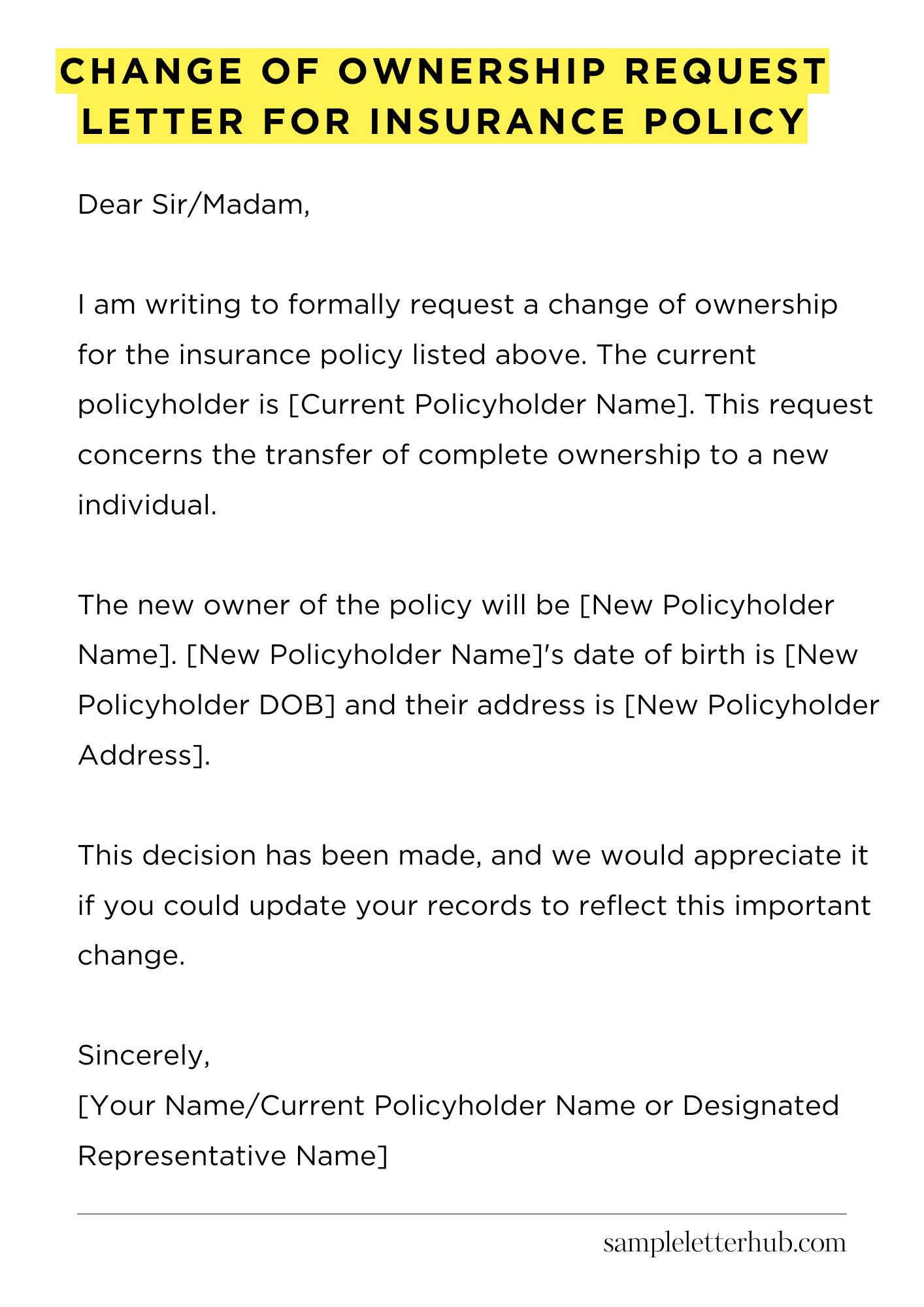
Dear Sir/Madam,
I am writing to formally request a change of ownership for the insurance policy listed above. The current policyholder is [Current Policyholder Name]. This request concerns the transfer of complete ownership to a new individual.
The new owner of the policy will be [New Policyholder Name]. [New Policyholder Name]’s date of birth is [New Policyholder DOB] and their address is [New Policyholder Address]. We would also like to provide [New Policyholder Name]’s phone number: [New Policyholder Phone Number].
This decision has been made, and we would appreciate it if you could update your records to reflect this important change. We are submitting this request to you with the hope that all the necessary actions will be taken promptly and efficiently.
Attached to this letter, you will find a copy of [Document – e.g., the original policy documents, a signed consent form, etc.]. Please find attached supporting documentation.
We kindly request that you confirm this ownership transfer in writing, once it has been processed. Please send the confirmation to both [Current Policyholder Name] at [Current Policyholder Address] and the new owner, [New Policyholder Name] at [New Policyholder Address]. This will ensure everyone is fully informed of the change.
Thank you for your time and assistance in this matter. We look forward to your positive response.
Sincerely,
[Your Name/Current Policyholder Name or Designated Representative Name]
How to Write Change of Ownership Request Letter for Insurance Policy
Navigating the administrative labyrinth of an insurance policy can often feel like traversing a treacherous mountain pass. One such undertaking is the transfer of ownership. This process, however, need not be an ordeal. A well-crafted letter can pave the way for a smooth and efficient transition. Here’s a comprehensive guide to crafting an impactful change of ownership request.
1. Identifying the Players: The Crucial First Step
Before you even begin to formulate your missive, you must meticulously identify the key stakeholders. You will need the current policyholder’s full legal name, the prospective new owner’s details, including their full name, mailing address, and contact information.
Be sure to have the policy number readily available. Precision is paramount here. Any discrepancies can lead to needless delays and complications.
2. Formatting the Foundation: A Structured Approach
Begin your letter with a formal business format. Position your contact information (your name, address, and phone number) at the top left, followed by the date. On the right, include the insurance company’s name and address. Maintain a professional demeanor. The salutation should be formal.
“Dear Sir/Madam” is a viable, though somewhat antiquated, option. Consider, if possible, addressing the letter to a specific individual or department to expedite processing.
3. Declaring the Objective: The Heart of the Matter
The introductory paragraph should clearly state the purpose of your letter: to request a change of ownership for the specified insurance policy. Mention the policy number immediately.
State the current policyholder’s name and the new owner’s details. Make it clear and concise. A convoluted opening will only serve to obfuscate your intent.
4. Providing Pertinent Policy Details: Filling in the Blanks
In the body of your letter, enumerate all relevant policy information. This includes the type of insurance (e.g., life, health, auto), the issue date, and any other pertinent details. You might also want to mention the current beneficiaries. This helps the insurer understand the complete picture. The more information you provide upfront, the smoother the process.
5. Securing Signatures and Acknowledgments: The Essential Components
This step is critical. Both the current policyholder and the proposed new owner must sign the letter. Include a statement acknowledging that both parties understand and consent to the change of ownership.
Depending on the insurance company’s requirements, you might need to include witness signatures or have the signatures notarized. This is essential to authenticate the request.
6. Attaching Supporting Documentation: Fortifying Your Request
Gather all the required documentation. Generally, this includes a copy of the policy, a government-issued photo ID for both parties (e.g., driver’s license, passport), and any other forms the insurance company requires. Make sure your documents are legible. Organize everything meticulously. This will expedite the processing, mitigating potential delays.
7. The Concluding Salutation: A Formal Farewell
Conclude your letter with a professional closing, such as “Sincerely” or “Respectfully.” Include your printed name below your signature. Provide a line for contact information.
Request that the insurance company confirm the change of ownership in writing, along with an updated policy statement reflecting the transfer. Express your appreciation for their attention to the matter. Proofread the entire letter meticulously before sending it.
FAQs about Change of Ownership Request Letter for Insurance Policy
What is a Change of Ownership Request Letter for an Insurance Policy?
A Change of Ownership Request Letter is a formal document submitted to an insurance company to transfer ownership rights of an existing life insurance policy from the current owner (the “original owner”) to a new owner (the “new owner” or “assignee”).
This allows the new owner to have control over the policy, including the ability to make beneficiary designations, borrow against the policy’s cash value (if applicable), and ultimately receive the death benefit when the insured person passes away.
What Information is typically required in a Change of Ownership Request Letter?
The letter should include the policy number, the full names and contact information of both the current owner and the new owner (including addresses, phone numbers, and dates of birth), and a clear statement requesting the change of ownership.
It usually requires notarization, which means the signatures of both the current and new owners must be witnessed and verified by a notary public. Some insurance companies may also have their own specific forms that need to be completed in conjunction with the letter.
What is the process for submitting a Change of Ownership Request Letter?
After the letter has been drafted, signed, and notarized, it should be sent to the insurance company, usually via mail. It is advisable to send the letter via certified mail with return receipt requested to have proof of delivery.
The insurance company will then review the request, verify the information, and update their records. The new owner will typically receive confirmation from the insurance company once the change has been processed.
Are there any tax implications associated with a Change of Ownership?
Changing the ownership of a life insurance policy can have tax implications. Depending on the circumstances, the transfer could be considered a taxable gift, subject to gift tax rules.
Furthermore, if the policy has any existing cash value, the transfer could trigger a taxable event. It’s crucial to consult with a tax advisor or financial planner to understand the potential tax consequences before proceeding with a change of ownership.
What if the original owner is deceased or incapacitated when a change of ownership is desired?
If the original owner is deceased, the policy typically goes through the estate settlement process. The beneficiaries named in the policy will receive the death benefit unless the policy was assigned to someone else prior to the owner’s death.
If the original owner is incapacitated, a legal guardian or someone with power of attorney may be able to make decisions about the policy on their behalf. The specific requirements for a change of ownership under these circumstances will depend on the insurance company’s policies.
Related:
Resignation letter due to rude boss
Resignation letter moving to another state
Resignation letter due to illness of family member
Resignation letter due to study
Resignation letter due to long commute