

Need to update medical records? An Update Request Letter for Medical History Information is essential. It is a formal way to notify healthcare providers about changes. This includes new conditions, medications, or contact details. The goal is to ensure your records are current and accurate.
Writing these letters can seem tricky. But don’t worry. This article simplifies the process. We provide various sample Update Request Letter for Medical History Information templates. You’ll find different formats and examples. This is to make writing your own medical history update request easy.
These samples cover different scenarios. We have examples for various situations. Whether you need to add information, correct errors, or update contact information, we’ve got you covered. Consider these letters as a roadmap. They are a tool to make you feel empowered.
[Your Name/Your Clinic Name]
[Your Address]
[Your Phone Number]
[Your Email Address]
[Date]
[Patient Name]
[Patient Address]
Subject: Request for Updated Medical History Information
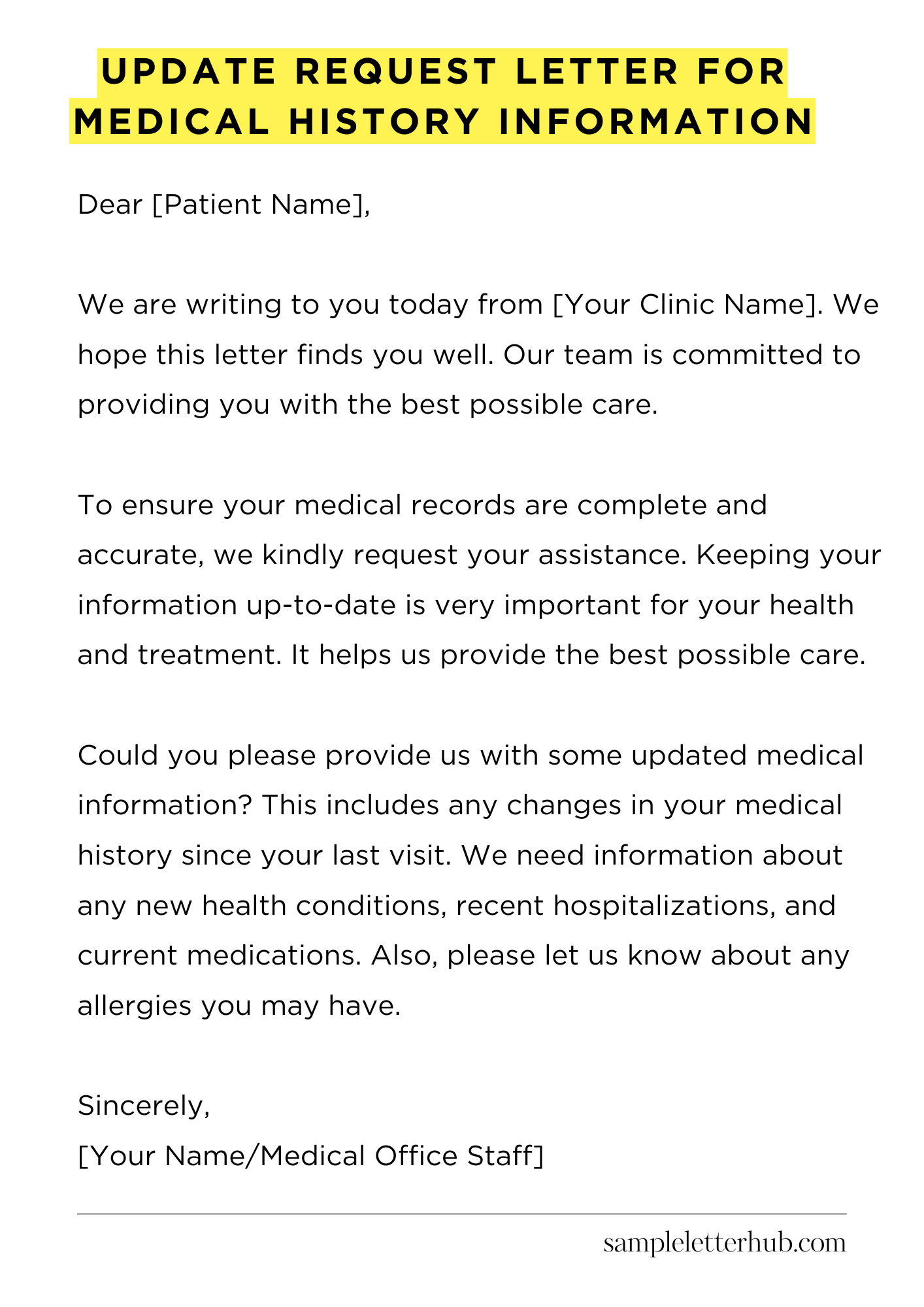
Dear [Patient Name],
We are writing to you today from [Your Clinic Name]. We hope this letter finds you well. Our team is committed to providing you with the best possible care.
To ensure your medical records are complete and accurate, we kindly request your assistance. Keeping your information up-to-date is very important for your health and treatment. It helps us provide the best possible care.
Could you please provide us with some updated medical information? This includes any changes in your medical history since your last visit. We need information about any new health conditions, recent hospitalizations, and current medications. Also, please let us know about any allergies you may have. Please also tell us about any surgeries you have had.
You can update your information in a few different ways. You can fill out the attached form and return it to us by mail. Alternatively, you can call our office at [Your Phone Number] to update your records over the phone. You can also log into our patient portal at [Website Address], if you have an account.
Please respond at your earliest convenience. We need the details to keep your medical file accurate. This helps us serve you better. We truly appreciate your cooperation in this matter.
If you have any questions, please do not hesitate to contact us. We are here to help you.
Sincerely,
[Your Name/Medical Office Staff]
How to Write Update Request Letter for Medical History Information
Navigating the healthcare system can sometimes feel like traversing a labyrinth. One crucial aspect of this journey is ensuring your medical history records are current and accurate.
A well-crafted update request letter for medical history information is your compass. It is your key to unlocking the right information. Let’s explore the essential components of composing an effective letter.
1. Initiating the Correspondence: The Salutation and Introductory Cadence
Your missive should commence with a professional salutation. Always address the recipient appropriately (e.g., “Dear Dr. [Last Name]”). Keep it personalized to gain attention. Subsequently, state the purpose of your letter succinctly. Open with a clear and concise introductory paragraph. Briefly mention you are requesting an update to your medical records.
2. Patient Identification: Pinpointing Your Persona
Precise patient identification is paramount. Include your full legal name, date of birth, and any other pertinent identifiers, such as your medical record number or social security number. This will prevent any misidentification and ensure your information is rightly added to your file. Be extra careful about accuracy.
3. The Corpus of Your Plea: Detailing the Required Modifications
This is where you articulate the specific changes required. Be explicit and precise in your descriptions. If you have a new diagnosis, list it. If there is a change in medication, list the original as well as the updated regimen.
If you are reporting recent surgical procedures, provide dates and details. The more information, the better. Consider using bullet points or numbered lists to improve clarity and readability.
4. Attaching Ancillary Documentation: Augmenting Your Case
To reinforce your request, consider including copies of supporting documentation. This might encompass diagnostic reports, specialist notes, or records from other healthcare providers. Never send originals; always provide copies. Remember, supporting documents can fortify your request’s credibility.
5. Expressing the Urgency (If Necessary): Prompting a Prompt Response
While patience is a virtue, sometimes your request warrants a sense of urgency. If the update is needed for an upcoming appointment, a specific treatment plan, or insurance purposes, succinctly state the time-sensitive nature of your request. Avoid hyperbole; a simple, factual explanation suffices. A considerate reminder may speed things along.
6. The Concluding Flourish: Politeness and Anticipation
Conclude your letter with a polite closing, such as “Sincerely” or “Respectfully.” Reiterate your name and contact information. Including your phone number and email address allows for ease of access. Express your gratitude for their time and attention to your matter. Anticipate a positive resolution.
7. Delivery and Preservation: The Final Act
Send your letter via certified mail with a return receipt requested. This ensures proof of delivery and confirmation that the recipient has received it. Keep a copy of the letter and all attached documentation for your records. This is invaluable. This practice serves as a safeguard. Retaining a record of the exchange is essential.
FAQs about Update Request Letter for Medical History Information
What is the primary purpose of an update request letter for medical history information?
The primary purpose of an update request letter is to ensure the accuracy and completeness of a patient’s medical records. It aims to inform healthcare providers about any changes in the patient’s medical status, including new diagnoses, treatments, medications, allergies, or changes in contact information.
This is critical for making informed decisions about patient care and preventing medical errors.
Who typically sends an update request letter for medical history information?
An update request letter is usually sent by the patient or their legal representative, such as a parent or guardian. However, in specific situations, a healthcare provider might send this letter to another provider to request information on behalf of the patient, or a lawyer might do so with the patient’s consent for legal purposes.
What specific information should be included in an update request letter?
An effective update request letter should include the patient’s full name, date of birth, and any other identifying information (like medical record number).
It must clearly state the specific information needing to be updated or added to the medical record. This may include new diagnoses, treatments, medications, allergies, immunization records, family medical history, changes in contact details, and dates associated with these changes. It should also specify the healthcare provider or institution to whom the information is being sent.
Where should the update request letter be sent?
The update request letter should be sent directly to the healthcare provider or institution that maintains the patient’s medical records. The mailing address or the specific department responsible for medical records should be included. Depending on the institution’s policies, the letter might also be submitted electronically through a patient portal if available.
How long does it typically take to update medical records after sending an update request letter?
The timeframe for updating medical records varies depending on the healthcare provider or institution’s policies and workload. Generally, the process could take anywhere from a few days to several weeks. It’s advisable to follow up with the provider to ensure the update has been processed, especially if the information is critical to ongoing care.
Related:
Resignation letter due to rude boss
Resignation letter moving to another state
Resignation letter due to illness of family member
Resignation letter due to study
Resignation letter due to long commute