

Need to remove someone from your insurance policy? You might need a Request Letter to Remove Additional Insured Person. This letter officially asks your insurance provider to take a person off your insurance policy as an additional insured. The purpose is to change who is covered under the policy and update your insurance details.
This article provides helpful request letter examples. We understand writing these letters can be tricky. Don’t worry, we’ve got you covered! You’ll find templates, samples, and examples. These are designed to make writing your own Request Letter to Remove Additional Insured Person simple.
Think of it as your friendly guide to insurance paperwork. We’ll share several formats. You can adapt them to your specific needs and situation. This makes the process easy, even if you are not familiar with insurance jargon. Let’s get started.
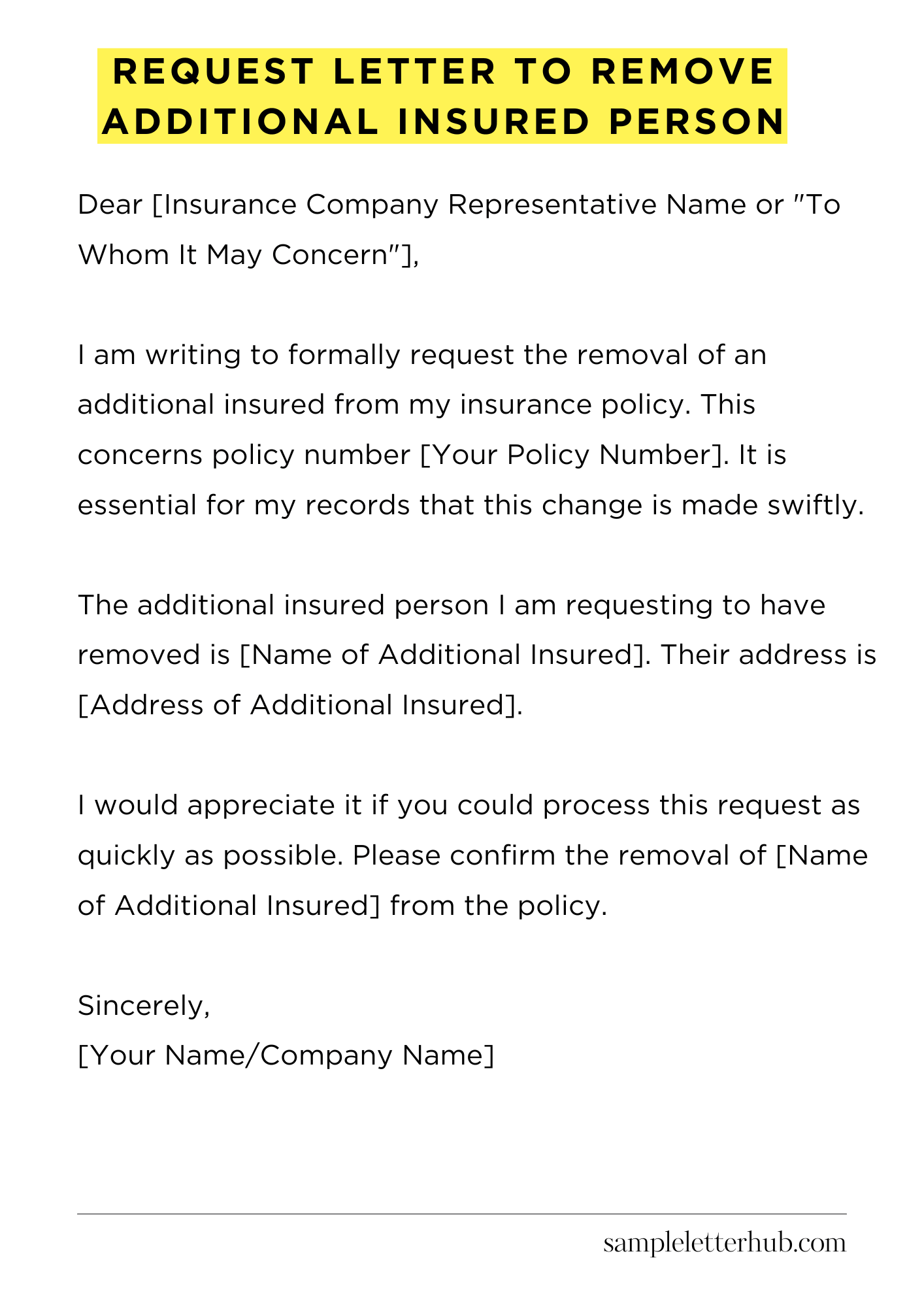
[Your Name/Company Name]
[Your Address]
[Your Phone Number]
[Your Email Address]
[Date]
[Insurance Company Name]
[Insurance Company Address]
Subject: Request to Remove Additional Insured – Policy Number [Your Policy Number]
Dear [Insurance Company Representative Name or “To Whom It May Concern”],
I am writing to formally request the removal of an additional insured from my insurance policy. This concerns policy number [Your Policy Number]. It is essential for my records that this change is made swiftly.
The additional insured person I am requesting to have removed is [Name of Additional Insured]. Their address is [Address of Additional Insured]. This person is no longer affiliated with [Reason for Removal – be brief and clear, e.g., “my business operations,” “the property,” “my project”]. This is a straightforward matter.
I would appreciate it if you could process this request as quickly as possible. Please confirm the removal of [Name of Additional Insured] from the policy. It is critical that I get a confirmation of this change in writing.
Could you please send the confirmation to the address listed above? I want to ensure my insurance coverage accurately reflects my current needs. You can also send the confirmation via email to [Your Email Address]. I look forward to your prompt response and confirmation of this adjustment.
Thank you for your time and attention to this matter. I appreciate your assistance.
Sincerely,
[Your Name/Company Name]
How to Write Request Letter to Remove Additional Insured Person
Sometimes, circumstances shift, and the need to maintain an additional insured on your policy wanes. Perhaps a business partnership dissolves, or a contractual obligation concludes. In such instances, a formal request to disencumber your insurance policy of an additional insured is warranted. Crafting a precise and compelling letter ensures a smooth and expeditious process.
1. Commence with Salutations and Identification
Begin your missive with a professional salutation. Address the letter to the appropriate insurance representative or the underwriter. Clearly state the date and your full name, policy number, and contact information. This is your initial pronouncement and crucial for efficient processing.
2. Declare the Purpose – The Premise of Your Plea
The first paragraph should delineate the central intent of your communication. Concisely state that you are requesting the removal of a specific additional insured from your policy. Be explicit and direct; vagueness breeds confusion. For instance: “This letter serves as a formal request to remove [Name of Additional Insured] from policy number [Policy Number] as an additional insured.”
3. Furnish Precise Particulars of the Insured to be Removed
Provide meticulous details about the additional insured whose removal is sought. Include their full legal name, any identifying information like their address, and any specific relationship to the policy or the insured party (e.g., “formerly a business partner,” “was previously contractually required”). The more data you provide, the less likely there will be protracted verification.
4. Enunciate the Rationale – Why the Revocation?
This is where you clarify the reason behind the request. Be forthright, but avoid unnecessary embellishment or emotional language. Common justifications include the termination of a business agreement, the completion of a contractual obligation, or a change in circumstances.
If relevant, briefly reference the initial agreement or circumstance that necessitated the addition of the insured in the first place. You must convince the authority.
5. Specify the Effective Date – The Time of Cessation
Clearly state the date from which you want the removal to be effective. This is of paramount importance. Ensure this date aligns with the termination of any relevant agreements or relationships. This avoids any possible ambiguity. If a specific date is not readily available, suggest that the removal is effective immediately. This ensures there are no unintended liabilities.
6. Reinforce and Request Confirmation – A Call to Action
In a concluding paragraph, restate your request for clarity. Express your desire for confirmation of the removal. Inquire how the confirmation will be delivered (e.g., via email, postal mail). Include your contact information again for ease of communication and efficiency. Offer your availability to assist the process; this helps expedite the case.
7. Execute with Professional Closure – The Formal Valediction
Close your letter professionally. Use a formal salutation like “Sincerely” or “Respectfully.” Sign your name legibly above your typed name and title. Ensure you include any supporting documentation that might be needed, such as a copy of a termination agreement or other pertinent paperwork. This concludes the process.
FAQs about Request Letter to Remove Additional Insured Person
What is the purpose of a request letter to remove an additional insured person?
The primary purpose of a request letter is to formally notify the insurance provider of your intention to remove a specific individual or entity from the additional insured status on your insurance policy.
This action typically follows a change in circumstances, such as the termination of a business relationship or the sale of a property, where the original justification for their coverage no longer applies.
What information should be included in a request letter?
A well-crafted request letter should include: your full name and contact information, the policy number, the name of the additional insured you wish to remove, the effective date of the removal (if known), and a brief explanation of why the removal is requested.
It is also advisable to include a statement confirming that the additional insured is no longer affiliated with your business or property, as applicable. Always maintain a copy for your records.
How do I know if the removal request was successful?
The insurance provider will typically send a confirmation letter or an updated policy endorsement as proof that the additional insured has been removed.
Review this documentation carefully to verify that the changes are accurately reflected in your policy. If you do not receive confirmation within a reasonable timeframe (as specified by your insurer), follow up with the insurance company directly.
What are the potential consequences of failing to remove an additional insured when it’s no longer necessary?
Failing to remove an unnecessary additional insured can lead to several complications. It could potentially impact your premiums, as the policy might be priced assuming the continued risk associated with that additional insured.
More significantly, it could create confusion or delays in the event of a claim, as the insurer might need to involve parties who are no longer associated with the covered risk. In some cases, it may also lead to legal complications.
How do I send the request letter and what’s the best way to ensure it’s received?
The request letter is generally sent to your insurance provider. The best way to send the letter and ensure its receipt is via certified mail with return receipt requested, or via email with read receipt confirmation.
Certified mail provides proof of delivery, while email offers quick communication and confirmation of receipt. Follow up with a phone call to confirm receipt and understanding of the request.
Related:
Resignation letter due to rude boss
Resignation letter moving to another state
Resignation letter due to illness of family member
Resignation letter due to study
Resignation letter due to long commute