

A Request Letter for Policy Amendment is a formal document. It asks for changes to existing policies. The goal is to improve or clarify them. Individuals or groups often use these letters. They address them to relevant authorities or organizations.
Need to draft a request letter for policy amendment? We understand it can seem tricky. That’s why we’ve prepared various sample letters for policy amendment. You can use them as guides. They are designed to simplify the process.
Inside, you will find several policy amendment letter templates. They are customizable. You will find different scenarios covered. These include request for policy change letters for various situations. Get ready to write your perfect letter with ease!
[Your Name/Company Name]
[Your Address]
[Your City, Postal Code]
[Your Email]
[Your Phone Number]
[Date]
[Recipient Name/Company Name]
[Recipient Address]
[Recipient City, Postal Code]
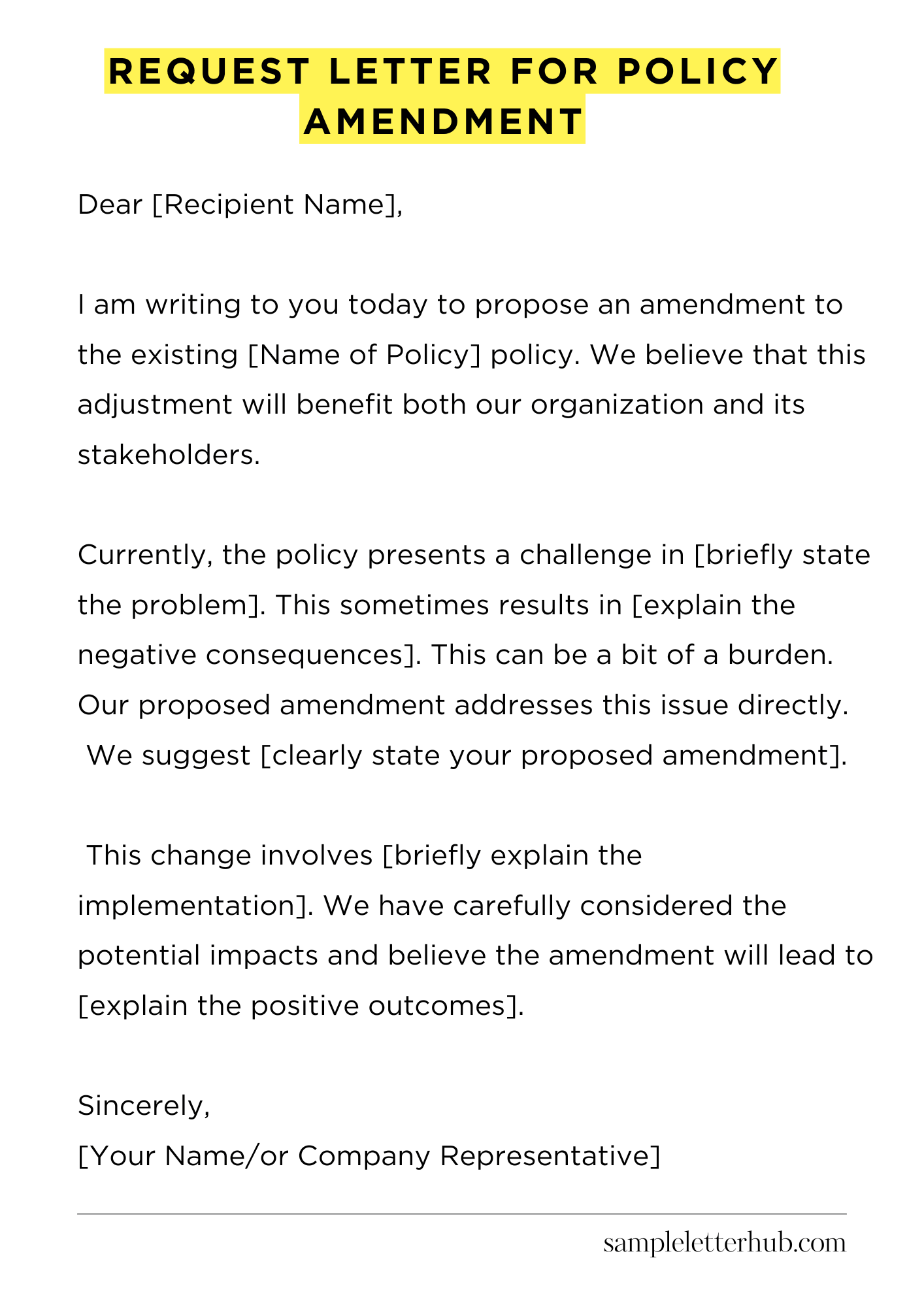
Dear [Recipient Name],
I am writing to you today to propose an amendment to the existing [Name of Policy] policy. We believe that this adjustment will benefit both our organization and its stakeholders.
Currently, the policy presents a challenge in [briefly state the problem]. This sometimes results in [explain the negative consequences]. This can be a bit of a burden.
Our proposed amendment addresses this issue directly. We suggest [clearly state your proposed amendment]. This change involves [briefly explain the implementation]. We have carefully considered the potential impacts and believe the amendment will lead to [explain the positive outcomes].
This will allow for improved efficiency. Furthermore, it will result in increased [specific benefit, e.g., employee satisfaction, customer retention, cost savings]. We have prepared a detailed document outlining the proposed changes, including [mention any supporting documentation, e.g., a rationale, supporting data, or a draft of the amended policy]. A copy of this is attached for your review.
We are confident that this amendment will strengthen our operations. We would appreciate the opportunity to discuss this proposal with you in more detail. We are available at your earliest convenience. Please feel free to contact us to schedule a meeting. We believe a discussion would allow us to further elaborate on the advantages.
Thank you for your time and consideration.
Sincerely,
[Your Name/or Company Representative]
How to Write Request Letter for Policy Amendment
Crafting a compelling request letter for a policy amendment is a crucial skill. A well-constructed letter can significantly influence the decision-making process.
The following guide offers a comprehensive approach to ensure your request is not only acknowledged but also given due consideration. Let’s start with a systematic deconstruction of the process.
1. Initiate with Precision: The Salutation and Recipient Identification
The commencement of your letter sets the tone. Begin by addressing the appropriate authority figure or department. Precise identification is paramount; if unsure, diligently research the correct recipient. Avoid generic salutations like “To Whom It May Concern.”
This signals a lack of specificity and may diminish the gravitas of your request. Instead, employ a formal salutation: “Dear Mr./Ms./Mx. [Last Name],”. Always double-check the recipient’s name and title for accuracy; a misaddressed letter can be construed as a sign of apathy, not an informed discourse.
2. Articulating Your Premise: The Opening Statement
The opening paragraph should immediately and unequivocally state the purpose of the letter: to request an amendment to a specific policy.
Conciseness is key. State the policy name and its specific clause you wish to be amended. Don’t beat around the bush; clarity is the paramount objective here. Provide a brief, high-level overview of the existing policy and why you believe an amendment is necessary. The introductory sentence must serve as a microcosm of your overall argument.
3. Substantiating Your Rationale: Presenting the Justification
This section is the crux of your argument. Detail the specific reasons for your request. Support each point with concrete evidence, such as data, statistics, or documented examples.
Use logical reasoning and avoid emotional language. Demonstrate how the current policy detrimentally impacts individuals, operations, or the organization as a whole.
Consider highlighting instances where the current policy has proven to be inefficient, inequitable, or outdated. The more compelling your evidence, the stronger your case. Be prepared to address potential counterarguments and provide preemptive rebuttals. Remember to maintain a tone of professional decorum.
4. Offering a Remedial Blueprint: Proposing the Amendment
This section is all about your proposed solution. Be precise and provide a clearly defined alternative. Do not merely state that the current policy is problematic; suggest an amendment that addresses the identified shortcomings. Articulate the specific changes you advocate for, leaving no room for ambiguity.
If possible, offer alternative formulations or options. Explain how your proposed amendment will resolve the identified issues and benefit the intended beneficiaries. Consider the potential implications of the proposed amendment and address any foreseen concerns. The more comprehensive and well-thought-out your suggestion, the higher the prospects of acceptance.
5. Reinforcing the Benefits: Highlighting the Positive Outcomes
Reiterate the positive consequences of the proposed amendment. Emphasize the advantages for all stakeholders, including the organization, its employees, and any external parties.
Quantify the benefits whenever possible; use metrics like increased efficiency, reduced costs, or improved employee morale. Frame your proposal in a way that resonates with the recipient’s priorities. Clearly demonstrate how the amendment aligns with the organization’s strategic objectives. By focusing on the positive outcomes, you strengthen the persuasive power of your letter.
6. Formal Closure: The Complimentary Close and Signature
Conclude your letter with a polite and professional closing. Use a formal closing such as “Sincerely,” or “Respectfully,” followed by your full name and title (if applicable). If submitting a hard copy, ensure your signature is clear and legible. If sending electronically, consider using a digital signature for added security and professionalism.
Proofread the entire letter one last time for any grammatical errors or typos before dispatch. Your closing should echo the tone of professionalism established in the opening.
7. Polishing and Distributing: The Review and Submission Process
Before submitting, rigorously proofread your letter. Check for grammatical errors, spelling mistakes, and clarity of expression. Ensure your formatting is consistent and professional. Verify that all supporting documentation is attached, if required. Consider having a colleague review the letter for feedback.
Once finalized, submit the letter according to the specified protocols, such as mail or email. Maintain a copy of the letter and any supporting documents for your records. Consider a follow-up, after a reasonable time, to confirm receipt and inquire about the status of your request, but refrain from becoming a nuisance.
FAQs about Request Letter for Policy Amendment
What is the primary purpose of a request letter for policy amendment?
The primary purpose of a request letter for policy amendment is to formally ask an organization or entity to change an existing policy. This could involve modifying specific clauses, adding new provisions, or removing outdated information. The letter serves as an official communication channel, documenting the request and providing a basis for discussion and consideration.
What key elements should be included in a request letter for policy amendment?
A well-crafted request letter for policy amendment should include: a clear identification of the policy needing amendment, specific details on the proposed changes (including the exact wording if possible), a clear justification for the amendment, relevant supporting evidence or data (if applicable).
Who typically writes a request letter for policy amendment?
The person or entity writing a request letter for policy amendment can vary depending on the context. It could be an employee requesting a change in company policy, a customer seeking adjustments to a service agreement, a member proposing revisions to an organizational constitution, or a citizen advocating for modifications to public regulations.
The author should be someone directly affected or with a vested interest in the policy change.
How should the justification for the policy amendment be structured in the letter?
The justification should be presented clearly, concisely, and persuasively. It should explain the reasons behind the request. This may include highlighting the current policy’s shortcomings, the benefits of the proposed amendment, the potential impact of the change, and any supporting evidence.
It’s often helpful to relate the amendment to organizational goals, values, or external factors like legal changes or industry best practices.
What is the typical follow-up process after submitting a request letter for policy amendment?
After submitting the letter, the follow-up process usually involves waiting for a response from the relevant authority or decision-making body.
This may involve an acknowledgement of receipt, a request for additional information, and a timeline for a decision. The requester might be invited to a meeting or asked to present their case in more detail. It is important to be patient, stay informed of the process, and follow up periodically, if necessary, while respecting the organization’s procedures.
Related:
Resignation letter due to rude boss
Resignation letter moving to another state
Resignation letter due to illness of family member
Resignation letter due to study
Resignation letter due to long commute