

Ever realize a wrong policy number is on your important documents? It can be a real headache! A correction request letter for wrong policy number is your solution. Its purpose? To formally inform the insurance company or relevant party about the error. You need them to update their records. This ensures your insurance policy information is accurate.
We get it. Writing these letters can feel tricky. That’s why we’re here to help! We’ll provide templates and examples of a correction request letter for wrong policy number. Need a sample letter? We’ve got you covered!
This article offers several pre-written sample letters. You can use these to create your own letter to correct policy number. Just adjust the details to fit your situation. We make it easy. Get ready to fix those policy number mistakes quickly!
[Your Name/Your Company Name]
[Your Address]
[Your Phone Number]
[Your Email Address]
[Date]
[Insurance Company Name]
[Insurance Company Address]
Subject: Correction Request for Incorrect Policy Number
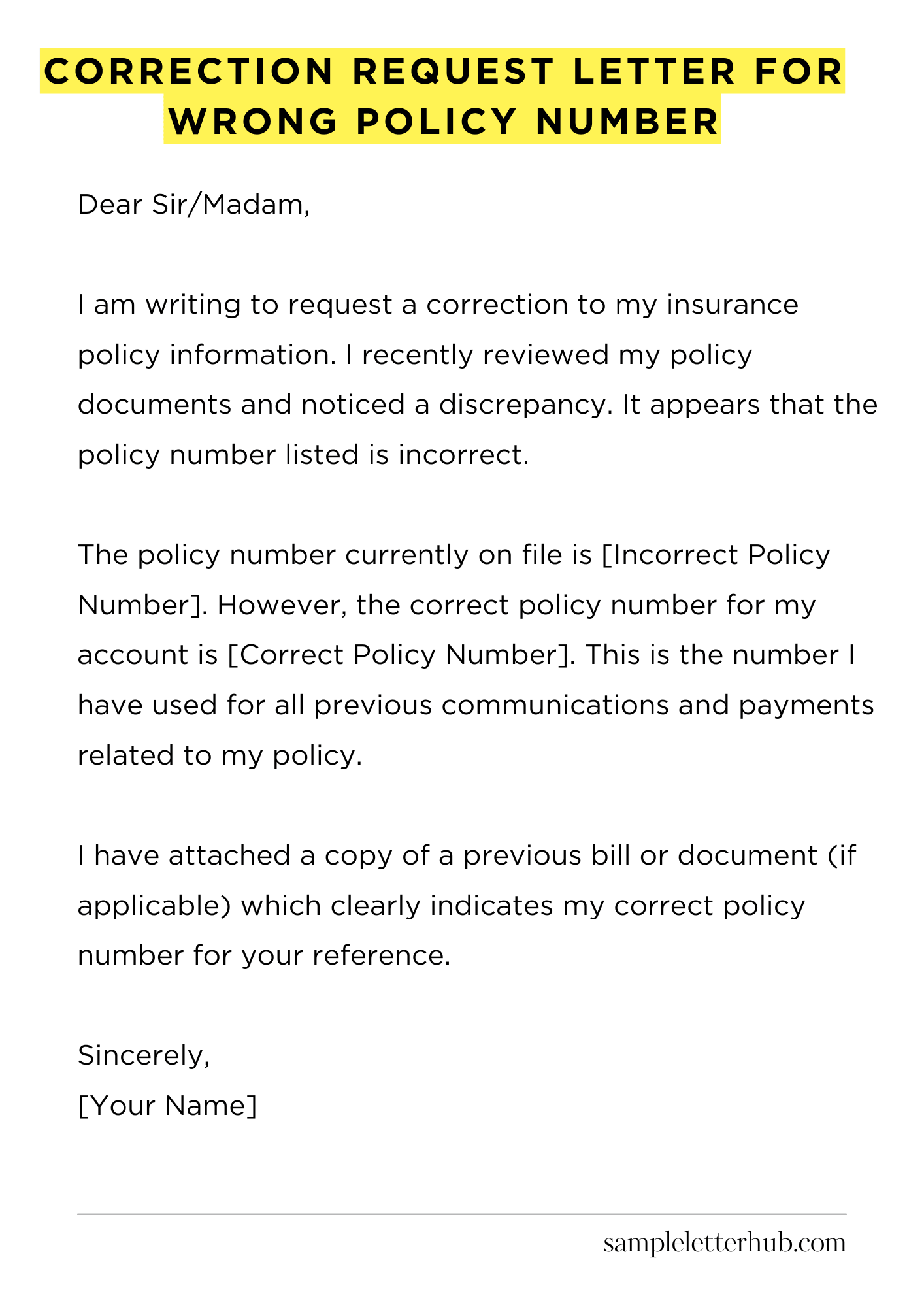
Dear Sir/Madam,
I am writing to request a correction to my insurance policy information. I recently reviewed my policy documents and noticed a discrepancy. It appears that the policy number listed is incorrect.
The policy number currently on file is [Incorrect Policy Number]. However, the correct policy number for my account is [Correct Policy Number]. This is the number I have used for all previous communications and payments related to my policy. I believe the error may have occurred during the initial setup or a recent update of my account details.
I have attached a copy of a previous bill or document (if applicable) which clearly indicates my correct policy number for your reference. This should help you quickly and accurately identify my account. It should make it easier to fix the problem.
Could you please update my policy information to reflect the correct policy number, [Correct Policy Number]? I would appreciate it if you could confirm the change in writing, including an updated copy of my policy details, once the correction is complete.
Please let me know if you need any further information from my end to facilitate this process. I will be happy to provide it to ensure a swift resolution.
Thank you very much for your time and assistance in resolving this matter. I look forward to receiving confirmation of the update soon.
Sincerely,
[Your Name]
How to Write a Correction Request Letter for Wrong Policy Number
A missive to rectify an erroneous policy number is a crucial document. It initiates the process of amending your insurance record. This is vital to ensure proper claims processing and accurate policy management. Let’s explore the key components of a compelling correction request.
1. Crafting the Salutation
Begin your letter with a formal salutation. Address it to the relevant department or individual within the insurance company. Use “Dear [Recipient’s Title and Last Name]” if you know the name. If not, phrases like “To Whom It May Concern” or “Dear Claims Department” are acceptable. The opening should be clear and concise. Politeness is paramount.
2. Explicitly State Your Purpose
Immediately state the purpose of your letter. This is where you declare your intention to correct a policy number. Employ direct language, for instance, “This letter serves as a formal request to rectify the incorrect policy number associated with my insurance policy.” Clarity prevents confusion. Your aim is to leave no room for ambiguity.
3. Provide Comprehensive Personal Details
Include all pertinent personal information. This encompasses your full legal name, current address, phone number, and email address. Include your date of birth, and any other identifying information like policy type and any identifying number that can allow the recipient to easily locate your file.
The more data you provide, the easier it is to streamline the correction process. This verification step ensures the integrity of the data.
4. Pinpoint the Erroneous Information
Clearly delineate the incorrect policy number. State the wrongly recorded number precisely. Next, furnish the correct policy number. Make it easily distinguishable from the error.
This is the cornerstone of your request; accuracy here is non-negotiable. Using bold fonts to highlight both the incorrect and corrected policy numbers is a useful stylistic choice.
5. Furnish Supporting Documentation (If Applicable)
If you possess any documentation that substantiates the accurate policy number, attach copies of it. This might include your insurance card, a previous policy document, or a payment confirmation. These documents act as irrefutable corroboration. Providing supporting documentation can expedite the rectification process considerably and bolster your case.
6. The Call to Action and Closing
Conclude your letter with a polite call to action. Specifically request the recipient to confirm the correction has been made. State how you wish to receive confirmation.
You can use phrases such as, “Kindly confirm the correction in writing.” End your letter with a formal closing, such as “Sincerely,” “Respectfully,” or “Yours faithfully” (if you began with “Dear Sir/Madam”). Then type your full name and signature.
7. Submission Protocols
Before dispatching your letter, proofread it meticulously. Ensure there are no typographical errors or grammatical lapses. Make a copy of the letter for your records.
The delivery method is crucial; consider sending it via certified mail with a return receipt requested. This provides proof of delivery. Alternatively, you can scan and email the letter, but this should be followed up with a phone call to confirm receipt. Retain all communication records pertaining to this request.
FAQs about Correction Request Letter for Wrong Policy Number
What is a correction request letter for a wrong policy number, and when is it needed?
A correction request letter for a wrong policy number is a formal written document used to notify an insurance provider or other relevant institution that an error has been made in associating a policy number with a specific account or information.
This letter is needed when an incorrect policy number is applied to a claim, payment, or any other important document, leading to potential issues such as delayed processing, incorrect billing, or denial of coverage. It serves to rectify the mistake and ensure the correct policy is associated with the intended details.
What information should be included in a correction request letter for a wrong policy number?
A comprehensive correction request letter should include: the date, your full name and contact information, the recipient’s information (insurance company name, address), a clear subject line indicating the request for correction, the incorrect policy number, the correct policy number.
This information ensures the recipient has all necessary details to efficiently process the correction.
How do I find the correct policy number if I’m unsure?
If you’re unsure of your correct policy number, you should gather any available documents related to your policy. These could include previous invoices, policy declarations, welcome letters, or any communication from the insurance provider.
Contacting your insurance provider directly, either by phone or email, is the most reliable way to obtain the correct policy number. Be prepared to provide identifying information such as your name, address, date of birth, and any other details that can help verify your identity and locate the correct policy.
What is the typical processing time for a correction request for a wrong policy number?
The processing time for a correction request can vary depending on the insurance company, the complexity of the correction, and the volume of requests they are currently handling.
Generally, you can expect the correction to be processed within a few business days to a few weeks. It’s advisable to check the insurance provider’s website or contact them directly to inquire about their specific processing timelines. Following up with the insurer a week or two after submitting your letter can also help ensure the correction is completed.
What happens if the correction request is not acknowledged or processed?
If your correction request is not acknowledged or processed within a reasonable timeframe, you should follow up with the insurance provider by phone or email. Keep a record of all communication.
If you are still not getting a satisfactory response, consider escalating the issue. This might involve contacting a supervisor or the company’s customer service department. You may also contact your state’s insurance regulatory agency to file a complaint. Keep copies of all documentation and communications, as this will be helpful in resolving the issue.
Related:
Resignation letter due to rude boss
Resignation letter moving to another state
Resignation letter due to illness of family member
Resignation letter due to study
Resignation letter due to long commute