

Need to lower your insurance costs? A “Request Letter to Decrease Coverage Amount” is the key. It is a formal letter. You send it to your insurance provider. Its purpose? To ask them to reduce your insurance coverage. This lowers your premium payments.
Writing this letter can feel tricky. Don’t worry, we’ve got you covered. We’re sharing helpful templates for your request letter to decrease coverage amount. Examples and samples are ready. Use these request letter examples as your guide. It makes it easier to write a convincing letter yourself.
We aim to help you save money. These sample letters are customizable. Decrease coverage amount requests are simple to manage. Find the perfect wording for your situation. Adjust the templates to fit your needs. Start saving now!
[Your Name/Company Name]
[Your Address]
[Your Phone Number]
[Your Email Address]
[Date]
[Insurance Company Name]
[Insurance Company Address]
Subject: Request to Decrease Coverage Amount for Policy Number [Your Policy Number]
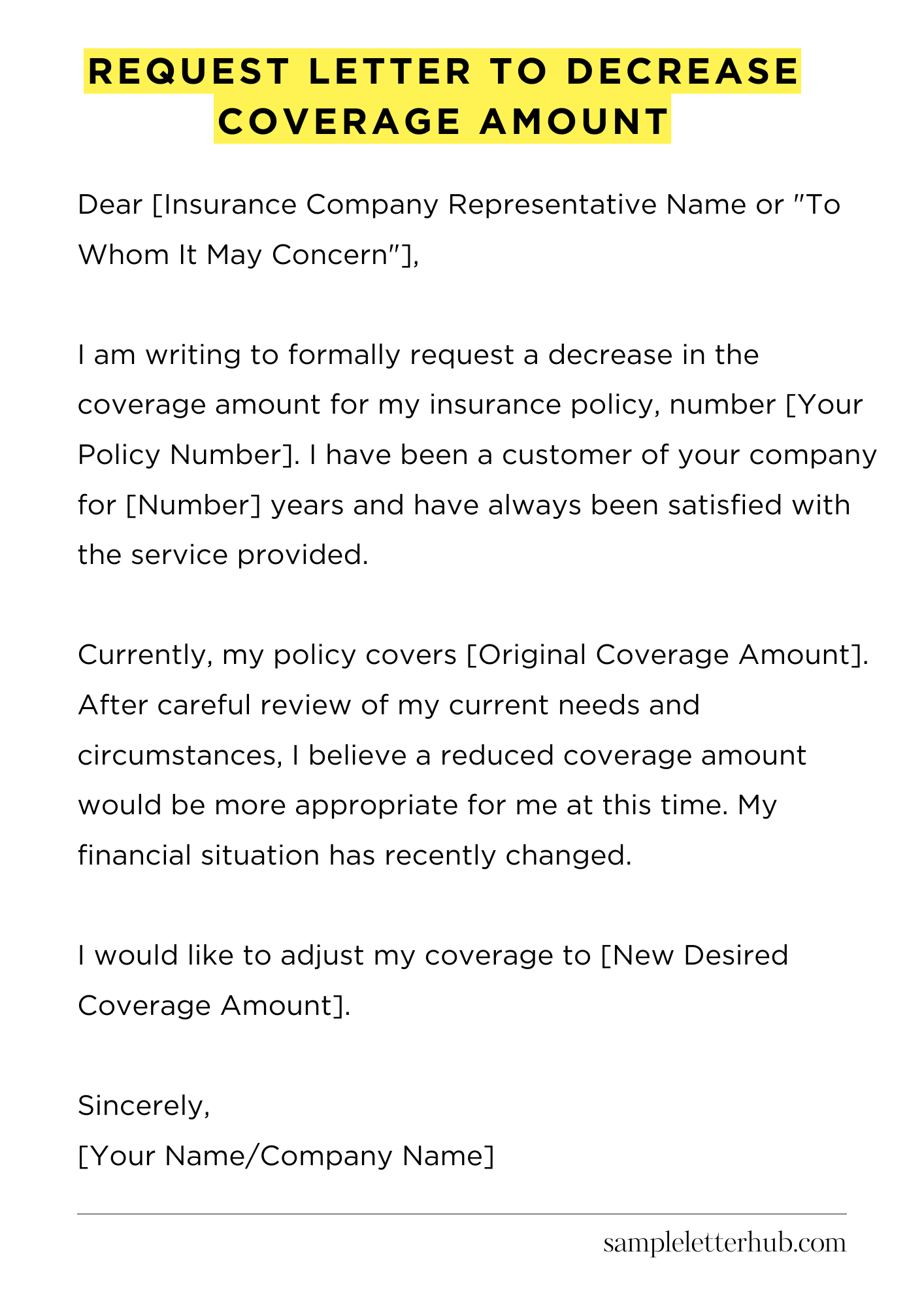
Dear [Insurance Company Representative Name or “To Whom It May Concern”],
I am writing to formally request a decrease in the coverage amount for my insurance policy, number [Your Policy Number]. I have been a customer of your company for [Number] years and have always been satisfied with the service provided.
Currently, my policy covers [Original Coverage Amount]. After careful review of my current needs and circumstances, I believe a reduced coverage amount would be more appropriate for me at this time. My financial situation has recently changed due to [brief, neutral explanation – e.g., a change in employment, a shift in personal assets].
I would like to adjust my coverage to [New Desired Coverage Amount]. This figure reflects my current needs and helps me better manage my insurance expenses. I understand that a lower coverage amount may affect my premium.
I would appreciate it if you could provide me with details regarding the revised premium costs and any other changes associated with this reduction. Please let me know what steps I need to take to finalize this adjustment. I am available to discuss this matter further at your convenience. You can reach me by phone at [Your Phone Number] or via email at [Your Email Address].
Thank you for your time and attention to this matter. I look forward to your prompt response and confirmation of this request.
Sincerely,
[Your Name/Company Name]
How to Write Request Letter to Decrease Coverage Amount
Negotiating the intricacies of your insurance policy can sometimes feel like navigating a labyrinth. One instance where this might arise is when you want to modify your existing coverage. This piece will serve as your lodestar, illuminating the path on how to craft a compelling request letter to decrease your coverage amount.
1. Understanding the Premise
Before you even begin to wield your pen, it’s crucial to grasp the underpinnings of your request. Evaluate why you want to diminish your coverage. Has your financial situation shifted?
Are you over-insured, potentially squandering premiums on excessive protection? Conduct a thorough analysis of your current needs and the level of risk you’re willing to bear. A judicious understanding forms the bedrock of a persuasive letter.
2. Ascertaining Policy Details
Your next step is to procure all the pertinent data. Locate your insurance policy document. Scrutinize the fine print, noting the policy number, the specific coverage types, the current coverage amounts, and the stipulations regarding policy modifications. This level of meticulousness is paramount to crafting a legally sound and effective missive.
3. Structuring Your Overture: The Salutation
Begin with a professional and respectful salutation. If you know the name of the insurance agent or the person in charge of your policy, address the letter directly to them. Otherwise, a general salutation like “To Whom It May Concern” is perfectly acceptable. Maintain a formal tone from the onset; it demonstrates respect and seriousness.
4. Articulating Your Request: The Body
The body of your letter is where you will delineate your request with clarity. Explicitly state your intention: to decrease the coverage amount.
Specify the exact coverage types you want to modify, and the new amounts you are seeking. Provide a concise, well-reasoned rationale for your decision. For instance, if you sold a valuable asset, mention that fact and how it has reduced your risk exposure.
5. Supporting Your Discourse: The Justification
The strength of your argument rests on the reasons you put forth. Be transparent and specific. If your finances have altered, provide a general explanation, avoiding overly personal details.
If you’ve undertaken measures to mitigate risk, such as installing security systems or reducing the value of your possessions, highlight these efforts. Provide any relevant supporting documentation if it’s necessary.
6. The Concluding Stipulations: The Closing
Conclude your letter with a clear statement of your expectations. Request confirmation of the coverage change in writing, including the date it will take effect.
You should also ask for a revised policy document or an endorsement reflecting the changes. Express your gratitude for their time and consideration. End with a professional closing, such as “Sincerely” or “Respectfully,” followed by your full name and contact information.
7. Polishing Your Prose: The Review
Before dispatching your letter, subject it to a rigorous review. Proofread for any typographical errors or grammatical lapses. Ensure your language is precise, concise, and professional.
You may consider having a trusted friend or colleague review the letter for clarity. A polished, well-crafted letter significantly increases the likelihood of a favorable response and successful implementation of your request.
FAQs about Request Letter to Decrease Coverage Amount
What information should I include in a request letter to decrease my insurance coverage amount?
Your request letter should clearly state your policy number, the specific coverage you wish to reduce (e.g., liability limits, property coverage), and the new desired coverage amount.
You should also include the effective date for the change and a brief explanation for the decrease, such as changes in your circumstances or risk profile. Always include your contact information for the insurer to respond.
What are the potential consequences of decreasing my insurance coverage amount?
Decreasing your coverage amounts will likely reduce your premium payments. However, it also exposes you to greater financial risk. If you experience a loss or claim, you will be responsible for a higher portion of the expenses, potentially paying out-of-pocket for damages exceeding your new coverage limits. Carefully assess your risks and financial situation before reducing coverage.
How do I write a request letter to decrease my insurance coverage?
The letter should be concise and professional. Begin with a formal salutation and identify the recipient (e.g., insurance company representative).
State your policy details, desired coverage changes, effective date, and a reason for the change. Close with a polite closing and your full contact information. Maintain a copy of the letter and any confirmation from the insurer.
What is the process for submitting a request to decrease my insurance coverage?
The process typically involves submitting your request in writing to your insurance provider. You might be able to submit the letter by mail, email, or through an online portal if one is available. Review your insurance policy for specific instructions on how to submit a request. Keep documentation of your request and any responses from the insurance company.
Can my insurance company deny my request to decrease my coverage amount?
While insurance companies generally accommodate requests to reduce coverage, they may deny them under certain circumstances.
This could be due to state regulations or if the requested coverage reduction falls below minimum coverage requirements. Always consult your insurance policy or contact your insurance provider for specific details on the terms and conditions and the possibility of denial.
Related:
Resignation letter due to rude boss
Resignation letter moving to another state
Resignation letter due to illness of family member
Resignation letter due to study
Resignation letter due to long commute