

Life changes. Your insurance policy needs to keep up. A “Letter to Update Contact Details in Insurance Policy” is exactly what it sounds like. It’s a formal way to inform your insurance provider about changes. Things like your address, phone number, or email. This ensures they can reach you. It’s crucial for claims and policy updates.
Updating your contact details can seem tedious. No worries, we are here to help. This article provides you with handy templates. We’ll share various “Letter to Update Contact Details in Insurance Policy” examples. These samples are designed to be user-friendly.
This article is your guide to quick and easy updates. Our samples cover different scenarios. We provide you with the framework. You can customize them to your needs. Get ready to update your insurance policy details effortlessly! This is the place to be if you are looking for samples or examples for updating your contact details in your insurance policy.
[Your Name]
[Your Address]
[Your Phone Number]
[Your Email Address]
[Date]
[Insurance Company Name]
[Insurance Company Address]
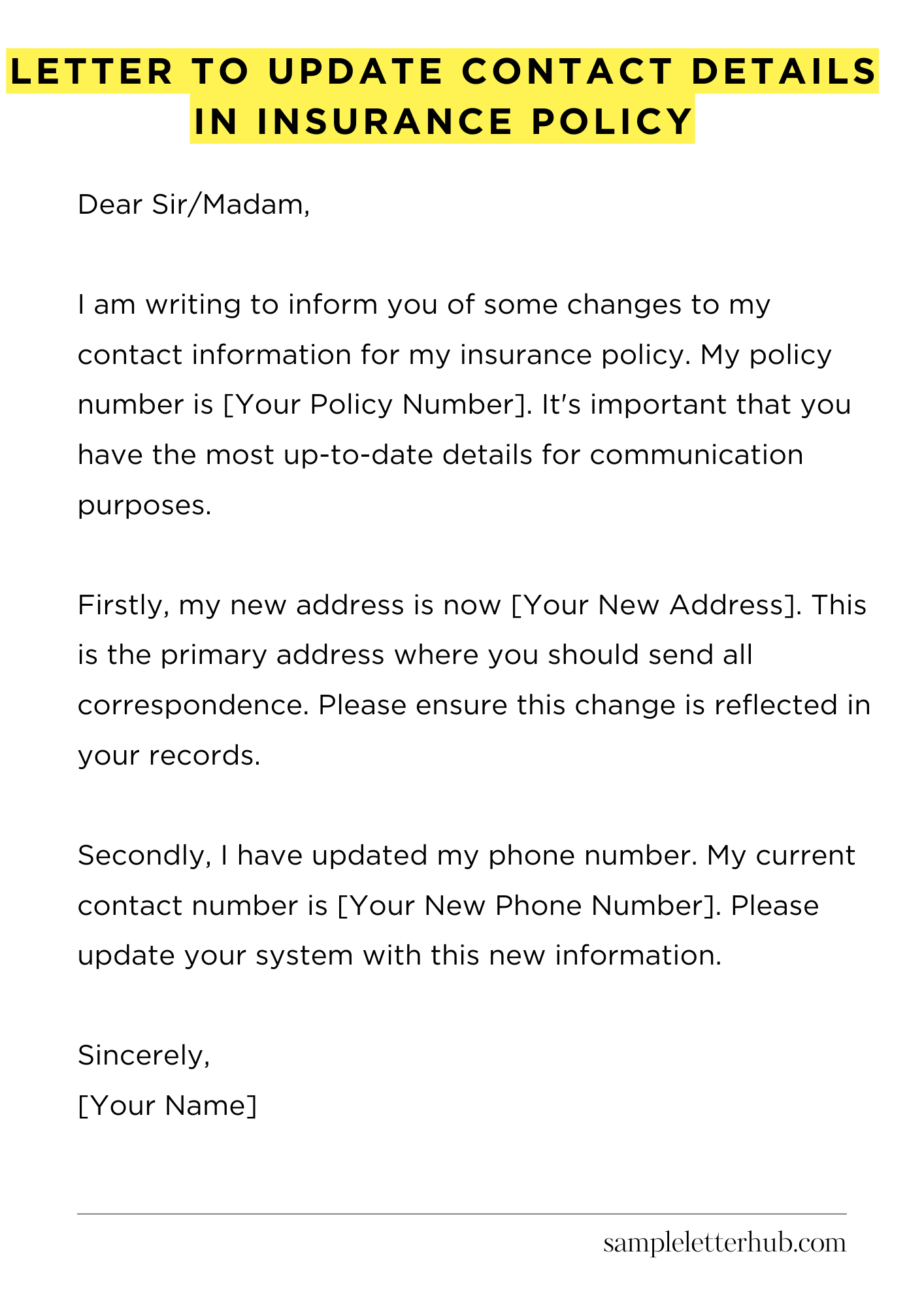
Dear Sir/Madam,
I am writing to inform you of some changes to my contact information for my insurance policy. My policy number is [Your Policy Number]. It’s important that you have the most up-to-date details for communication purposes.
Firstly, my new address is now [Your New Address]. This is the primary address where you should send all correspondence. Please ensure this change is reflected in your records.
Secondly, I have updated my phone number. My current contact number is [Your New Phone Number]. Please update your system with this new information.
I also want to make sure you have my current email address. My email address is [Your New Email Address]. This would be useful for sending policy updates and other important notifications.
These changes are effective immediately, and I appreciate your prompt attention to this matter. Please confirm receipt of this letter and the successful update of my contact details. I want to make sure everything goes smoothly.
Thank you for your assistance. I value your services.
Sincerely,
[Your Name]
How to Write Letter to Update Contact Details in Insurance Policy
Life is dynamic, and sometimes, your contact information needs a swift adjustment. This guide elucidates the process of penning a letter to your insurance provider to effectuate modifications to your contact details. This ensures you receive crucial policy updates and correspondence without interruption. Let’s delve in.
1. Commence with a Salutation and a Formal Tone
Your letter should begin with a professional salutation. Initiate by addressing the letter to the appropriate department or individual at your insurance company.
If you are unsure, you can address it to the “Customer Service Department.” This signifies a level of decorum. For example, use “Dear Sir/Madam,” or if you know the name, “Dear Mr./Ms. [Last Name]”. Avoid informal greetings like “Hey” or “Hello.”
2. Clearly State Your Purpose: The Exordium
Immediately articulate the letter’s purpose: to update your contact details. This clear, unambiguous statement sets the stage. In the first paragraph, you must plainly state your intention. A simple sentence like, “The purpose of this letter is to formally request an update to my contact information associated with my insurance policy” is apt.
3. Provide Your Policy Information: The Crucial Data
Crucially, provide all pertinent policy information. This is the cornerstone of your request. Include your policy number (or numbers if you have multiple policies). Also, add your full name, date of birth, and any other identifying information required by your insurer.
This data facilitates the seamless correlation of your request with your records. Omitting this information can lead to substantial delays.
4. Enumerate Your New Contact Details: The Core of the Matter
Now, meticulously present your new contact information. Ensure clarity and accuracy are your watchwords. Include your new mailing address (street address, city, state, and zip code), phone number (with area code), and email address.
Double-check all digits and characters for accuracy. Consider breaking it down into distinct bullet points for optimal readability and a lack of ambiguity. For example:
- New Mailing Address: 123 Main Street, Anytown, CA 91234
- New Phone Number: (555) 123-4567
- New Email Address: your.email@example.com
5. Express a Request for Confirmation: The Follow-Up
Add a brief paragraph requesting confirmation of the update. This guarantees your peace of mind. Request the insurer to confirm the change has been made, ideally with a method for verification. You could ask them to send a confirmation email or letter. This step assures you that the changes are enacted. Also, include your preferred method of contact for this confirmation, in case it varies.
6. Conclude with a Formal Closing: The Courteous Farewell
Conclude your letter with a formal closing and your signature. Use a professional closing like “Sincerely,” “Yours faithfully,” or “Respectfully,” followed by your full name. If sending a physical letter, sign it in blue or black ink. This imparts a touch of professionalism and authenticity. Do not forget to type your name below your signature.
7. Submission and Proofreading: The Final Check
Before submitting, thoroughly proofread your letter. This step is indispensable. Check for spelling errors, grammatical inaccuracies, and clarity of expression.
Ensure all information is accurate and easily understood. Either mail the letter via registered mail (for proof of delivery), send it via the method your insurance company specifies (email, online portal etc), or scan a copy for your records. This creates a concrete trail of your request. This will provide you with a paper trail, safeguarding your interests.
FAQs about Letter to Update Contact Details in Insurance Policy
What information should I include in a letter to update my contact details?
Your letter should clearly state your policy number, full name, and the new contact details you wish to update. This typically includes your new address, phone number, and email address. You may also need to provide supporting documentation, such as a copy of your driver’s license or a utility bill, to verify the changes. Be sure to date the letter and include your signature.
How do I submit the letter to update my contact details?
The submission method can vary depending on your insurance provider. Common methods include mailing the letter to a designated address, submitting it through an online portal (if available), or sending it via email to a specific department or representative.
Always check your policy documentation or contact your insurance provider directly to determine the preferred method and any specific instructions they may have.
What happens after I send the letter?
After you submit the letter, the insurance company will process the changes to your policy. They may send a confirmation letter or email to your new contact details to confirm the update has been made.
It’s important to keep a copy of the letter and any confirmation received for your records. The processing time can vary, so it’s advisable to allow sufficient time for the update to be reflected in their systems.
Why is it important to update my contact details with my insurance provider?
Keeping your contact details up-to-date ensures that you receive important policy information, renewal notices, and claims-related communications promptly. Failure to do so could result in missed notifications, potential lapses in coverage, or difficulties in filing a claim. It also allows the insurer to contact you in case of emergencies related to your policy.
What happens if I don’t update my contact details?
If you fail to update your contact details, you may miss crucial communications from your insurer. This includes policy renewal notices, which could lead to a lapse in coverage if you’re unaware of the renewal requirements.
You may also not receive important claim information. In addition, if the insurer cannot contact you, you might miss opportunities to make necessary changes to your policy, potentially impacting your coverage.
Related:
Resignation letter due to rude boss
Resignation letter moving to another state
Resignation letter due to illness of family member
Resignation letter due to study
Resignation letter due to long commute