

Need to update your insurance information? An address change request letter to your insurance company is the official way to do it. It informs your insurer about your new residential or mailing address. This ensures you receive important policy documents and communications. It also helps them keep your records accurate.
We get it. Writing a formal letter can be a hassle. That’s why we’re here to help! We’ve prepared a collection of address change request letter templates. Consider it your address change request letter to insurance company cheat sheet. You can use these examples as a starting point. Modify them as per your needs.
These address change request letter samples cover various scenarios. From home moves to changes in mailing addresses, we’ve got you covered. This makes it easy to update your details with your insurance provider. Get ready to save time and effort. Say goodbye to confusing paperwork!
[Your Name]
[Your Address]
[Your Phone Number]
[Your Email Address]
[Date]
[Insurance Company Name]
[Insurance Company Address]
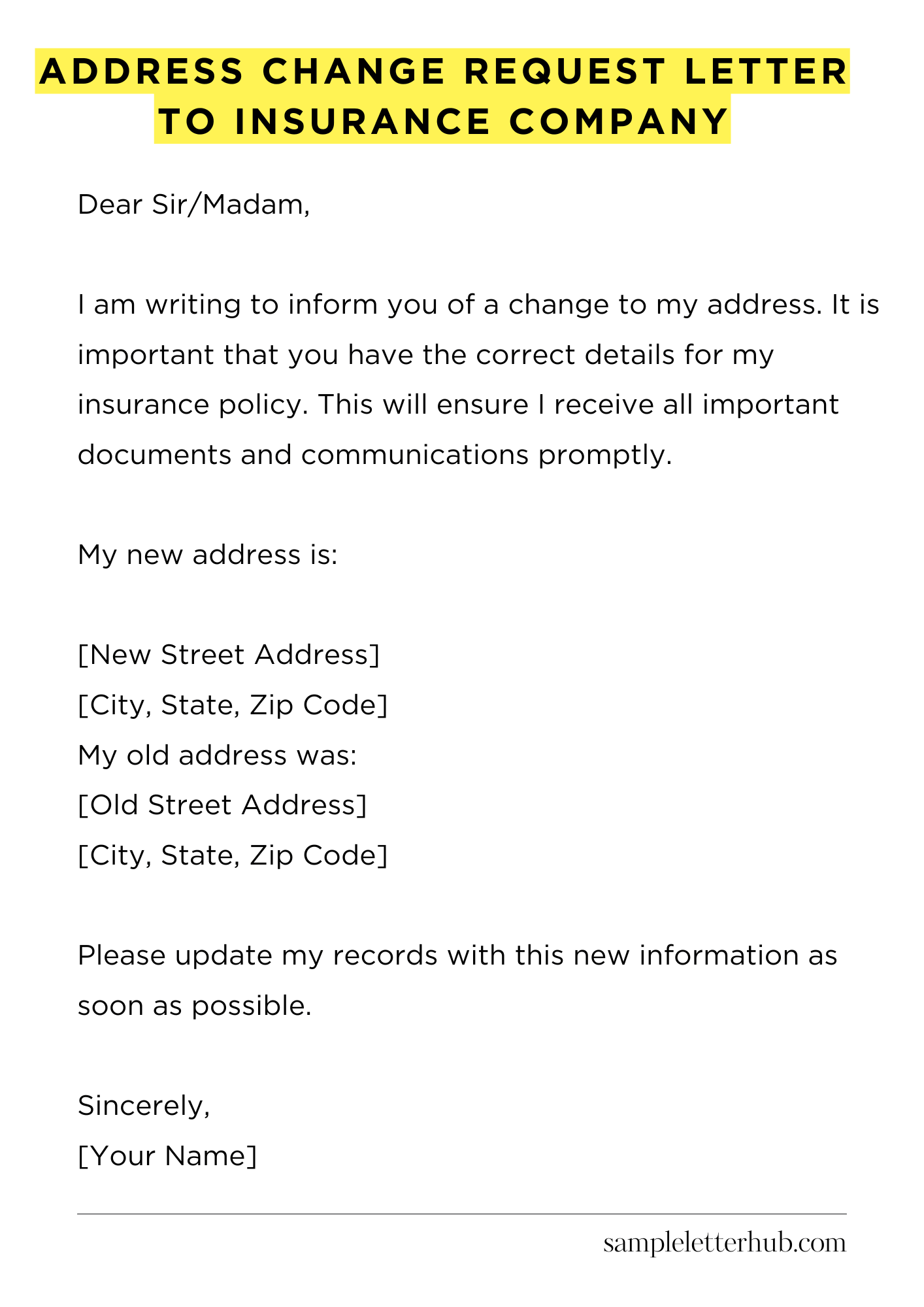
Dear Sir/Madam,
I am writing to inform you of a change to my address. It is important that you have the correct details for my insurance policy. This will ensure I receive all important documents and communications promptly.
My new address is:
[New Street Address]
[City, State, Zip Code]
My old address was:
[Old Street Address]
[City, State, Zip Code]
Please update my records with this new information as soon as possible. I would appreciate it if you could confirm the change has been made. I rely on your company to protect me, and timely communication is vital.
My policy number is [Your Policy Number]. I have been a loyal customer for many years.
Thank you for your attention to this matter. I look forward to receiving confirmation of the address change. Please feel free to contact me if you require any further information.
Sincerely,
[Your Name]
How to Write Address Change Request Letter to Insurance Company
1. Initiate Your Correspondence
The genesis of your missive should be clear and concise. Begin by formally stating the purpose of your communication: to request an address modification.
This overture sets the stage for the subsequent details. It’s the equivalent of a formal introduction before you launch into a detailed discussion. Your goal is to inform the insurance company what you need and what information you are sharing.
2. The Salutation and Recipient Identification
Choose an appropriate salutation to set the tone. “Dear Sir/Madam” is a safe harbor if you lack a specific contact. If you know the name of a claims adjuster or representative, use “Dear Mr./Ms. [Last Name]”.
Following this, clearly state the recipient, which is usually the insurance company’s name and the specific department, such as “Claims Department” or “Policy Services”. Remember, accuracy is paramount to ensure your letter reaches the intended recipient.
3. Provide Policy Identification
This is a critical section. Include all relevant policy details to ensure your address modification is correctly processed. This typically involves the policy number, the insured’s full name, and any other pertinent identifiers, such as the claim number if applicable.
Omission of this information could lead to processing delays or errors, frustrating everyone involved. Be thorough; double-check everything before moving forward.
4. Explicate the Change – Your New Locality
This section is where you impart the meat of your communication. Meticulously state your new address, ensuring accuracy is your watchword. Include the complete street address, apartment number (if applicable), city, state, and zip code. Consider providing the date from which this change becomes effective.
This way, the insurance company will update their records on the right time.
5. Convey Other Pertinent Details (Optional)
Beyond the address itself, you might want to furnish additional, ancillary information. This could include the date you moved, a phone number where you can be reached, or an email address for correspondence. This is more of an extra step, and it is entirely up to you. This is an extra precaution that can help expedite the process.
6. The Formal Closure and Signature
Conclude your letter with a professional closing. Use phrases such as “Sincerely,” “Yours faithfully,” or “Best regards.” Under the closing, provide a space for your handwritten signature followed by your printed name. This creates a proper closure for this formal communication. It’s the symbolic seal on your request.
7. Proofreading and Submission of the Document
Before dispatching your letter, proofread it assiduously. Check for grammatical errors, spelling mistakes, and the overall clarity of your message. Ensure all policy details are correct.
Consider making a copy of your letter for your records. This is vital. Consider your preferred method of submission, whether it’s via postal mail or electronic channels (if the company provides an email address or online portal).
FAQs about Address Change Request Letter to Insurance Company
What information should I include in an address change request letter?
Your letter should include your full name, policy number, old address, new address, effective date of the change, contact information (phone number and email), and your signature. It’s also helpful to clearly state that you are requesting an address change.
How do I know the correct mailing address for my insurance company?
You can usually find the correct mailing address on your insurance policy documents, their website, or by calling their customer service line. Double-check to ensure you’re sending the letter to the correct department handling policy changes.
Can I submit an address change request electronically?
Many insurance companies allow you to change your address online through their website or mobile app. Check your insurer’s website for instructions. However, it’s always good practice to keep a copy of your request for your records.
How long does it take for an address change to be processed?
The processing time varies depending on the insurance company. Some changes are processed within a few business days, while others may take a couple of weeks. You should contact the company to verify the timeline and when the changes take effect.
What happens if I don’t update my address with my insurance company?
Failing to update your address can lead to missed important communications like policy renewals, claim information, and other critical documents. It could also impact the delivery of claims checks or other important items. You may also miss critical communications regarding changes to your policy.
Related:
Resignation letter due to rude boss
Resignation letter moving to another state
Resignation letter due to illness of family member
Resignation letter due to study
Resignation letter due to long commute