

Need to adjust your insurance policy? You might need an insurance policy change request letter. This letter formally asks your insurance provider to modify your existing policy. Its purpose is to clearly communicate the specific changes you desire.
Writing this letter can feel tricky. Don’t worry, we’ve got you covered. This article offers helpful insurance policy change request letter templates. We’ll also give you easy-to-use examples. These sample letters will simplify the writing process.
Whether you’re adding a driver or changing coverage, we’re here to help. Our letter samples cover various situations. Use our guidance to draft a professional and effective insurance policy change request letter. It is a perfect guide.
[Your Name/Company Name]
[Your Address]
[Your City, Postal Code]
[Your Email]
[Your Phone Number]
[Date]
[Insurance Company Name]
[Insurance Company Address]
[Insurance Company City, Postal Code]
Subject: Request for Change to Insurance Policy [Policy Number]
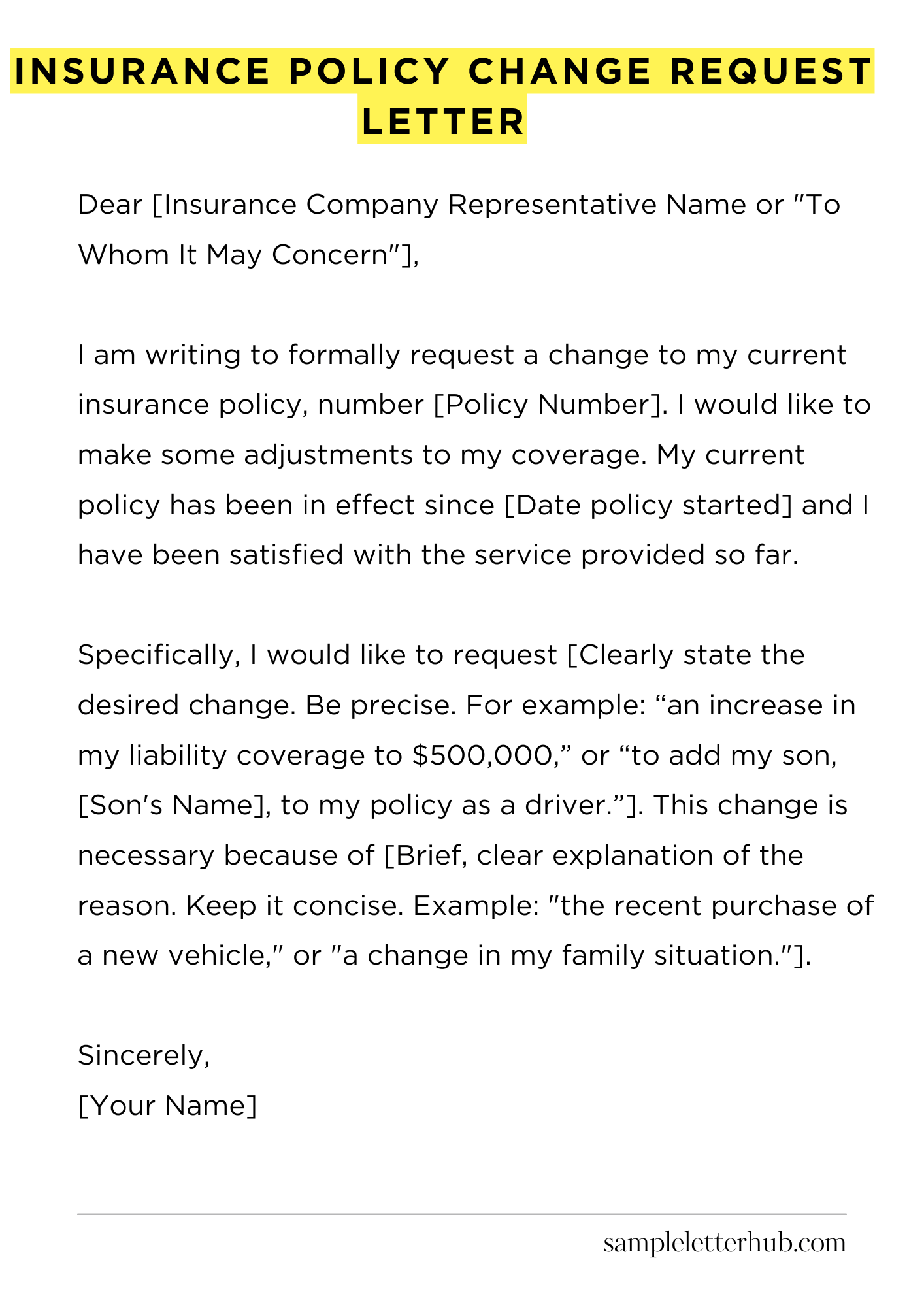
Dear [Insurance Company Representative Name or “To Whom It May Concern”],
I am writing to formally request a change to my current insurance policy, number [Policy Number]. I would like to make some adjustments to my coverage. My current policy has been in effect since [Date policy started] and I have been satisfied with the service provided so far.
Specifically, I would like to request [Clearly state the desired change. Be precise. For example: “an increase in my liability coverage to $500,000,” or “to add my son, [Son’s Name], to my policy as a driver.”]. This change is necessary because of [Brief, clear explanation of the reason. Keep it concise. Example: “the recent purchase of a new vehicle,” or “a change in my family situation.”].
I have attached [Mention any documents you are including. Example: “a copy of the vehicle registration for the new car,” or “proof of my son’s driver’s license.”] to support this request. It should help expedite the process.
Please let me know what steps I need to take to complete this change. I am available to discuss this further at your convenience. You can reach me by phone at [Your Phone Number] or by email at [Your Email]. It is very important to me that I receive a timely response.
Thank you for your time and attention to this matter. I look forward to hearing from you soon regarding this request.
Sincerely,
[Your Name]
How to Write Insurance Policy Change Request Letter
Navigating the labyrinthine world of insurance often necessitates amendments to your existing policies. This is where a well-crafted insurance policy change request letter becomes your most potent ally.
It serves as the formal instrument to articulate your desired modifications, ensuring a clear, concise, and legally sound communication with your insurance provider. Let’s delve into the mechanics of composing such a critical piece of correspondence.
1. Identifying the Confluence of Requirements: What Changes are You Seeking?
Before putting pen to paper (or fingers to keyboard), you must meticulously outline the precise alterations you require. Are you seeking to modify your coverage limits?
Perhaps you need to add or remove a beneficiary, or maybe you’re updating your address or vehicle information. Precisely defining these desiderata is the cornerstone of an effective request. This preparatory phase allows for a focused and streamlined communication, reducing the potential for ambiguity.
2. The Art of Salutation: Addressing the Right Entity
Properly addressing your letter is paramount. Ascertain the correct department or individual responsible for policy modifications at your insurance company.
Often, this information is readily available on your policy documents or the insurer’s website. Employ a formal salutation, such as “Dear [Name of Agent/Department]”, to establish a tone of professionalism. Incorrectly addressing the letter can lead to delays in the processing of your request and must be meticulously observed.
3. The Anatomy of the Body: Articulating Your Intent
The body of your letter is where you articulate your specific change requests. Begin by explicitly stating the purpose of the letter: “This letter constitutes a formal request to modify my insurance policy.”
Then, provide all the necessary details. Include your policy number, the specific changes you want, and any supporting information. Be crystal clear and avoid convoluted sentence structures. Use numbered lists or bullet points to enhance readability, particularly when detailing multiple changes. Remember, perspicuity is key.
4. The Tangible Elements: Supplying Necessary Documentation
Depending on the nature of your request, you might need to include supporting documentation. This could include copies of legal documents, such as a marriage certificate or birth certificate, or evidence of a new address.
Carefully review your policy terms or consult with your insurance representative to ascertain any documentation prerequisites. Failing to furnish the necessary documentation will invariably delay the processing of your request; therefore, be thorough.
5. The Closing Remarks: Formalities and Call to Action
Conclude your letter with a polite and professional closing. Express your anticipation for a timely response and reiterate your contact information, including your phone number and email address.
Consider including a concise call to action, such as “Please confirm receipt of this request and advise me of the next steps.” This fosters clear communication and prompts a prompt response from the insurance provider. The language should be polite but firm.
6. Polishing the Prose: Proofreading and Reviewing
Before dispatching your letter, meticulously proofread it for any grammatical errors, typographical inaccuracies, or omissions. Ensure that all the information provided is accurate and consistent with your policy details.
Consider having a second pair of eyes review the letter to catch any potential issues you might have missed. A well-edited letter projects a sense of professionalism and attention to detail. This is very important for the overall impact.
7. Delivery and Confirmation: Sending the Letter and Securing Evidence
Choose your delivery method wisely. Certified mail with return receipt requested is highly recommended, as it provides verifiable proof that your letter was received. Keep a copy of the letter and the return receipt for your records. If sending electronically, consider using a secure email service and retaining a copy of the email correspondence.
Obtain confirmation of receipt of your request and follow up if you don’t hear back within a reasonable timeframe. This diligent approach safeguards your interests and ensures that your request is processed efficiently. Always keep a paper trail.
FAQs about Insurance Policy Change Request Letter
What is an Insurance Policy Change Request Letter?
An insurance policy change request letter is a formal document submitted to an insurance provider to modify the terms or details of an existing insurance policy. This can include changes to coverage, beneficiaries, address, or other policy-related information.
What types of changes can I request in an Insurance Policy Change Request Letter?
You can request a variety of changes, including adding or removing coverage, updating personal information (address, contact details), changing beneficiaries, increasing or decreasing coverage amounts, and sometimes, switching to a different insurance plan offered by the same provider.
What information should be included in an Insurance Policy Change Request Letter?
The letter should include your full name, policy number, contact information, the specific change(s) requested, the effective date for the changes (if applicable), and your signature. It’s also helpful to clearly state the current policy details and the desired changes in a clear, concise manner.
How do I submit an Insurance Policy Change Request Letter?
The method of submission varies depending on the insurance provider. Common methods include submitting the letter via mail, email, or through an online portal if one is available. Always retain a copy of the letter for your records and ensure you get confirmation from the insurer that the changes have been processed.
How long does it take for changes requested in an Insurance Policy Change Request Letter to be processed?
Processing times can vary based on the insurance provider and the complexity of the requested changes. Typically, the process can take from a few days to several weeks. It’s advisable to check with your insurance provider for an estimated processing timeline, as they will provide the most accurate information on how long their procedure takes.
Related:
Resignation letter due to rude boss
Resignation letter moving to another state
Resignation letter due to illness of family member
Resignation letter due to study
Resignation letter due to long commute