

Ever paid insurance premiums and barely used the service? A request letter for premium reduction due to low usage is your way out. Its purpose? To ask your insurance provider to lower your costs. This is because you haven’t been claiming or using the insurance much.
Good news! We’re here to help you draft the perfect request letter for premium reduction. We understand that writing can be a hassle. That’s why we’ve prepared templates and examples. These examples of a request letter will guide you. Writing your letter will now be simple.
No more staring blankly at a page. This article provides easy-to-customize sample letters. You can adjust the request letter to fit your specific needs. Get ready to save money. Learn how to write a compelling letter to your insurance provider. Let’s get started.
[Your Name/Company Name]
[Your Address]
[Your Phone Number]
[Your Email Address]
[Date]
[Name of Service Provider]
[Service Provider Address]
Subject: Request for Premium Reduction Due to Low Usage – Account [Your Account Number]
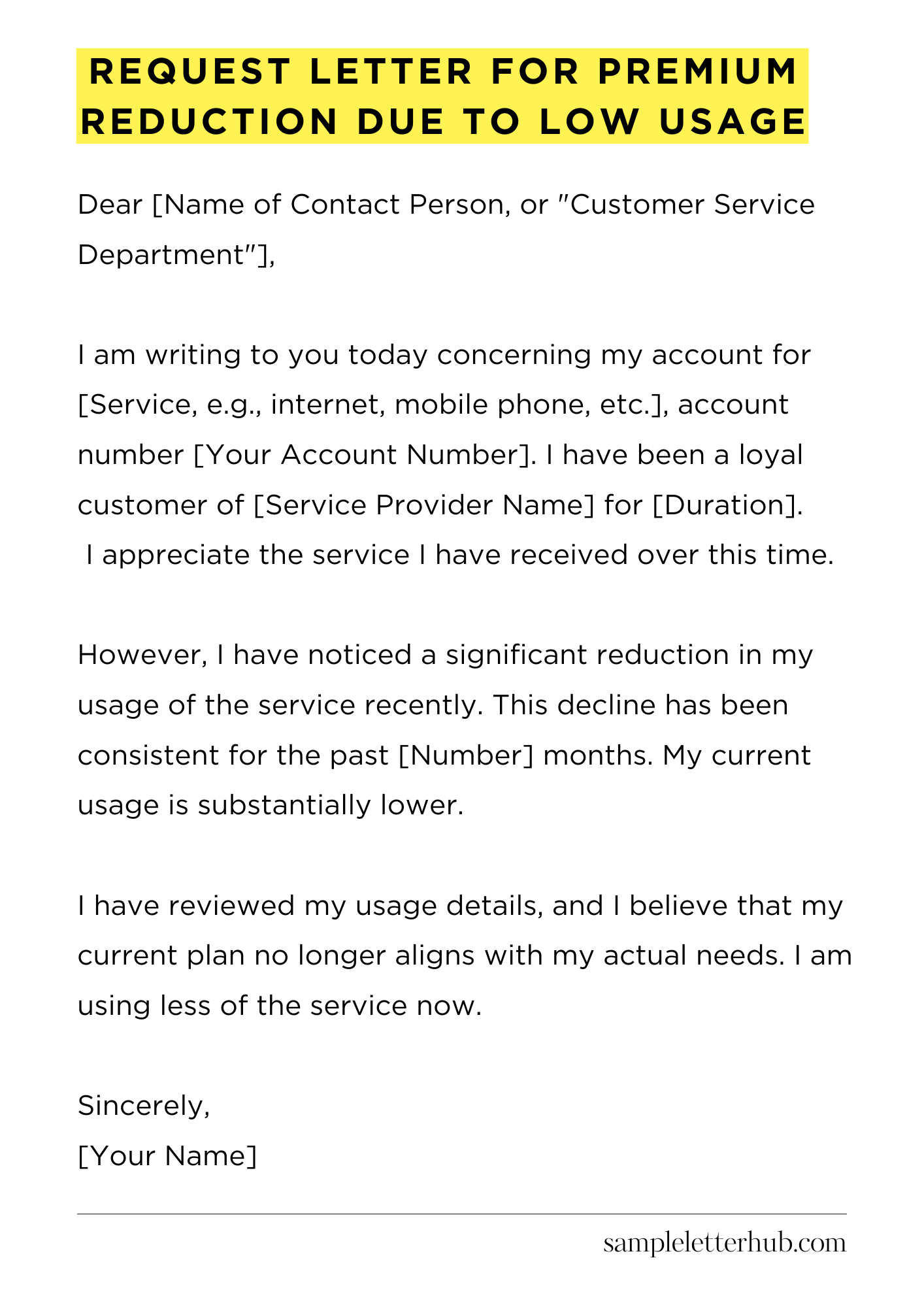
Dear [Name of Contact Person, or “Customer Service Department”],
I am writing to you today concerning my account for [Service, e.g., internet, mobile phone, etc.], account number [Your Account Number]. I have been a loyal customer of [Service Provider Name] for [Duration]. I appreciate the service I have received over this time.
However, I have noticed a significant reduction in my usage of the service recently. This decline has been consistent for the past [Number] months. My current usage is substantially lower than what was anticipated when I originally selected my current premium plan. It is important to me that I use services efficiently.
I have reviewed my usage details, and I believe that my current plan no longer aligns with my actual needs. I am using less of the service now. It’s quite a difference.
Therefore, I would like to respectfully request a review of my current premium plan. I am hoping for a possible reduction in my monthly fee to better reflect my current usage patterns.
A more appropriate plan would be beneficial. I am open to discussing alternative plans that might be a better fit for me.
I would appreciate it if you could consider my request. Please let me know the process for initiating this change. I look forward to hearing from you soon and discussing this matter further.
Thank you very much for your time and attention to this matter.
Sincerely,
[Your Name]
How to Write Request Letter for Premium Reduction Due to Low Usage
Are you overpaying for a service you’re not fully utilizing? It happens! Sometimes, life circumstances change, and your needs evolve, leaving you with a service you’re paying a premium for, but barely touching.
Fear not; a well-crafted request letter can be your shield against over-expenditure. We’ll guide you through the process, arming you with the knowledge to write a compelling letter that could potentially lead to a favorable outcome.
1. Initiate: Formatting and the Salutation
Your missive should commence with a professional, formally structured appearance. Start with your full name, address, phone number, and email address, typically aligned to the top left of the document. Directly below, on the right side, incorporate the date.
Now for the recipient: Include their full name, title, and the company’s full mailing address. The salutation is the ceremonial commencement; use a formal greeting like “Dear Mr./Ms./Mx. [Last Name]”. Avoid the informal “To Whom It May Concern” if possible; ideally, address your letter to a specific individual.
2. Explicate Your Intent: The Opening Paragraph
The opening paragraph is your inaugural opportunity to seize the reader’s attention. Clearly and concisely state the purpose of your letter: to request a premium reduction due to diminished usage. State the account details. Specify the service or product for which you’re seeking a lower premium. The goal is clarity.
3. Substantiate Your Claim: Detailing Low Usage
This section is the crux of your persuasive argument. Provide concrete, quantifiable evidence of your reduced consumption. Use specific metrics. If it’s a utility bill, reference your historical usage compared to your current usage, illustrating the decline in a clear manner.
For instance, you can include data. If it’s a subscription service, articulate how you are utilizing less frequently. Be precise. Substantiate your case with solid figures. Your rationale should be compelling.
4. Enumerate the Justification: Reasons for Reduced Usage
Here, delve into the reasons behind your decreased consumption. Be honest, but tactful. Provide a valid explanation. Did you move, change jobs, or experience a shift in your lifestyle? If applicable, present this context clearly.
If you have been travelling or were unwell, or experienced any event that caused low usage, specify that. The more credible your reasons, the more likely your request is to be favorably considered.
5. Present Your Proposition: The Specific Request
Now, precisely state what you desire. Clearly articulate your request for a premium reduction. Specify the type of reduction you are seeking.
Perhaps you are hoping for a lower monthly rate, a temporary suspension, or an alternative plan that aligns with your current usage patterns. Be realistic. Be specific. Make your request easily understood.
6. Reinforce with Gratitude and Closing: The Final Flourishes
Conclude your letter with a tone of gratitude and professionalism. Express your appreciation for their time and consideration. You can mention the value you place on the service, and your intent to continue using it in the future, if you can.
End with a formal closing, such as “Sincerely,” or “Respectfully,” followed by your full name and signature (if sending a physical letter). This adds a touch of sophistication to your communication.
7. Polishing and Dispatch: Proofreading and Delivery
Before submitting your letter, rigorously proofread it for any grammatical errors, typos, and formatting inconsistencies. Ensure your language is clear, concise, and professional.
Double-check all details, including account numbers, dates, and contact information. If sending electronically, consider using a professional font and formatting. If sending via postal mail, ensure the letter is printed on quality paper. Keep a copy of your letter for your records. The final step is to mail or email your letter.
FAQs about Request Letter for Premium Reduction Due to Low Usage
What is the primary purpose of a request letter for premium reduction due to low usage?
The primary purpose is to formally request a decrease in the insurance premium based on documented low utilization of the insured service or product. This letter serves as evidence of the reduced risk and justifies the request for a more favorable premium rate.
What specific information should be included in a request letter for premium reduction due to low usage?
The letter should include the policyholder’s details, policy number, dates of low usage (e.g., claims, mileage, service use), specific examples supporting the low usage claim, and the desired premium reduction amount or percentage, if known. Supporting documentation, such as service records or mileage logs, should also be included.
What types of insurance policies are typically eligible for premium reduction based on low usage?
Policies that are most often eligible are those where usage directly correlates to risk. This includes auto insurance (mileage-based), health insurance (low medical claims), and certain business insurance policies. However, eligibility varies depending on the insurer and the specific policy terms.
What are the common reasons for premium reduction requests being denied?
Requests are often denied due to insufficient evidence of low usage, failure to meet the insurer’s eligibility criteria (which can include minimum usage thresholds), or the policy terms not explicitly allowing for such reductions. Incomplete or vague requests and a lack of supporting documentation are also common reasons for denial.
How should a policyholder follow up if their request for premium reduction is denied?
If denied, the policyholder should carefully review the denial letter for specific reasons. They can then gather any missing information, clarify discrepancies, or appeal the decision with additional supporting evidence.
If the denial seems unjust or unclear, seeking clarification from the insurer or consulting with an insurance agent is recommended.
Related:
Resignation letter due to rude boss
Resignation letter moving to another state
Resignation letter due to illness of family member
Resignation letter due to study