

Dealing with an insurance company can be tricky. Sometimes, you may discover that you have been overcharged. A “Letter for Reimbursement of Overcharged Premium” is a formal request. It asks your insurance provider to refund the extra money you paid. This letter is crucial for getting your money back.
Need to write a letter for reimbursement? We’ve got you covered! This article provides samples and templates. We’ll help simplify the process. Overcharged premium issues become less stressful. We’ll make it easier to draft your own reimbursement letter.
We understand writing these letters can be daunting. Therefore, we’ll give you letter for reimbursement examples. These samples are easy to adapt. Use them to create your own letter requesting a refund. Get your overcharged premium back quickly.
[Your Name/Your Company Name]
[Your Address]
[Your Phone Number]
[Your Email Address]
[Date]
[Insurance Company Name]
[Insurance Company Address]
Subject: Reimbursement Request for Overcharged Premium – Policy Number [Your Policy Number]
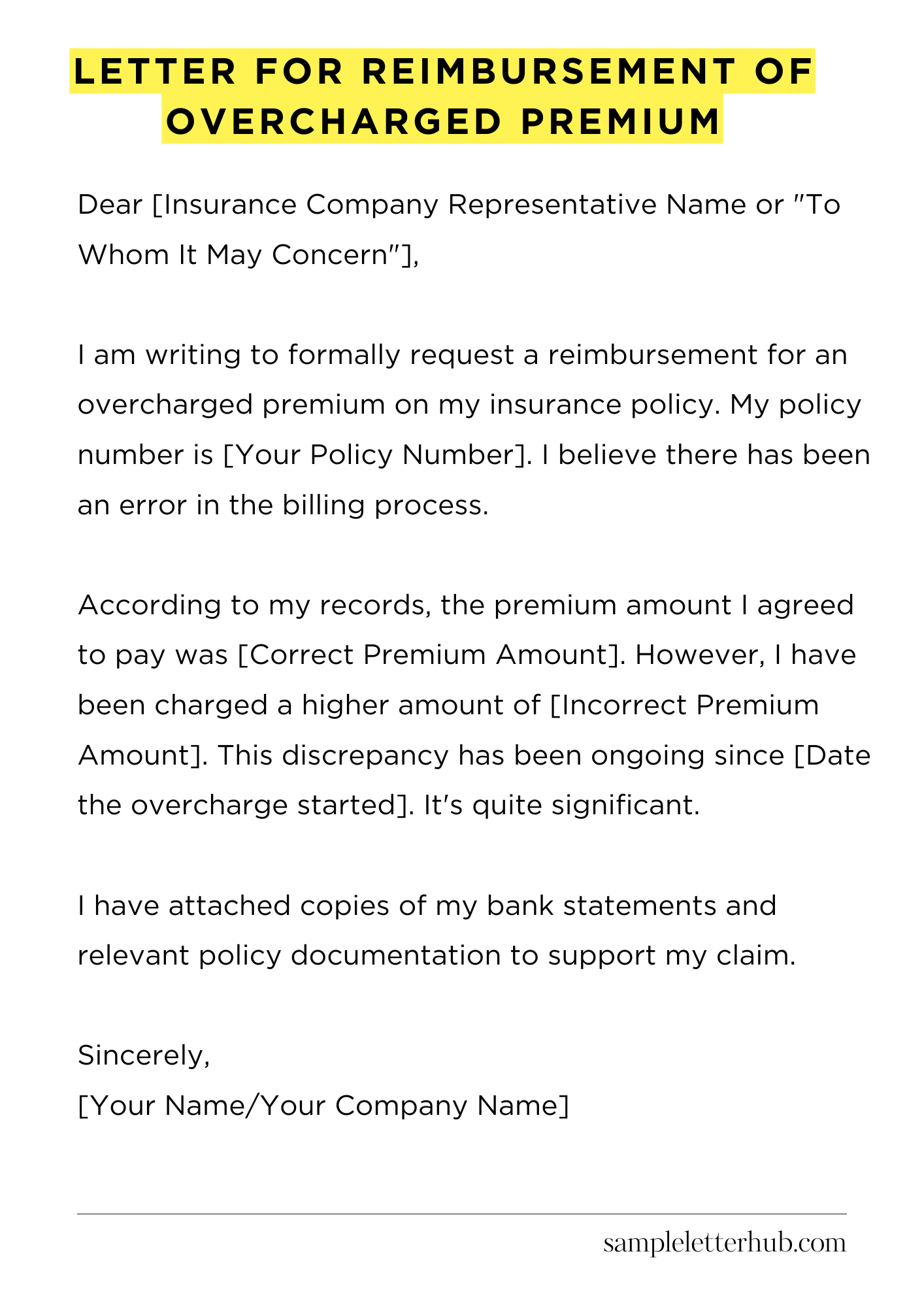
Dear [Insurance Company Representative Name or “To Whom It May Concern”],
I am writing to formally request a reimbursement for an overcharged premium on my insurance policy. My policy number is [Your Policy Number]. I believe there has been an error in the billing process.
According to my records, the premium amount I agreed to pay was [Correct Premium Amount]. However, I have been charged a higher amount of [Incorrect Premium Amount]. This discrepancy has been ongoing since [Date the overcharge started]. It’s quite significant.
I have attached copies of my bank statements and relevant policy documentation to support my claim. These documents clearly show the difference between the agreed-upon premium and the amount I have been charged. These will surely help you.
I kindly request that you review my account and process a reimbursement for the overcharged amount. The total overcharged amount is [Total Overcharged Amount]. I would appreciate it if you could credit this amount to my account as soon as possible. Please note the amount is important to me.
I look forward to your prompt attention to this matter and a swift resolution. I would appreciate it if you could notify me once the reimbursement has been processed. I hope it won’t take too long.
Thank you for your time and assistance.
Sincerely,
[Your Name/Your Company Name]
How to Write Letter for Reimbursement of Overcharged Premium
Are you staring at your insurance bill, bewildered by a seemingly excessive premium? You’re not alone. Sometimes, inadvertent billing errors can occur. But fret not! You have recourse.
A well-crafted letter can set the wheels in motion for reimbursement. Here’s a comprehensive guide to composing a compelling claim.
1. Commence with Cogent Correspondence (The Heading)
Your missive should begin with a professional tone. This is not a casual email. Use a formal business letter format. Include your full name, address, phone number, and email address in the upper left-hand corner.
On the right, date the letter, and follow with the recipient’s name, title, and the insurance company’s address. This sets a tone of professionalism, the groundwork for a successful claim.
2. Subject Line: The Decisive Declaration
Your subject line is your first impression; make it count. It should be concise and unequivocally state your purpose. Something along the lines of “Reimbursement Claim – Overcharged Insurance Premium – Policy Number: [Your Policy Number]” works perfectly. This immediately flags the letter’s significance.
3. Salutation: The Polite Prologue
Use a professional salutation. “Dear [Name of Claims Adjuster/Relevant Department]” or “To Whom It May Concern” is appropriate. Ensure this component fosters a respectful relationship from the beginning. This shows that you understand the formal aspects of correspondence.
4. The Core: Articulating Your Argument
This is the crux of your argument. Clearly explain why you believe you were overcharged. Detail the specific dates, amounts, and policy numbers involved.
Include concrete facts supported by concrete evidence. Reference your policy documentation and any related communications. Articulate this narrative clearly and succinctly, avoiding hyperbole. Be factual and objective.
5. Supporting Documentation: The Evidentiary Arsenal
Gather all supporting documentation to fortify your claim. This includes copies of your policy, previous bills, payment records, and any correspondence you’ve had with the insurance company.
Carefully list these attachments in your letter, using clear enumerations. For instance: “Attached are the following documents: 1. Copy of Policy Document, 2. Previous Bills, 3. Payment Receipts.” This demonstrates your diligence.
6. The Peroration: Demanding Redress
The closing paragraph must clearly state your request. Explicitly state the amount of reimbursement you are seeking. Specify how you would like to receive the funds (e.g., check, direct deposit).
Add a polite yet firm request for a prompt response within a reasonable timeframe (e.g., 30 days). Reiterate your policy number to facilitate expeditious processing.
7. Closing and Submission: The Final Flourish
Conclude with a professional closing, such as “Sincerely,” or “Respectfully,” followed by your full name and signature. If you’re sending the letter via postal mail, print a hard copy, sign it, and keep a copy for your records.
Consider sending it via certified mail with a return receipt requested. This provides proof of delivery. Follow up within the specified timeframe if you don’t receive a response. Persist and remain professional.
FAQs about Letter for Reimbursement of Overcharged Premium
What is the primary purpose of a letter for reimbursement of an overcharged premium?
The primary purpose of this letter is to formally request a refund from an insurance provider or other entity for an incorrect or excessive premium payment. It serves as a written record of the claim, outlining the specific details of the overcharge and providing supporting documentation to justify the request.
What information should be included in a letter requesting reimbursement of an overcharged premium?
A comprehensive letter should include the policyholder’s name, policy number, date of the overcharge, the amount overcharged, the reason for the overcharge (e.g., incorrect rate, duplicate billing), and supporting documentation such as copies of bills, payment records, and any relevant policy documents. Contact information and a clear request for reimbursement are also essential.
What types of documentation are typically required to support a claim for an overcharged premium?
Supporting documentation can vary but typically includes copies of invoices or bills that show the overcharge, payment records (bank statements, receipts, canceled checks) to confirm the payment, the original insurance policy or agreement, and any correspondence that relates to the premium or billing. Any communication regarding the error should also be attached.
How should the letter for reimbursement be delivered, and what is the expected response time?
The letter should ideally be sent via certified mail with return receipt requested to provide proof of delivery. It can also be sent via email if the insurance provider allows.
The expected response time varies depending on the provider, but it’s generally within 30-60 days. Checking the insurance policy for the terms and conditions regarding claims submission is recommended.
What steps should be taken if the reimbursement request is denied?
If the reimbursement request is denied, the policyholder should review the denial letter carefully to understand the reasons for the rejection.
They can gather additional supporting evidence, file an appeal, or consider alternative dispute resolution methods like mediation or arbitration as outlined in the policy. As a last resort, legal action may be considered if the overcharge is significant.
Related:
Resignation letter due to rude boss
Resignation letter moving to another state
Resignation letter due to illness of family member
Resignation letter due to study