

Dealing with insurance premiums can be tricky. Sometimes, you might notice an error. This is where a correction request letter for wrong premium rate comes in handy. Its purpose? To formally inform your insurance provider about the mistake. You request them to fix the premium rate. This ensures you are paying the correct amount.
We understand writing these letters can feel daunting. That’s why we’re here to help! We’ve prepared several templates, examples, and samples of a correction request letter for wrong premium rate. Consider it your toolkit. These samples will guide you. You can easily adapt them to your specific situation.
Our goal is simple. We aim to make the process smoother. With our ready-made letter samples, you can confidently communicate with your insurance company. Say goodbye to confusion. Writing a correction request letter will be a breeze. Get ready to write your own letter.
[Your Name]
[Your Address]
[Your Phone Number]
[Your Email Address]
[Date]
[Insurance Company Name]
[Insurance Company Address]
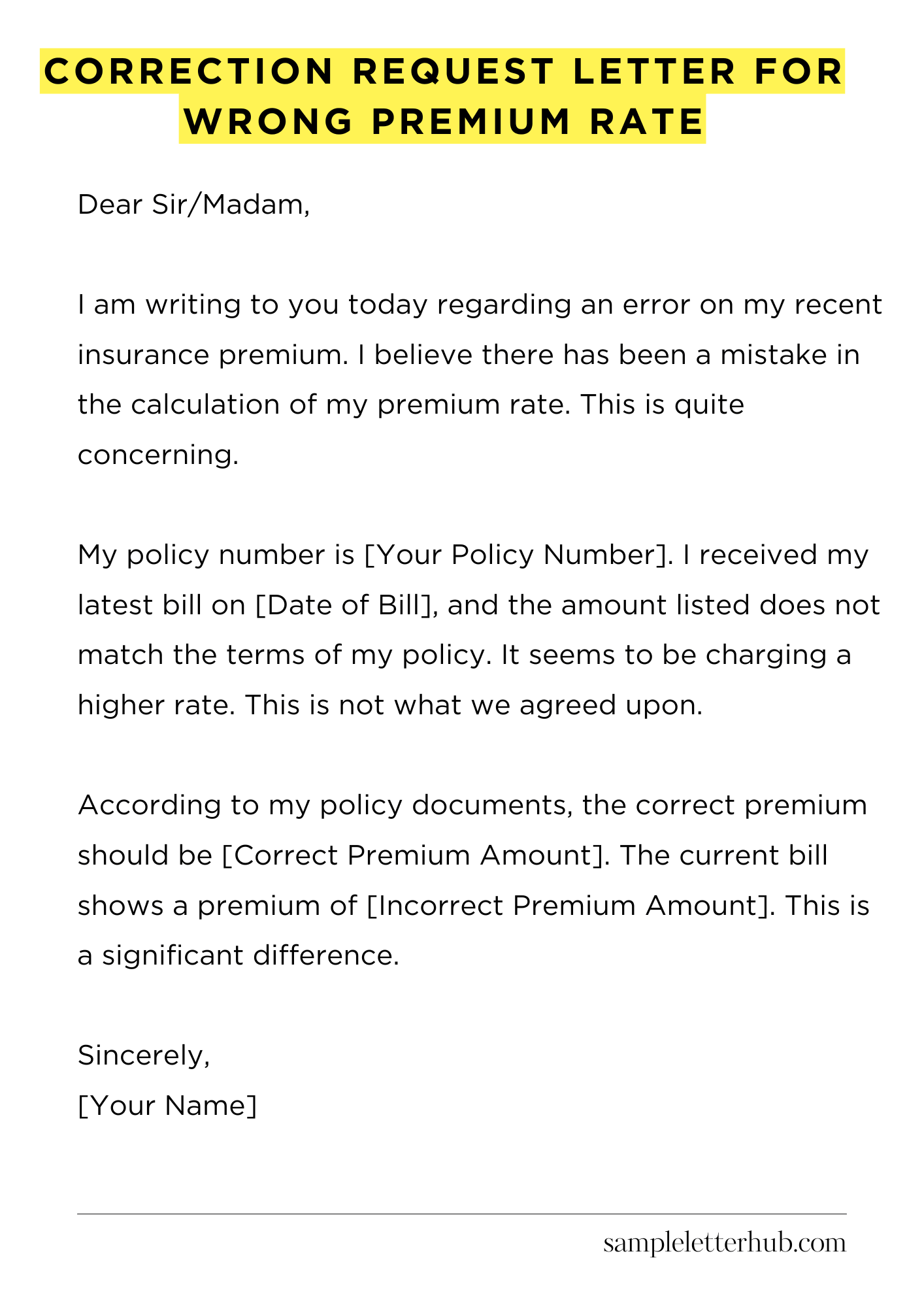
Dear Sir/Madam,
I am writing to you today regarding an error on my recent insurance premium. I believe there has been a mistake in the calculation of my premium rate. This is quite concerning.
My policy number is [Your Policy Number]. I received my latest bill on [Date of Bill], and the amount listed does not match the terms of my policy. It seems to be charging a higher rate. This is not what we agreed upon.
According to my policy documents, the correct premium should be [Correct Premium Amount]. The current bill shows a premium of [Incorrect Premium Amount]. This is a significant difference.
I have reviewed my policy carefully. I can confirm that my circumstances have not changed since the policy was initiated. Everything is in order.
I kindly request that you review my account and investigate this discrepancy promptly. Please correct the premium to the accurate amount. I would appreciate it if you could provide me with a revised bill reflecting the corrected rate. The matter needs to be resolved quickly.
I have attached a copy of my policy documents for your reference. These documents should clarify the correct premium rate. I look forward to your prompt attention to this matter and a swift resolution.
Thank you for your time and assistance with this.
Sincerely,
[Your Name]
How to Write Correction Request Letter for Wrong Premium Rate
1. Initiate: Laying the Groundwork
Commence your missive with a formal salutation. Address the letter to the relevant department or, if known, the specific claims adjuster or underwriter.
This personal touch demonstrates attentiveness. It is the initial act in the process of rectifying the premium anomaly. Clearly state the purpose of your letter in the opening paragraph: to formally request a correction to the erroneously billed premium.
2. Identify and Specify: Pinpointing the Discrepancy
Precise identification is paramount. Begin by furnishing essential details about the policy: the policy number, the effective date, and the insured’s name.
Proceed to explicitly delineate the nature of the error. Articulate the incorrect premium rate, contrasting it with the rate you believe to be accurate. Provide cogent reasoning as to why the incorrect rate was applied.
3. Data-driven Justification: Presenting Supporting Documentation
This is the cornerstone of your argument. Fortify your claim with irrefutable evidence. Enclose all supporting documentation: copies of the original policy documents, any applicable rate quotes, and any relevant communication confirming the correct premium. The more substantial the supporting materials, the stronger your position becomes. Think of it as constructing a robust case.
4. Concision and Clarity: Mastering the Art of Expression
The tone of the letter should be professional and polite. Maintain a clear and concise writing style. Avoid jargon or convoluted phrasing.
Use direct, unambiguous language that leaves no room for misinterpretation. Succinctness increases the likelihood of a positive outcome. Make it as easy as possible for the recipient to grasp the crux of your assertion.
5. The Desired Outcome: Articulating the Remedy
Specify the precise correction you seek. Explicitly state the desired adjustment to the premium. Request a revised billing statement reflecting the correct premium rate. Outline any further actions you expect the recipient to undertake to rectify the issue. The clarity of your desired outcome streamlines the resolution process.
6. Reinforce and Reiterate: Summarizing the Plea
Conclude with a succinct summary. Reiterate the key points of your argument. Express your confidence in a prompt resolution. Include your contact information (phone number, email address) to facilitate communication. This reinforces your commitment to the issue’s resolution.
7. The Parting Salutation: Closing with Decorum
End with a professional closing, such as “Sincerely” or “Respectfully.” Sign your name and, if appropriate, your title. Retain a copy of the letter and all supporting documentation for your records. This ensures you possess a full record of your correspondence. Good luck in your quest for premium correction!
FAQs about Correction Request Letter for Wrong Premium Rate
What is a correction request letter for a wrong premium rate, and when is it needed?
A correction request letter for a wrong premium rate is a formal written communication sent to an insurance provider or financial institution to dispute and rectify an incorrect premium charge.
It’s needed when you’ve been billed a premium that doesn’t align with your policy terms, coverage, or the agreed-upon rates. This could involve discrepancies in the coverage type, incorrect risk assessment, or errors in applying discounts.
What information should I include in a correction request letter for a wrong premium rate?
A well-structured letter should include your policy details (policy number, effective dates), the specific error you’re disputing (e.g., incorrect rate, overcharge amount, the period affected), clear supporting documentation (copies of your policy, previous bills, any evidence of discounts or agreements), and a clear request for correction.
Explicitly state the desired outcome (e.g., a refund, a corrected bill, or adjustment to the ongoing premium) and include your contact information for easy follow-up.
How do I write a correction request letter for a wrong premium rate?
Start by clearly identifying the purpose of the letter in the subject line (e.g., “Correction Request for Incorrect Premium”). Then, begin with a formal salutation. In the body, detail the error, referencing specific policy terms and supporting documents. Be polite but firm, and maintain a professional tone.
Close with a clear statement of your requested action and your contact information. Proofread thoroughly before sending the letter, and consider sending it via certified mail with return receipt requested for proof of delivery.
What supporting documentation should I attach to the correction request letter?
The documentation you provide should directly support your claim. This may include a copy of your policy documents that clarify the correct coverage and premiums, any previous bills that show a different rate, any documentation about discounts you were supposed to receive.
How long should I expect to wait for a response to my correction request letter, and what should I do if I don’t hear back?
The response time can vary depending on the insurance provider and the complexity of the issue, but typically, you should expect a response within 30 to 60 days. If you don’t receive a response within a reasonable timeframe (or if the response isn’t satisfactory), follow up with a phone call or a second letter, referencing the original request and the date it was sent.
If you’re still not satisfied, consider escalating the issue to a supervisor, filing a formal complaint with the insurance company’s internal dispute resolution process, or contacting your state’s insurance regulatory agency.
Related:
Resignation letter due to rude boss
Resignation letter moving to another state
Resignation letter due to illness of family member
Resignation letter due to study
Resignation letter due to long commute