

Have you ever been charged incorrectly for your policy renewal? It happens more often than you think. A refund request letter after policy renewal error is crucial. It’s your official way to ask for a refund. It helps you get back money you weren’t supposed to pay.
Writing this letter can seem daunting. No need to worry! We have you covered. This article offers helpful samples and templates. These are for a refund request letter after policy renewal error. Use these to craft your own. It will make things easier.
We will provide clear examples. They are easy to adapt. You can tailor them to your specific situation. Let us help you get your money back!
[Your Name]
[Your Address]
[Your Phone Number]
[Your Email Address]
[Date]
[Insurance Company Name]
[Insurance Company Address]
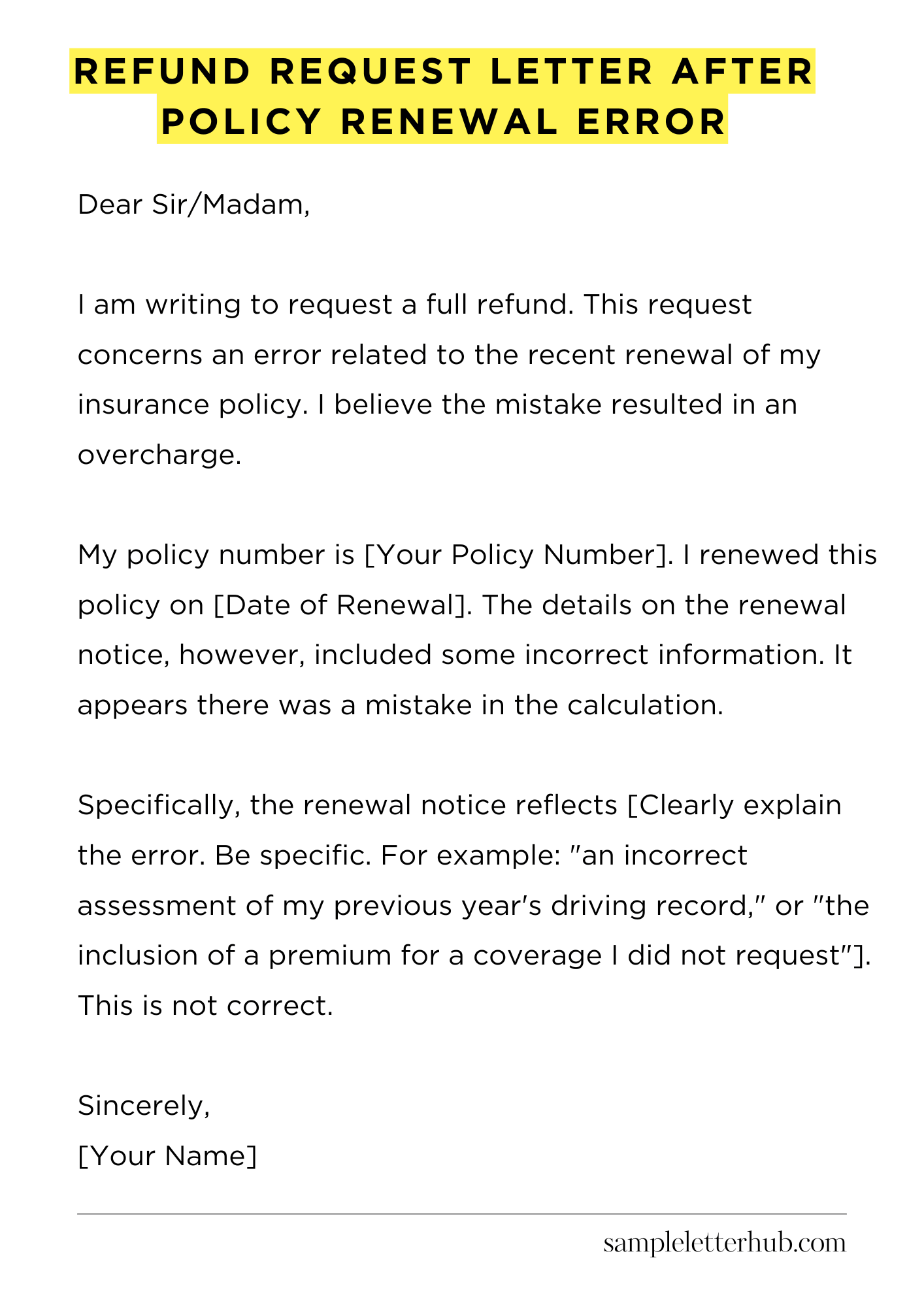
Dear Sir/Madam,
I am writing to request a full refund. This request concerns an error related to the recent renewal of my insurance policy. I believe the mistake resulted in an overcharge.
My policy number is [Your Policy Number]. I renewed this policy on [Date of Renewal]. The details on the renewal notice, however, included some incorrect information. It appears there was a mistake in the calculation.
Specifically, the renewal notice reflects [Clearly explain the error. Be specific. For example: “an incorrect assessment of my previous year’s driving record,” or “the inclusion of a premium for a coverage I did not request”]. This is not correct. Because of this error, I was charged a higher premium than I should have been.
I have attached a copy of my renewal notice and any supporting documents that show the correct information. The documents clearly demonstrate the mistake.
I kindly request a complete refund of the overcharged amount. Could you please review my policy and these documents to rectify this issue promptly? I would appreciate it if the refund could be processed within [Number] business days.
Please let me know if you require any further information from my side. I look forward to your quick response and resolution of this matter.
Thank you for your time and attention to this. I appreciate your prompt assistance.
Sincerely,
[Your Name]
How to Write Refund Request Letter After Policy Renewal Error
Encountering a policy renewal error can be frustrating, especially when it leads to unwarranted charges. The key to retrieving your funds lies in a well-crafted refund request letter. Here’s a comprehensive guide to composing a compelling missive that increases your chances of a favorable outcome.
1. Commence with a Cogent Opening
Your opening gambit is crucial. Begin by clearly stating your intent: to request a refund due to a policy renewal error. Provide your full name, policy number, and contact information. This upfront clarity immediately orients the recipient and establishes the essence of your claim. Keep it succinct and professional.
2. Detail the Deceptive Incident: A Chronological Recount
Next, meticulously outline the specifics of the error. Include dates, times, and any relevant documentation, such as emails or previous policy documents. Be objective; avoid emotionally charged language.
Present the facts in a chronological order, making it straightforward for the recipient to grasp the sequence of events. The more concrete details you provide, the stronger your case.
3. Pinpoint the Pertinent Error: An Articulate Explanation
Explicitly identify the nature of the renewal error. Was it an incorrect premium calculation? An unauthorized policy change? Did it involve a duplicated charge? Clearly articulate the discrepancy. Refer to the terms and conditions of your policy where relevant. This section anchors your argument in fact, showing that you are informed and paying attention to detail.
4. Assemble Supporting Paraphernalia: The Supplemental Documentation
Compile all supporting documents. Include copies of your original policy, previous bills, any communication related to the renewal, and evidence of the incorrect charge. Make sure these are easily accessible and referenced within your letter. This reinforces your claim and adds to your credibility. Always retain copies for your records.
5. Formulate a Direct and Concise Request: The Stipulated Remedy
Clearly state the refund amount you are requesting. Be precise. Indicate how you’d prefer to receive the refund (e.g., check, bank transfer). State a reasonable timeframe for processing the refund, typically 14-30 days. This makes your expectations explicit and adds a sense of urgency. Keep your tone firm but courteous.
6. Conclude with a Professional Finale: The Courteous Close
End your letter on a professional note. Express your hope for a swift resolution. Thank the recipient for their time and consideration. Reiterate your contact information. A well-crafted closing leaves a positive final impression. A simple, “Thank you for your prompt attention to this matter” works well.
7. Refine and Proofread: The Final Audit
Before dispatching your letter, meticulously proofread it for any grammatical errors, spelling mistakes, and factual inaccuracies. Ensure that the tone is professional, the language is clear, and all necessary details are included.
Consider having a second pair of eyes review your letter. A polished letter significantly increases your credibility and the likelihood of a positive response. Make sure to keep a copy for your files.
FAQs about Refund Request Letter After Policy Renewal Error
What is the primary reason for sending a refund request letter after a policy renewal error?
The primary reason for sending a refund request letter after a policy renewal error is to formally request a return of funds paid due to an incorrect calculation, overcharge, or other mistake made during the policy renewal process.
This letter serves as documented proof of the error and the requested remedy, ensuring a clear record for both the policyholder and the insurance provider.
What specific details should be included in a refund request letter after a policy renewal error?
A well-crafted refund request letter should include the policyholder’s full name, policy number, and contact information. It must clearly state the nature of the error (e.g., incorrect premium calculation, duplicate payment, wrong coverage), the amount of the overcharge, and the desired refund amount.
Provide supporting documentation such as previous policy documents, payment receipts, and any communication regarding the error. Finally, it should specify the preferred method for receiving the refund (e.g., check, bank transfer).
What is the typical timeframe for receiving a refund after submitting a request letter?
The timeframe for receiving a refund varies depending on the insurance provider and the complexity of the error. However, it is reasonable to expect a response within 30-60 days.
Factors that may impact the processing time include the need for internal investigation, the volume of requests the insurer is handling, and the accuracy and completeness of the documentation provided with the request.
It is often wise to follow up with the insurance company if a refund isn’t received within the initially promised time frame.
What if the insurance company denies the refund request after a policy renewal error?
If the insurance company denies the refund request, review the denial letter carefully. It should provide a reason for the denial. If you disagree with the reason, gather additional evidence to support your claim (e.g., quotes, policy documents).
You can escalate the issue by contacting the company’s customer service department or filing a formal complaint. In some cases, it may be necessary to involve a state insurance regulator or seek legal advice if the matter remains unresolved.
How can I prevent policy renewal errors in the future?
To minimize the risk of future policy renewal errors, review your policy details carefully each year. Compare renewal quotes with previous policies to identify discrepancies.
Maintain clear records of all payments, policy documents, and communications with the insurer. If you notice any inconsistencies, contact your insurance provider immediately to clarify the information before the renewal is finalized. Regularly update your contact information and policy details to ensure accurate record-keeping.
Related:
Resignation letter due to rude boss
Resignation letter moving to another state
Resignation letter due to illness of family member
Resignation letter due to study
Resignation letter due to long commute