

Policy adjustments can sometimes mean you’re owed money. A letter for refund after policy adjustment is a formal request. It asks an insurance company or service provider for a refund. The purpose is to reclaim funds due to changes in your policy.
Dealing with paperwork can be a headache. That’s why we’re here. We’ve got you covered. We’ll share letter for refund templates. We have refund request letter samples. Our policy adjustment refund letter examples are easy to use.
Need to write a refund letter? You’re in luck. This guide simplifies the process. Access these sample letters to write your own. Get your refund after policy adjustment faster. Use our templates and examples to craft your perfect refund request!
[Your Name/Company Name]
[Your Address]
[Your Phone Number]
[Your Email Address]
[Date]
[Insurance Company Name]
[Insurance Company Address]
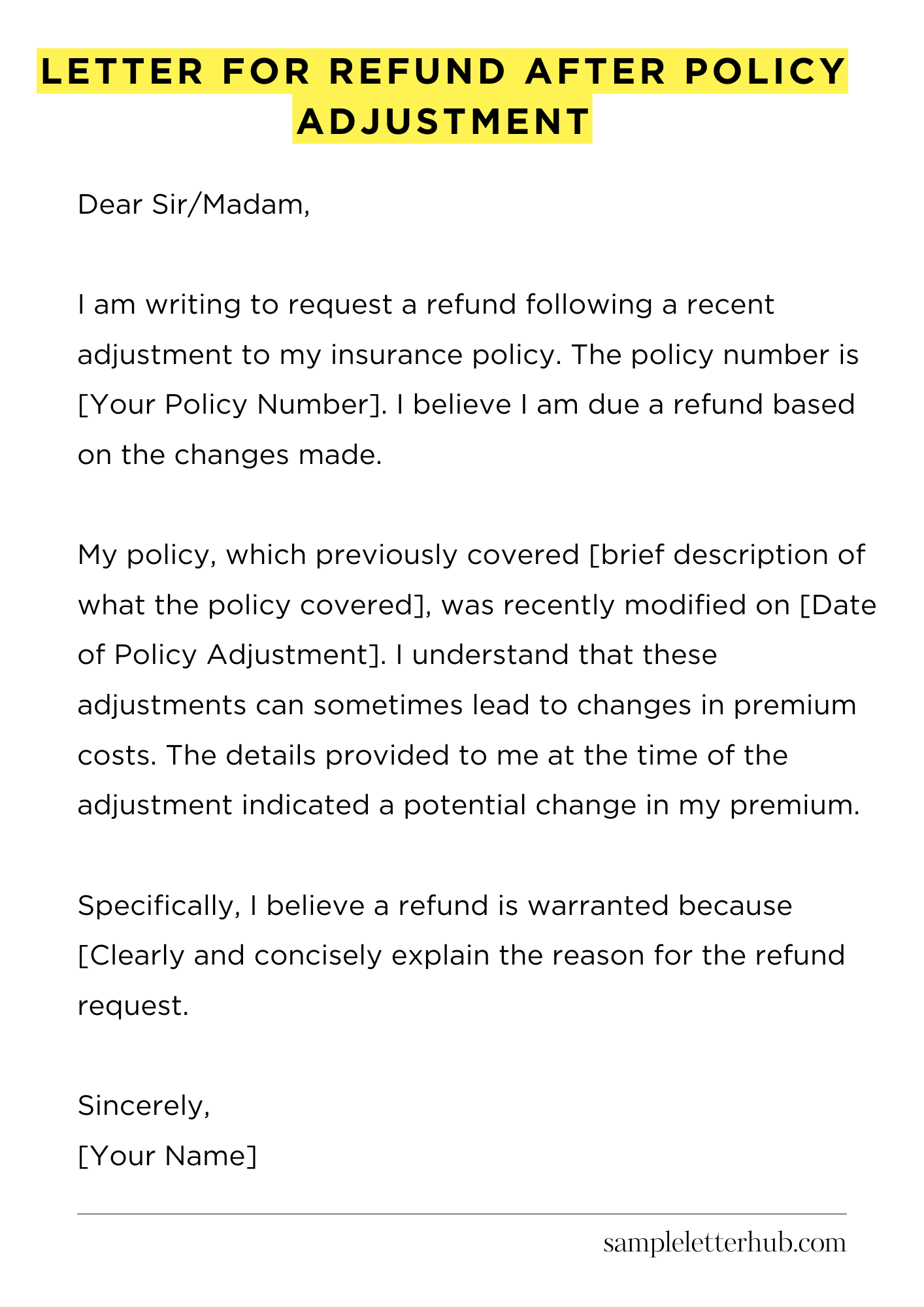
Dear Sir/Madam,
I am writing to request a refund following a recent adjustment to my insurance policy. The policy number is [Your Policy Number]. I believe I am due a refund based on the changes made.
My policy, which previously covered [brief description of what the policy covered], was recently modified on [Date of Policy Adjustment]. I understand that these adjustments can sometimes lead to changes in premium costs. The details provided to me at the time of the adjustment indicated a potential change in my premium.
Specifically, I believe a refund is warranted because [Clearly and concisely explain the reason for the refund request. Be specific about the reason, mentioning the initial agreement and the adjustment]. This discrepancy directly impacts the amount I’ve already paid.
I have attached copies of [List any supporting documents you are including, e.g., the original policy documents, the policy adjustment notification, and any relevant receipts]. These documents should help clarify my request. I hope they provide the information needed for a prompt review.
I would appreciate it if you could review my policy and process the appropriate refund. Please let me know the estimated refund amount and the expected timeframe for receiving the funds. I look forward to your quick response on the matter. You can reach me by phone or email. Thank you for your time and attention to this matter.
Sincerely,
[Your Name]
How to Write Letter for Refund After Policy Adjustment
Navigating the labyrinthine world of insurance policies can be a Herculean task. Sometimes, policy adjustments occur, impacting your premiums. These changes may warrant a refund, and a well-crafted letter is your key to unlocking it. Let’s unravel the intricacies of composing a compelling refund request.
1. Commence with Decorum: The Salutation and Introductory Paragraph
Begin your missive with a formal salutation. Employ the appropriate title, addressing the individual or department responsible for handling policy adjustments.
For instance, “Dear Claims Adjuster” or “To Whom It May Concern.” The initial paragraph should succinctly state your purpose: to request a refund due to a policy modification. Include your policy number and the date the adjustment took effect. Avoid rambling; brevity is your ally.
2. Explicate the Precipitating Circumstance: Detailing the Adjustment
Proceed to elucidate the specifics of the policy alteration. Precisely describe the modification and its impact on your premium. Mention the original premium, the new premium, and the difference.
This necessitates precision. Include dates, specific clauses, and any documentation supporting your claim. The more cogent your explanation, the stronger your case.
3. Substantiate Your Proffer: Evidence is Paramount
Now, provide concrete evidence to bolster your request. Attach copies of relevant documents, such as the policy schedule, notices of adjustment, and any correspondence you’ve received.
Highlight key information with a highlighter, if appropriate. Ensure all attachments are legible and clearly referenced within your letter. This step is indispensable, as it provides undeniable credence to your claim.
4. Articulate the Requested Reimbursement: The Precise Demand
This section is where you clearly specify the refund amount you are seeking. Calculate the sum meticulously, outlining how you arrived at that figure. State whether you prefer the refund to be a check or a credit to your account. Include your preferred method of payment along with any pertinent account details. Clarity here avoids potential confusion.
5. Cite Pertinent Policy Provisions: Leverage the Fine Print
Thoroughly examine your insurance policy for any clauses related to refunds or premium adjustments. Quote these clauses verbatim in your letter, demonstrating your understanding of your rights. Referencing these provisions strengthens your argument. Remember, insurers are bound by their policies.
6. The Concluding Admonition: A Professional Close
Conclude your letter with a professional and assertive closing. Thank the recipient for their time and consideration. Reiterate your contact information, including your phone number and email address, for follow-up purposes.
State a reasonable timeframe for a response. For example, “I look forward to your prompt response within fourteen business days.” A clear timeframe promotes timely attention.
7. The Ambit of Examination: Proofreading and Delivery
Before dispatching your letter, proofread it meticulously. Check for grammatical errors, typos, and factual inaccuracies. Ensure the tone is polite but firm. Make copies of all documentation for your records.
Send the letter via certified mail with return receipt requested. This provides proof of delivery and confirmation of receipt. Maintaining a diligent record increases your chances of a successful outcome.
FAQs about Letter for Refund After Policy Adjustment
What information should I include in the letter?
Your refund request letter should include your full name, policy number, contact information (address, phone number, and email), and a clear statement requesting a refund due to a policy adjustment.
Be sure to specify the date of the adjustment, the reason you believe a refund is due (e.g., premium reduction, coverage change), and the amount of the refund you are requesting. It’s also helpful to attach any supporting documentation, such as the policy adjustment notice.
How do I determine the amount of the refund I am owed?
The refund amount is usually calculated based on the difference in premiums paid before and after the policy adjustment. Refer to your policy documents and the adjustment notice to understand the terms.
If the adjustment resulted in a lower premium, the refund may cover the difference from the date the adjustment took effect. It’s best to contact your insurance provider to clarify the exact calculation if you are unsure.
Where do I send the letter, and how should I send it?
The letter should be sent to the insurance company’s claims department or the address specified in your policy documents or on the policy adjustment notice. It’s recommended to send the letter via certified mail with return receipt requested.
This provides proof that the letter was delivered and received by the insurance company. Keeping a copy of the letter and the delivery confirmation is crucial for your records.
What happens after I submit the letter?
After you submit your letter, the insurance company will review your request. They may contact you for additional information or clarification. The timeframe for processing the refund can vary, but generally, expect a response within a few weeks.
If your request is approved, the refund will be issued according to the insurance company’s standard procedures, which may include a check, direct deposit, or a credit to your account.
What if my refund request is denied?
If your refund request is denied, the insurance company should provide a written explanation for the denial. Review the explanation carefully to understand the reasons.
You may have the option to appeal the decision by providing additional information or evidence. Contact your insurance provider to find out the appeal process. If the issue remains unresolved, you could also consider seeking assistance from your state’s insurance department.
Related:
Resignation letter due to rude boss
Resignation letter moving to another state
Resignation letter due to illness of family member
Resignation letter due to study