

Need your insurance premium re-evaluated? A letter to request recalculation of insurance premium is the perfect tool. This letter formally asks your insurance provider to re-assess the amount you pay. It highlights changes in your situation that might warrant a lower premium. The main goal is to potentially save money on your insurance coverage.
We’ve got you covered. This article offers helpful letter to request recalculation of insurance premium templates. Need a sample letter? We have many. You’ll find different examples suitable for various scenarios. Easily adapt them to fit your specific needs.
Writing a persuasive letter is now simple. Forget staring at a blank page. These sample letters will guide you. Craft the perfect message for your insurance company. Get started and potentially lower your insurance premium today!
[Your Name/Your Company Name]
[Your Address]
[Your Phone Number]
[Your Email Address]
[Date]
[Insurance Company Name]
[Insurance Company Address]
Dear Sir/Madam,
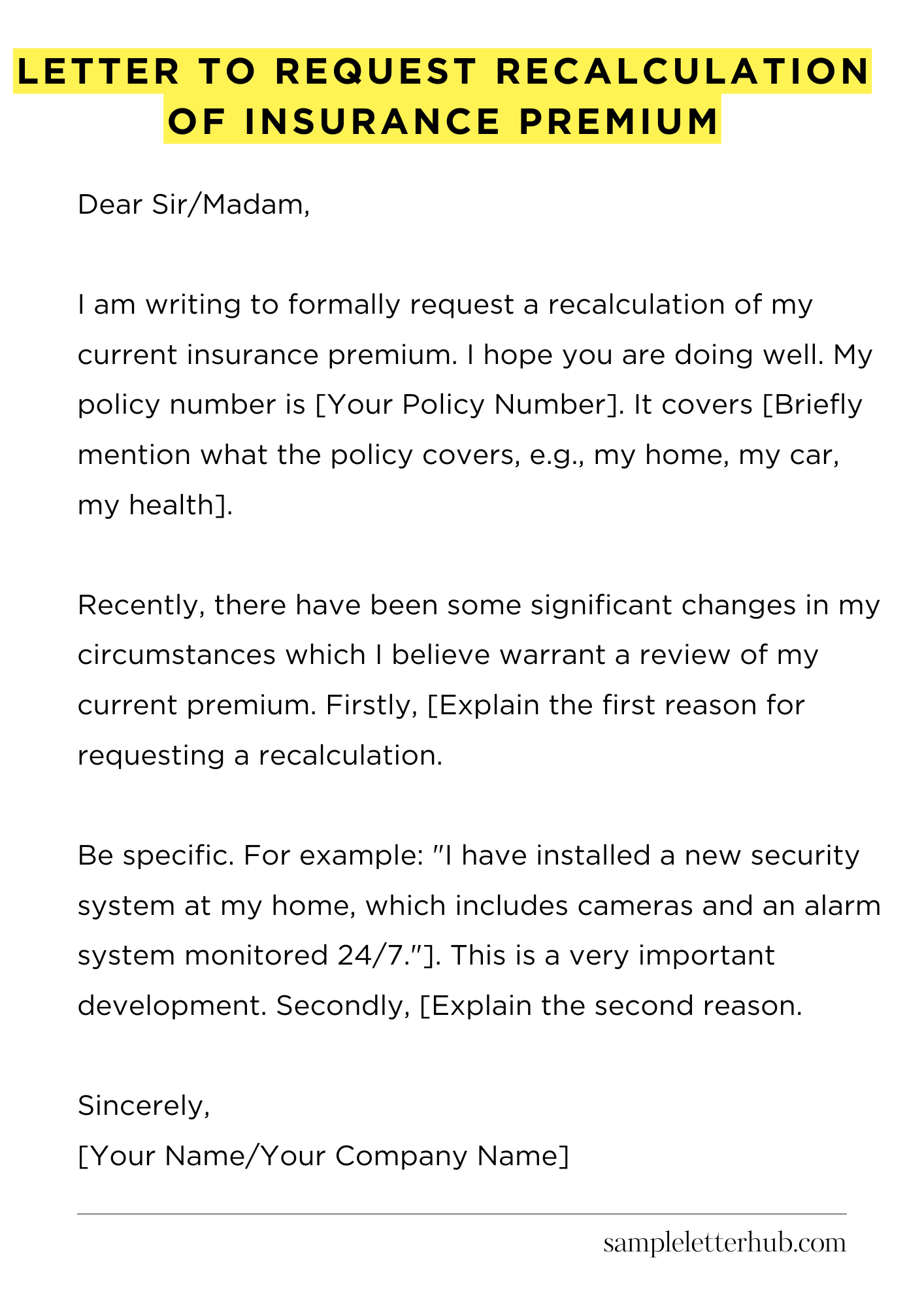
I am writing to formally request a recalculation of my current insurance premium. I hope you are doing well. My policy number is [Your Policy Number]. It covers [Briefly mention what the policy covers, e.g., my home, my car, my health].
Recently, there have been some significant changes in my circumstances which I believe warrant a review of my current premium. Firstly, [Explain the first reason for requesting a recalculation.
Be specific. For example: “I have installed a new security system at my home, which includes cameras and an alarm system monitored 24/7.”]. This is a very important development. Secondly, [Explain the second reason. For example: “I have also changed my job and now commute a much shorter distance, reducing my annual mileage considerably.”].
I believe these changes may make my risk profile lower than it was when the policy was originally issued. Therefore, I would appreciate it if you could recalculate my insurance premium to reflect these updated factors. Please consider this request carefully.
I have attached supporting documentation [Mention what documents you are attaching, e.g., “copies of the security system installation invoice and a statement from my employer confirming my new commute”]. These documents should help in your evaluation. I’m hoping this helps you with your review.
Please let me know the process for this recalculation and when I can expect a response. You could call or write me back. I can be reached at the phone number and email address listed above.
Thank you for your time and attention to this matter.
Sincerely,
[Your Name/Your Company Name]
How to Write Letter to Request Recalculation of Insurance Premium
Disputing an insurance premium can feel daunting. However, armed with the correct approach, you can construct a compelling and effective letter that may result in a favorable recalculation. This guide elucidates the essential components for crafting a letter specifically tailored to request a recalculation of your insurance premium.
1. Commence with an Impeccable Salutation
The commencement is crucial; it sets the tone. Begin with a formal salutation. Address the letter to the appropriate department or individual at your insurance provider. You might consider using “Dear Claims Adjuster,” or “Dear Insurance Representative,” followed by the specific name if known. This immediately establishes a professional ambiance.
2. Subject Line: Precision is Paramount
A concise and unambiguous subject line is vital. It expedites the processing of your communication. Employ a subject line that clearly states your purpose. Examples include: “Request for Recalculation of Insurance Premium – Policy Number [Your Policy Number]” or “Dispute of Insurance Premium – Policy Number [Your Policy Number].” This instantly alerts the recipient to the subject matter.
3. Clearly Articulate Your Grievance
The core of your letter should precisely explain why you believe the premium requires recalculation. Include specific details. Indicate the discrepancy in the premium. Reference any supporting evidence, such as policy documents or previous communications.
Be factual and avoid emotional language. For instance, explain that you believe an error occurred, specifically pointing out that the premium is higher than expected according to your coverage guidelines. This is the cornerstone of your persuasive argument.
4. Provide Supporting Documentation: The Ammunition of Your Argument
Enclose all relevant documentation. This is critical for substantiating your claims. Include copies of any documents that support your request. Examples are quotes from other insurance providers.
Other examples include, a certificate of no claims bonus, or any other paperwork that may clarify your situation. Make sure to clearly reference these documents within your letter, such as: “Attached, please find a copy of [Document Name], which demonstrates…” This acts as solid proof.
5. Outline the Desired Recourse
Explicitly state the desired outcome. Clearly indicate the recalculation you are seeking. Specify the revised premium amount, if known. Request a written response confirming the recalculated premium and any adjustments. Clarity here mitigates ambiguity and facilitates a swift resolution. This will help them understand what you want.
6. Conclude with a Professional Closing
End your letter with a professional closing. Use a formal sign-off, such as “Sincerely,” or “Respectfully,” followed by your full name and contact information. Your name, address, phone number, and email address should be easily visible. This ensures that the recipient can readily contact you. This enhances the credibility of your letter.
7. Proofread and Iterate: The Final Polish
Before dispatching your letter, meticulously proofread it for any grammatical errors or typos. Ensure the tone is professional, and the language is clear. Consider having a second party review the letter for objectivity. Make multiple passes. A well-crafted and polished letter bolsters your credibility and increases the probability of a successful outcome.
FAQs about Letter to Request Recalculation of Insurance Premium
What information should I include in my letter requesting a premium recalculation?
Your letter should clearly state your policy number, the specific reason for requesting a recalculation (e.g., change in circumstances like a new address, vehicle upgrade or downgrade, removal of a driver), and the effective date of the change.
Include supporting documentation such as proof of address, details of vehicle modifications, or any other information relevant to your request. Be sure to provide your contact information, including your full name, address, phone number, and email address for easy communication.
What are the common reasons for requesting a recalculation?
Common reasons include a change in address (especially if you moved to a different risk area), a change in vehicle (e.g., buying a different car), removal of a driver from the policy, changes in the usage of the insured item (e.g., using a vehicle for business purposes instead of personal use), improvement in your driving record.
How do I submit the letter, and what is the typical response time?
Most insurance companies allow you to submit the letter via mail, email, or through their online portal. Some insurers may even provide a dedicated form for premium recalculation requests.
Check your policy documents or contact your insurer to determine the preferred method. Response times vary, but you should typically receive a response within a few weeks. Keep a copy of the letter and any supporting documentation for your records.
What happens if the insurance company approves my request for recalculation?
If your request is approved, the insurance company will adjust your premium. This may result in a refund if you overpaid, or a revised payment schedule going forward. You will receive a notification from your insurance provider, usually in writing, outlining the new premium amount and any changes to your policy details. They may also send an updated policy schedule.
What if my request for recalculation is denied? What are my options?
If your request is denied, the insurance company should provide a detailed explanation of the reason. If you disagree with the decision, you have a few options.
You can gather additional supporting documentation and resubmit your request, appeal the decision to a higher level within the insurance company, or seek assistance from your state’s insurance regulatory agency. You may also consult an independent insurance agent or attorney for advice.
Related:
Resignation letter due to rude boss
Resignation letter moving to another state
Resignation letter due to illness of family member
Resignation letter due to study