

An Insurance Premium Error Correction Letter is a formal document. Its purpose is to fix mistakes in your insurance bills. You send it to your insurance company. This letter requests a correction to your premium. It aims to resolve billing discrepancies.
Are you struggling to write a premium error correction letter? We understand it can be tricky. Don’t worry, we’ve got you covered. We’ll provide you with handy insurance premium error correction letter templates. These templates offer practical examples. They help you craft your own insurance letters with ease.
We’ll share various insurance premium error correction letter samples. These examples cover different scenarios. Whether it’s an overcharge or a wrong coverage detail, we have a sample. Simplify your insurance communication. Use our user-friendly guide and templates.
[Your Name/Company Name]
[Your Address]
[Your Phone Number]
[Your Email Address]
[Date]
[Insurance Company Name]
[Insurance Company Address]
Subject: Correction Request for Insurance Premium – Policy Number [Your Policy Number]
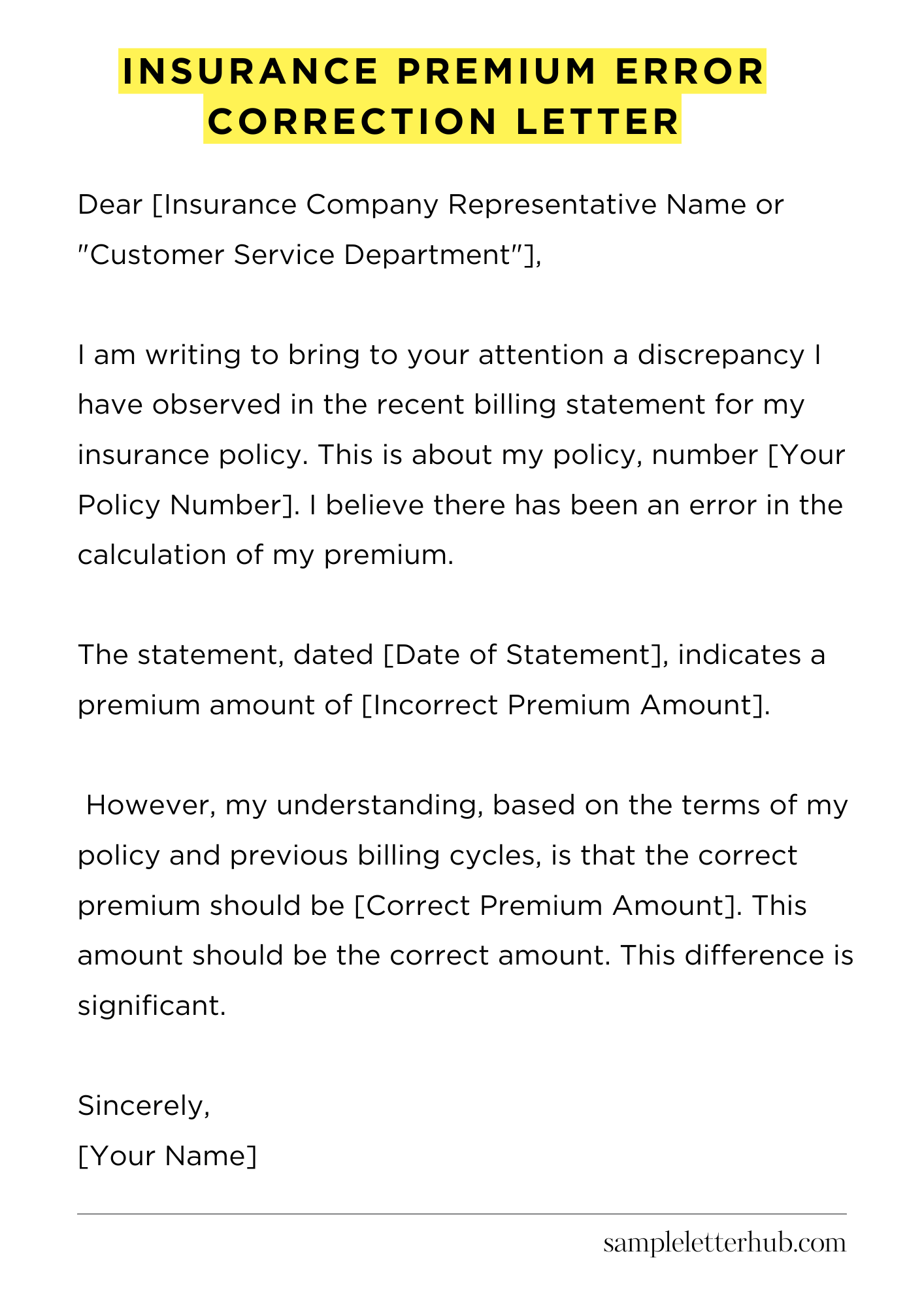
Dear [Insurance Company Representative Name or “Customer Service Department”],
I am writing to bring to your attention a discrepancy I have observed in the recent billing statement for my insurance policy. This is about my policy, number [Your Policy Number]. I believe there has been an error in the calculation of my premium.
The statement, dated [Date of Statement], indicates a premium amount of [Incorrect Premium Amount]. However, my understanding, based on the terms of my policy and previous billing cycles, is that the correct premium should be [Correct Premium Amount]. This amount should be the correct amount. This difference is significant.
I have reviewed my policy documents and believe that the discrepancy may be due to [Briefly Explain the Potential Cause of the Error – e.g., an incorrect vehicle listed, an inaccurate coverage level, etc.]. Perhaps a mistake was made?
To assist in resolving this matter, I have attached copies of [Mention any supporting documents you are including – e.g., previous billing statements, the relevant section of your policy document, etc.]. I included these things in the email. These documents clearly support my claim.
I kindly request that you investigate this matter promptly and correct the premium accordingly. A corrected invoice would be helpful. Please confirm the revised premium and let me know how you plan to address the overpayment if applicable.
I look forward to hearing from you within [Number] business days regarding the resolution of this issue.
Thank you for your time and attention to this important matter.
Sincerely,
[Your Name]
How to Write Insurance Premium Error Correction Letter
Encountering a discrepancy in your insurance premium statement can be vexing. It’s a situation that demands a swift, decisive response. Writing a well-crafted letter to your insurance provider is often the most effective method for rectifying this.
Let’s delineate the steps required to compose a compelling and persuasive letter that yields the desired outcome: an accurate premium reflecting your policy and circumstances.
1. Initiate with Precision: The Salutation and Date
Begin your missive with a formal salutation. Employ “Dear [Insurance Company Name] Customer Service,” or the name of the designated recipient, if known.
Accuracy here is crucial; proper protocol communicates professionalism and enhances the chance of a favorable reception. Always include the current date; this establishes a crucial temporal reference. It helps in the process of tracking correspondence.
2. The Subject Line: A Succinct Synopsis
The subject line is not merely ancillary; it’s a vital element. It immediately alerts the recipient to the letter’s purpose. Something like “Subject: Premium Discrepancy – Policy Number [Your Policy Number]” provides instant clarity.
Keeping it concise and specific streamlines the process. This ensures swift attention from the concerned department.
3. Clearly Articulate the Error
In the opening paragraph, unequivocally state the nature of the error. Be direct. Provide precise details regarding the incorrect premium amount, comparing it to what you believe it should be. Specify the exact period the error encompasses.
For instance, “I am writing to dispute an overcharge on my premium statement for the period of [Date] to [Date]. The premium charged was $[Incorrect Amount], whereas the correct premium, based on my policy terms, is $[Correct Amount].” This clarity is paramount.
4. Furnish Supporting Evidence: The Corroborating Collateral
Include any supporting documentation to substantiate your claim. This could include a copy of your policy documents, previous statements, payment records, or any other material that reinforces your assertion.
Explicitly state what documents you’ve attached. For example, “Attached please find copies of my policy schedule and previous payment confirmations for your review.” Robust evidence mitigates any room for ambiguity.
5. Explain the Discrepancy’s Justification
Elucidate the rationale behind your assertion. Explain why you believe the premium is incorrect. Perhaps there’s an error in the calculation based on your coverage, or a misunderstanding regarding discounts.
Provide a clear and concise explanation, referencing the pertinent clauses within your policy. Explain the circumstances in clear words.
6. The Call to Action: Defining the Desired Remedy
Clearly state the action you expect the insurance company to take. Whether you’re requesting a refund, a corrected statement, or an adjustment to future premiums, be explicit.
An example: “I request that you investigate this discrepancy and issue a refund of the overcharged amount, $[Amount]. Additionally, I request that future premium statements reflect the correct rate, as outlined in my policy.” This is the core of your request.
7. Conclude with Courtesy and Contact Information
Close your letter with a professional and courteous closing, such as “Sincerely,” or “Respectfully.” Provide your full name, address, phone number, and email address. This ensures the insurance company can readily contact you regarding the matter. Proofread the entire letter meticulously before sending.
A polished, well-presented letter significantly increases the likelihood of a positive outcome. These steps when adhered to will pave the way for a more streamlined and productive correspondence.
FAQs about Insurance Premium Error Correction Letter
What is an Insurance Premium Error Correction Letter?
An Insurance Premium Error Correction Letter is a formal document sent by an insurance provider to rectify a mistake in a policyholder’s premium. This error can stem from various sources, such as data entry errors, incorrect application of discounts, or misunderstandings about the policy terms.
The letter outlines the original error, the corrected premium amount, the reason for the adjustment, and the steps the policyholder needs to take, such as making additional payments or receiving a refund.
What Information Should Be Included in an Insurance Premium Error Correction Letter?
A comprehensive error correction letter typically includes the policyholder’s name and policy number, a clear description of the error (e.g., incorrect vehicle model), the original premium amount, the corrected premium amount, the date the correction takes effect, the reason for the adjustment.
Why Did I Receive an Insurance Premium Error Correction Letter?
You may receive this letter due to several reasons. These include but aren’t limited to: mistakes made during the application process, incorrect data entered into the system, overlooked discounts, changes in coverage that affect the premium, or adjustments based on audits.
How Do I Respond to an Insurance Premium Error Correction Letter?
Your response to the letter depends on the situation. Review the letter carefully to understand the changes. If you agree with the correction, follow the payment instructions if you owe additional money or wait for the refund if applicable.
If you disagree, or if you have any questions, contact the insurance company immediately using the provided contact information. Keep a copy of the letter and any communication for your records.
What if I Disagree with the Changes in the Error Correction Letter?
If you disagree with the proposed changes, you should immediately contact your insurance provider using the contact information provided in the letter. Gather any supporting documentation, such as previous policy documents, payment records, or communication, to support your claim.
Explain your reasons for disagreement and seek clarification on the basis for the adjustment. Your insurance provider will then investigate the discrepancy, and if necessary, will either update the premium or offer a resolution.
Related:
Resignation letter due to rude boss
Resignation letter moving to another state
Resignation letter due to illness of family member
Resignation letter due to study