

Sometimes, life throws curveballs. Policies get canceled. This can lead to a premium refund. A premium refund request for policy cancellation is simply asking your insurance company for money back. You are requesting a portion of your premium. The purpose? To get the unused portion of your paid premium returned to you.
Navigating the process can be tricky. Don’t worry, we’ve got you covered. We’re here to make things easier. We will share several premium refund request samples. Think of these as your cheat sheets. They are templates and examples to help you.
We will provide you with easy-to-customize letter formats. You can adapt these premium refund request letter templates to fit your specific situation. Writing the perfect policy cancellation refund letter is now a breeze. Get ready to request your refund with confidence.
[Your Name/Company Name]
[Your Address]
[Your City, Postal Code]
[Your Email Address]
[Your Phone Number]
[Date]
[Insurance Company Name]
[Insurance Company Address]
[Insurance Company City, Postal Code]
Dear Sir/Madam,
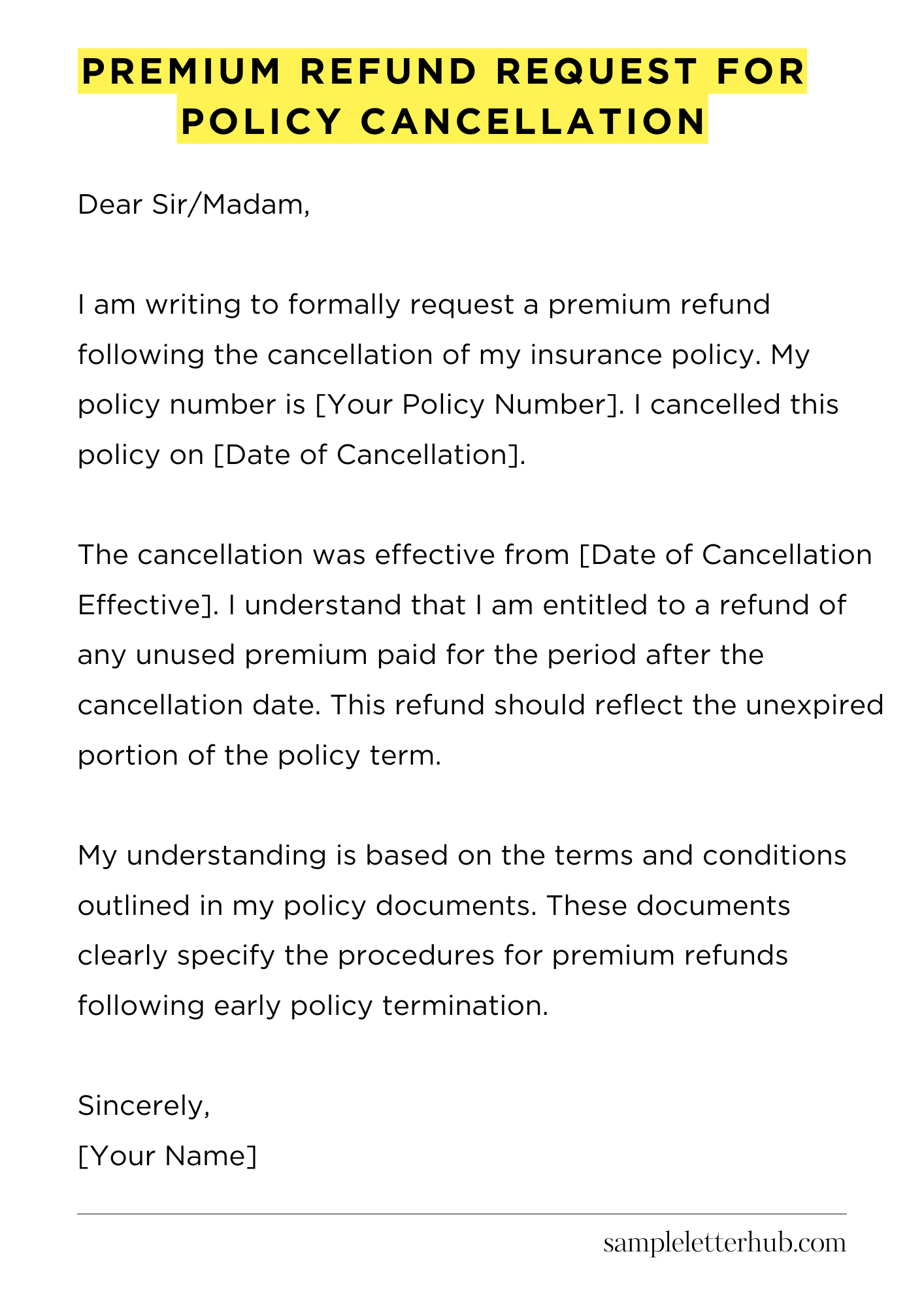
I am writing to formally request a premium refund following the cancellation of my insurance policy. My policy number is [Your Policy Number]. I cancelled this policy on [Date of Cancellation].
The cancellation was effective from [Date of Cancellation Effective]. I understand that I am entitled to a refund of any unused premium paid for the period after the cancellation date. This refund should reflect the unexpired portion of the policy term.
My understanding is based on the terms and conditions outlined in my policy documents. These documents clearly specify the procedures for premium refunds following early policy termination. I have carefully reviewed these terms.
To facilitate the processing of this refund, I have attached a copy of my cancellation confirmation. You will find it enclosed with this letter. The confirmation provides all necessary details regarding the cancellation date and the policy itself.
I kindly request that you process the refund as soon as possible. Please issue the refund to [Your Preferred Method of Payment – e.g., bank account, cheque] and send it to the address provided above. This is the address where I wish to receive the refund.
If you require any further information or documentation, please do not hesitate to contact me. I am readily available to assist in any way that I can. You can reach me by phone or email.
Thank you for your prompt attention to this matter. I appreciate your assistance in finalizing this request. I look forward to receiving confirmation of the refund and its processing timeline.
Sincerely,
[Your Name]
How to Write Premium Refund Request for Policy Cancellation
You’ve decided to cancel your insurance policy. This is a crucial step, and you’re also hoping to get some of your hard-earned premium back. Well, crafting a compelling refund request is your first move. This guide will help you construct a clear, concise, and persuasive letter that maximizes your chances of a successful outcome.
1. Commence with a Formal Salutation
Begin your letter with a formal salutation. Address it to the appropriate department or individual at the insurance company. If you’re unsure, a quick phone call to their customer service can ascertain the correct recipient.
Using a generic greeting like “To Whom It May Concern” is permissible, but addressing a specific individual, if possible, is usually more impactful. Precision is key in this initial phase.
2. Explicitly State Your Purpose
Immediately declare the intent of your missive: to request a premium refund due to policy cancellation. Be direct and avoid ambiguity. State your policy number clearly, and mention the date of cancellation. Consider this your declaration of intent; the more explicit you are, the better the chances of getting the result you desire.
3. Provide Comprehensive Policy Information
Include all pertinent details of your policy. This includes the policy number, the effective date, the cancellation date, and the type of policy. Verify this data against your original policy documents. The company’s ability to locate your details depends on this. Omission of important information will definitely lead to delays in the refund processing.
4. Articulate the Rationale for Cancellation
While not always mandatory, briefly stating the reason for your policy cancellation can sometimes be beneficial, especially if it relates to a specific event or circumstance (e.g., selling a property, or changing residence). Keep this concise and factual, as unnecessary elaboration might be counterproductive. Briefly describe the trigger for the termination of the insurance coverage.
5. Compute the Refund Amount and Method
Calculate the estimated refund amount based on the policy terms. Many insurance companies prorate the premium based on the time the policy was in effect. If the policy included a cancellation fee, take that into account, too.
Specify your preferred refund method (e.g., check, direct deposit) and provide the relevant details, such as bank account information. Verify all these data meticulously. This ensures prompt delivery.
6. Reinforce and Affirm
Reiterate your policy number and the expected refund amount. It also provides the opportunity to gently request confirmation of receipt. Adding a sentence expressing your expectations of a speedy resolution demonstrates your proactive approach. This also gives the company one more chance to review your request.
7. Execute with Professional Closure
Conclude your letter with a professional closing, such as “Sincerely” or “Respectfully.” Sign your full name above your printed name and contact information.
Ensure your current address and phone number are readily available. Proofread your entire letter meticulously before sending it, and retain a copy for your records. This serves as your evidence if any issues arise. This is an insurance for your request.
FAQs about Premium Refund Request for Policy Cancellation
What is the typical timeframe for processing a premium refund after policy cancellation?
The processing time for a premium refund can vary depending on the insurance provider and the method of payment used. However, it generally takes between 30 to 60 days from the date the cancellation is finalized.
Factors that might influence this timeframe include the volume of refund requests the insurer is currently handling, the accuracy of the information provided by the policyholder, and the specific procedures the insurer has in place for processing refunds.
What documentation is usually required to request a premium refund?
Typically, you will need to provide a formal written request for cancellation along with your policy number, a copy of your identification (such as a driver’s license), and details regarding how you would like to receive your refund (e.g., bank account details or a mailing address for a check).
Some insurers might also request the original policy document or proof of payment. It’s always a good idea to check with your specific insurance provider for their exact requirements.
How is the refund amount calculated for a cancelled insurance policy?
The refund amount is typically calculated based on the unused portion of the premium paid. If the policy was paid in full, the insurer will calculate the premium for the period the policy was active and refund the remaining amount.
The calculation method can differ depending on the type of policy and the specific terms and conditions outlined in the policy documentation. Short-term policies often have different refund terms than annual policies, and cancellations may be subject to administrative fees.
Are there any fees or charges that can be deducted from the refund amount?
Yes, there can be fees or charges deducted from the refund.
These may include cancellation fees, administrative fees, or any outstanding premiums owed. The specific fees and charges, if any, are usually detailed within the policy document. It is important to review the policy carefully and inquire about any potential deductions before initiating the cancellation process.
What steps should I take if I haven’t received my premium refund within the expected timeframe?
If you haven’t received your refund within the expected timeframe, the first step is to contact your insurance provider directly. Inquire about the status of your refund and the reason for any delays.
You should have your policy number and cancellation request details ready. If the issue is not resolved, you might consider contacting your state’s insurance regulatory agency or the financial ombudsman for assistance.
Related:
Resignation letter due to rude boss
Resignation letter moving to another state
Resignation letter due to illness of family member
Resignation letter due to study