

A Request Letter for Premium Waiver is a formal document. Its purpose is simple. You are asking for a reduction or elimination of insurance premiums. This letter is sent to your insurance provider. It explains why you cannot pay the full amount.
We understand life throws curveballs. Writing a Request Letter for Premium Waiver can feel daunting. That’s why we’re here to help. This article provides sample letters. We will cover various scenarios. These templates are designed to guide you. Use them to craft your own premium waiver request.
Our goal? To make the process easy. We’ve compiled examples for different situations. This includes request letter sample formats. Finding the right words can be tricky. We provide letter examples you can adapt. Write your premium waiver letter with confidence.
[Your Name]
[Your Address]
[Your Phone Number]
[Your Email Address]
[Date]
[Insurance Company Name]
[Insurance Company Address]
Dear Sir/Madam,
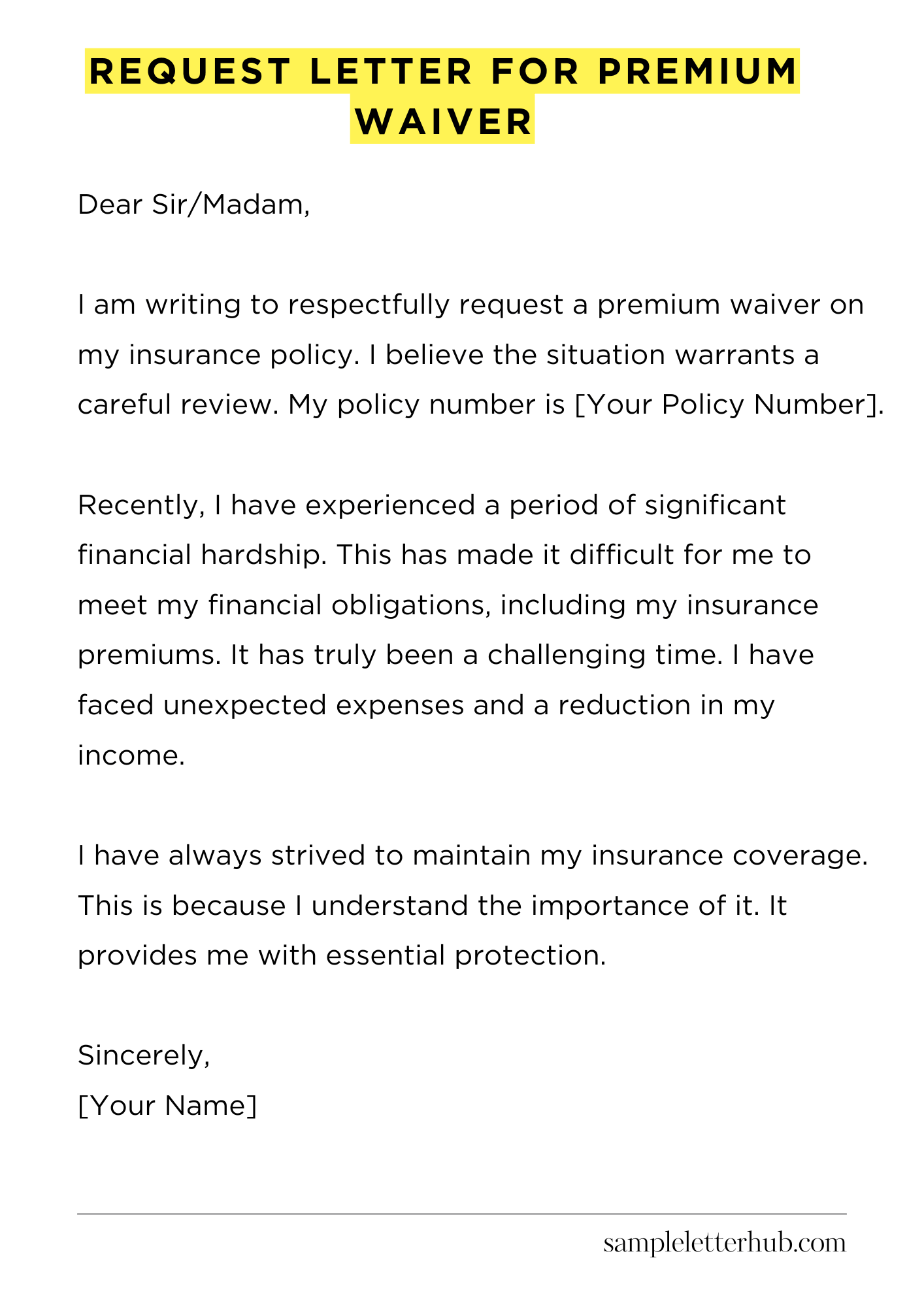
I am writing to respectfully request a premium waiver on my insurance policy. I believe the situation warrants a careful review. My policy number is [Your Policy Number].
Recently, I have experienced a period of significant financial hardship. This has made it difficult for me to meet my financial obligations, including my insurance premiums. It has truly been a challenging time. I have faced unexpected expenses and a reduction in my income.
I have always strived to maintain my insurance coverage. This is because I understand the importance of it. It provides me with essential protection.
I would be extremely grateful if you would consider waiving my premium for the next [Number] months. I am confident that my financial situation will improve in the near future. This would provide me with much-needed relief during this difficult period.
I have attached supporting documentation to help with your decision. This includes [List of Documents, e.g., bank statements, proof of income reduction]. Please review this documentation at your convenience.
Thank you very much for your time and consideration of my request. I am hoping for a favorable response. I look forward to hearing from you soon.
Sincerely,
[Your Name]
How to Write Request Letter for Premium Waiver
Sometimes, life throws curveballs. Financial hardship can strike, leaving you grappling with unexpected expenses. If you find yourself in such a predicament and struggling to meet your insurance premium obligations, a well-crafted request letter for a premium waiver could be your saving grace.
1. Understanding the Stipulations: Your Prerequisite Research
Before you even begin to draft your letter, diligence is paramount. Scrutinize your insurance policy with meticulous care. Delve into the fine print; this is where the crucial information is sequestered. Look specifically for the terms and conditions regarding financial hardship waivers. Some policies are more amenable than others.
2. Assembling Your Arsenal: Essential Documentation
Your request letter is only as potent as the evidence you furnish. Gather all the pertinent documentation that substantiates your claim of financial difficulty.
This might include recent bank statements demonstrating dwindling funds, a layoff notice if you’ve lost your job, medical bills if you’re dealing with substantial healthcare expenses, and any other relevant paperwork that fortifies your case. A paucity of evidence will significantly weaken your appeal.
3. Structuring Your Overture: The Salutation and Introductory Paragraph
Commence your missive with a professional salutation. Address the insurance company or the relevant department with formality. In the introductory paragraph, succinctly state the purpose of your letter: to request a premium waiver. Clearly identify your policy number and the specific period for which you are seeking relief. Brevity here is key.
4. Articulating Your Plight: The Body of Your Argument
This is where you make your case. Painstakingly explain the circumstances that have led to your financial hardship. Be candid and transparent. Provide factual details; for example, the recent job termination, the unexpected medical crisis, or any other exigency.
Do not indulge in hyperbole; a straightforward and honest narrative is more persuasive. Explain how these circumstances have impacted your ability to meet your premium obligations. The more transparent your account, the better.
5. Presenting Your Proffer: The Specific Request
Explicitly state the exact action you are requesting. Are you seeking a full waiver of your premium for a specific period? Or perhaps a partial waiver or a temporary suspension? Clearly articulate your desired outcome, leaving no room for ambiguity. Be precise in your language. Avoid vague assertions.
6. Reinforcing Your Resolve: The Concluding Paragraph
Conclude your letter with a reiteration of your commitment to maintaining your insurance coverage, if possible. Express your gratitude for their consideration and understanding.
Provide your contact information, including your phone number and email address, for ease of communication. Ending with a polite closing, such as “Sincerely” or “Respectfully,” is customary.
7. Polishing Your Presentation: Editing and Delivery
Before you dispatch your letter, meticulously proofread it for any grammatical errors or typos. Ensure your tone is professional, respectful, and sincere.
The last step is delivery, either via certified mail or electronic means, depending on the insurance company’s preferred method. Keep a copy for your records; it’s a valuable insurance policy for your own peace of mind. Remember, a well-crafted letter can often be the catalyst for a favorable outcome.
FAQs about Request Letter for Premium Waiver
What is a premium waiver, and why would someone request it?
A premium waiver is a clause or agreement that allows an individual to have their insurance premiums excused or forgiven under specific circumstances. These circumstances usually involve situations like disability, critical illness, or job loss, as outlined in the insurance policy.
People request a premium waiver to avoid the financial burden of premium payments when they are unable to work or are facing significant financial hardship due to covered events.
What key information should be included in a request letter for a premium waiver?
A well-crafted request letter should include the policyholder’s full name, policy number, and contact information. The letter must clearly state the reason for the waiver request, referencing the specific clause or event triggering the waiver (e.g., disability due to illness, job loss).
It should also include supporting documentation such as medical reports, proof of unemployment, or other evidence, as required by the insurance provider. The date and a clear, concise request for the waiver are also essential.
What supporting documents are typically required when requesting a premium waiver?
The required supporting documentation varies depending on the reason for the request. For medical reasons, expect to provide medical reports, doctor’s notes, and potentially documentation about the diagnosis or treatment.
For job loss, typically you would provide a termination letter or documentation from the unemployment office. When related to other circumstances, the insurer may ask for evidence relevant to the reason stated for the waiver. It’s crucial to review the policy details for a clear understanding of the needed documentation.
How long does it typically take to get a decision on a premium waiver request?
The processing time for a premium waiver request can vary greatly. Factors influencing the time include the complexity of the case, the completeness of the documentation submitted, and the insurance provider’s internal procedures.
It’s wise to contact your insurance provider or review their policy documentation, since the information about the time may vary, but on average it might take anywhere from a few weeks to several months. Following up periodically to check the status of your request is important.
What happens if a premium waiver request is denied?
If a premium waiver request is denied, the policyholder will typically receive a written explanation of the decision. This letter should outline the reasons for the denial, such as insufficient evidence or ineligibility based on the policy terms.
The policyholder might have the option to appeal the decision, providing additional documentation or information to support their claim. Understanding the denial reasons is crucial, so you are better equipped to pursue other options or appeal the decision.
Related:
Resignation letter due to rude boss
Resignation letter moving to another state
Resignation letter due to illness of family member
Resignation letter due to study