

Are you paying too much for your insurance? A premium reassessment request letter can help. It’s a formal way to ask your insurance company to review your current premium. The goal? Potentially lower your insurance costs.
Writing this letter might seem tricky. Don’t worry, we’ve got you covered. This article will provide you with several insurance premium reassessment request letter examples. We’ll offer templates you can easily customize. Writing your insurance letters will be a breeze.
Whether it’s car insurance, home insurance, or another type of coverage, we have samples. Find the perfect template to reduce your insurance premium. Get ready to save money! Let’s get started crafting that perfect letter today.
[Your Name]
[Your Address]
[Your Phone Number]
[Your Email Address]
[Date]
[Insurance Company Name]
[Insurance Company Address]
Subject: Request for Insurance Premium Reassessment
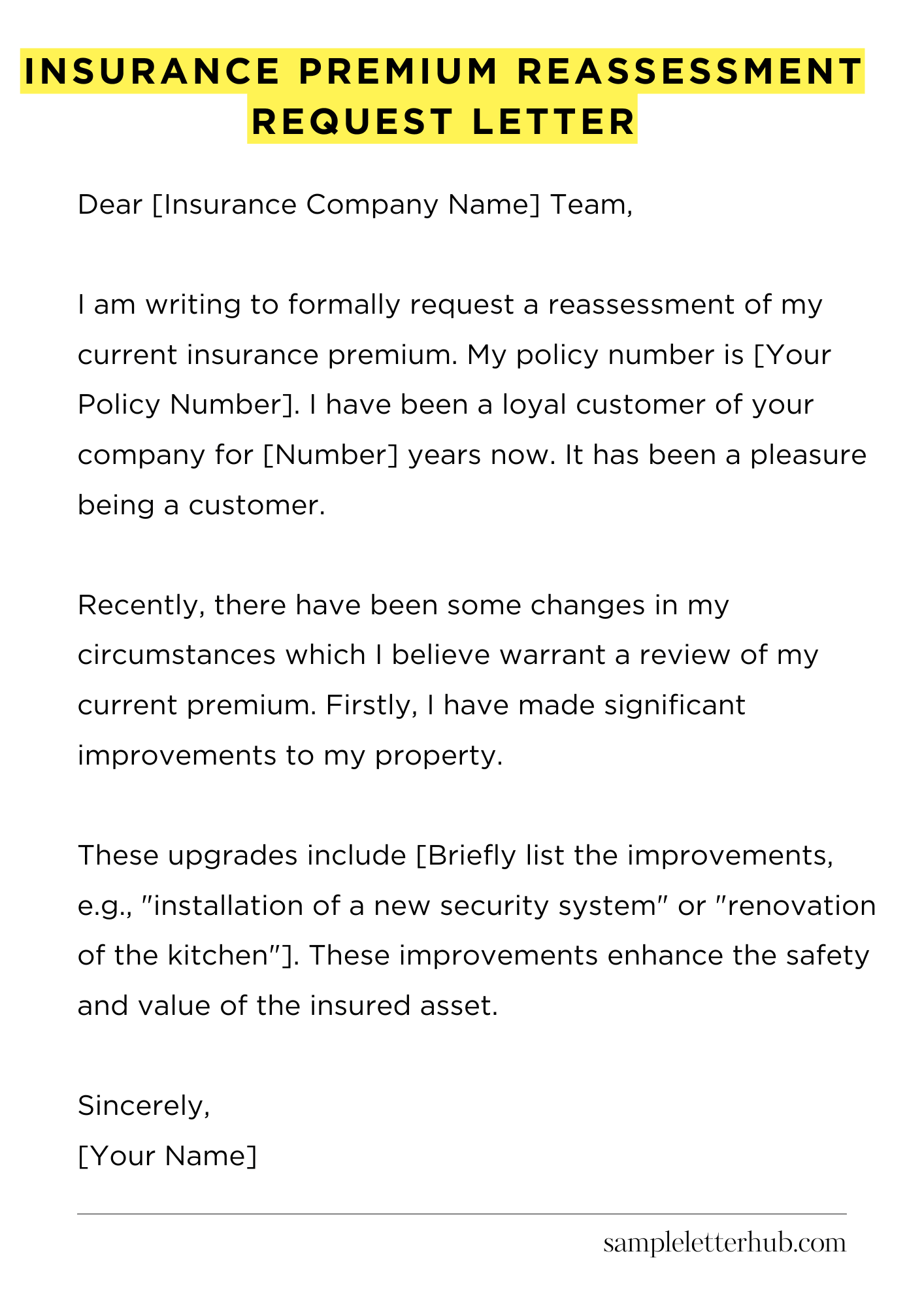
Dear [Insurance Company Name] Team,
I am writing to formally request a reassessment of my current insurance premium. My policy number is [Your Policy Number]. I have been a loyal customer of your company for [Number] years now. It has been a pleasure being a customer.
Recently, there have been some changes in my circumstances which I believe warrant a review of my current premium. Firstly, I have made significant improvements to my property.
These upgrades include [Briefly list the improvements, e.g., “installation of a new security system” or “renovation of the kitchen”]. These improvements enhance the safety and value of the insured asset.
Secondly, my risk profile has also evolved. For instance, [Briefly explain the change in risk, e.g., “I have reduced my annual mileage significantly” or “I now work from home”]. This change should have a positive impact on my overall insurance risk. Furthermore, my driving record has remained clear of any incidents during the coverage period.
I have attached supporting documentation to this letter. This includes [List any documents you are attaching, e.g., “photos of the property improvements” or “documentation of reduced mileage”]. I believe the attached documents thoroughly support my request for a premium reassessment.
I am confident that these changes will allow for a reduced premium. I would appreciate it if you could consider my request and adjust my premium accordingly. Could you please let me know the expected timeframe for this reassessment process? I look forward to your positive response and continued excellent service.
Thank you very much for your time and consideration.
Sincerely,
[Your Name]
How to Write an Insurance Premium Reassessment Request Letter
A well-crafted letter can be your most potent tool when contesting an insurance premium. Sometimes, insurance companies levy premiums that seem disproportionate to your risk profile or the perceived value of their service. Knowing how to articulate your concerns effectively is paramount.
This guide provides a step-by-step approach to composing a compelling request for a premium reassessment. Let’s get started.
1. Initiate with Precision: The Salutation and Subject Line
Your missive should commence with a formal salutation. Employ “Dear [Insurance Company Name] Claims Department” or, if known, address it to a specific underwriter by name.
Always investigate the correct recipient. The subject line is where you immediately grab attention. A direct and unambiguous subject line such as “Request for Premium Reassessment – Policy Number: [Your Policy Number]” streamlines the process, ensuring your letter is routed to the appropriate personnel. This immediately signals the letter’s purpose, saving time.
2. The Premise: State Your Grievance Concisely
In the opening paragraph, articulate the reason for your request. It’s imperative to be explicit. State the policy number and the specific aspect of the premium you are challenging. Clearly explain why you believe the current premium is unjust. Did your risk profile improve? Did you recently reduce your coverage needs? Be unequivocal, but avoid inflammatory language.
3. Evidence-Based Assertion: Presenting Your Rationale
This is where your research comes into play. Provide concrete evidence to bolster your claim. Detail any factors that merit a premium reduction. Did you install security systems? Have you maintained a pristine driving record?
Did you experience a reduction in your property’s value? Include dates, and reference specific policy clauses that support your position. For property insurance, provide recent appraisals. For auto insurance, furnish a copy of your clean driving record. The more solid your substantiation, the better your chances.
4. Comparative Analysis: Citing Market Standards
If applicable, compare your current premium with those of competitors. This comparative analysis strengthens your argument. Research similar policies offered by other insurance providers. If their premiums are significantly lower for comparable coverage, cite these figures. Include the name of the competitor and the details of the policy.
This demonstrates that your request is not simply based on subjective feelings but also on demonstrable market anomalies. This strategy also highlights any apparent rate discrepancies.
5. Demarcation of Intended Action: State Your Desired Outcome
Be explicit about the desired outcome. Do you seek a complete premium reduction? Would a partial adjustment suffice? State your expectations clearly and directly. The precise articulation of your goal will guide the insurer’s response. State it in simple words. This avoids any misinterpretations or confusion. Make sure that they know what you want to achieve.
6. The Formal Closure: Politeness and Professionalism
Conclude your letter with a professional closing. Use “Sincerely,” or “Respectfully,” followed by your full name, signature (if mailing), address, phone number, and email address. Always proofread your letter meticulously for any typographical errors or grammatical inconsistencies. It is your opportunity to represent yourself. It reflects your attention to detail.
7. Delivery and Follow-Up: Dispatching Your Request
Send your letter via certified mail with return receipt requested. This provides proof of delivery and ensures the insurance company acknowledges receipt. Keep a copy of the letter and all supporting documentation for your records.
If you do not receive a response within a reasonable timeframe (typically 30-45 days), follow up with a phone call or a subsequent letter. Document all communication with the insurance company. This comprehensive approach maximizes your chances of a favorable outcome in your quest for a fair premium assessment.
FAQs about Insurance Premium Reassessment Request Letter
What is an insurance premium reassessment request letter, and why would I need one?
An insurance premium reassessment request letter is a formal written communication sent to your insurance provider. It requests a review of your current insurance premium. You might need one if you believe your premium is too high, especially if your circumstances have changed in a way that suggests a lower risk profile.
This could include improvements to your property (for homeowners insurance), changes in your driving record (for auto insurance), or a change in your health status (for life or health insurance).
What information should I include in an insurance premium reassessment request letter?
Your letter should clearly state that you are requesting a premium reassessment. Include your policy number, the specific type of insurance (e.g., home, auto, health), and the date.
Detail the reasons why you believe a reassessment is warranted. Provide evidence to support your claims. For example, include copies of documents related to the installation of a new security system, a driving record, or medical reports. Be polite and professional in your tone.
How do I write a compelling insurance premium reassessment request letter that increases my chances of success?
Start with a clear subject line indicating your purpose. Address the letter to the appropriate department or individual. Clearly and concisely state your request. Provide detailed, factual information about the changes or improvements that justify a lower premium. Attach any supporting documentation.
End with a polite closing, expressing your willingness to provide further information and thanking them for their time and consideration. Be sure to retain a copy of the letter and any attachments for your records.
What are the possible outcomes after submitting an insurance premium reassessment request letter?
The insurer might approve your request and lower your premium. They might reject your request, providing a reason for their decision. They might request additional information before making a decision.
In some cases, they might propose alternative solutions, such as suggesting different coverage options. The outcome depends on factors like your policy terms, the type of insurance, and the evidence you provide.
How long does it typically take to receive a response to an insurance premium reassessment request letter?
The timeframe for receiving a response can vary depending on the insurance company, the complexity of your request, and the volume of requests they are currently handling.
However, it’s generally best to allow a few weeks (typically 3-6 weeks) for a response. If you haven’t heard back within that time frame, you may consider contacting your insurance provider to inquire about the status of your request.
Related:
Resignation letter due to rude boss
Resignation letter moving to another state
Resignation letter due to illness of family member
Resignation letter due to study