

Ever received an insurance bill that just didn’t seem right? A insurance premium dispute letter is your tool to challenge those charges. It’s a formal way to tell your insurance company you disagree. The goal is to get the billing error corrected.
We understand navigating insurance can be tricky. Writing a insurance premium dispute letter can be daunting. No worries! We’ve got you covered. This article offers ready-to-use samples and templates.
These insurance premium dispute letter examples make the process simple. You’ll find different formats for various situations. Quickly craft your own effective letter and get the issue resolved.
[Your Name]
[Your Address]
[Your Phone Number]
[Your Email Address]
[Date]
[Insurance Company Name]
[Insurance Company Address]
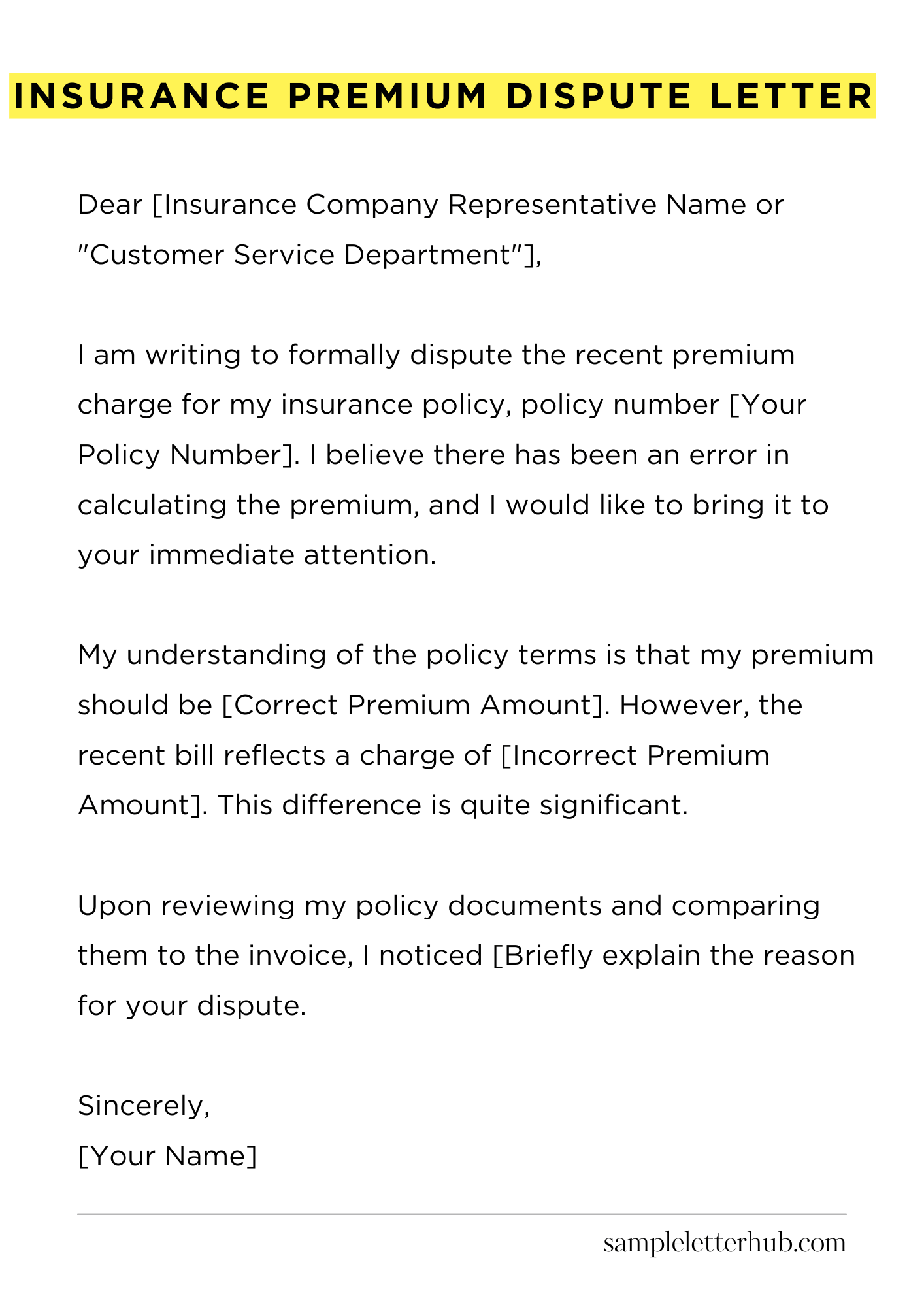
Dear [Insurance Company Representative Name or “Customer Service Department”],
I am writing to formally dispute the recent premium charge for my insurance policy, policy number [Your Policy Number]. I believe there has been an error in calculating the premium, and I would like to bring it to your immediate attention.
My understanding of the policy terms is that my premium should be [Correct Premium Amount]. However, the recent bill reflects a charge of [Incorrect Premium Amount]. This difference is quite significant.
Upon reviewing my policy documents and comparing them to the invoice, I noticed [Briefly explain the reason for your dispute – e.g., a discrepancy in covered vehicles, a change in my driving record that should have lowered the premium, or a misunderstanding about discounts].
This strongly suggests a miscalculation. I have attached copies of [Mention any documents you’re including, e.g., my policy schedule, previous bills, and any supporting documentation] as evidence supporting my claim.
I kindly request a thorough review of my account and the premium calculation. Please investigate the matter and provide a detailed explanation of the current premium. I would appreciate it if you could correct the charge to the accurate amount of [Correct Premium Amount].
Could you also let me know how you will address this, and what the timeline will be for resolving this dispute? I need clarity on how this will be managed.
I look forward to your prompt attention to this matter and a resolution. I hope to hear back from you within [Number] business days.
Sincerely,
[Your Name]
How to Write an Insurance Premium Dispute Letter
Disputing an insurance premium can seem daunting, but with a structured approach, you can effectively communicate your grievances and seek a resolution. Let’s embark on a journey to craft a compelling letter that will resonate with your insurance provider.
1. Commence with a Cogent Introduction
Your opening paragraph is your inaugural opportunity to make a positive impression. State the purpose of your communication explicitly and succinctly.
Identify the policy number, and any associated reference numbers. This preliminary step establishes the context immediately. State the date and include your complete contact information, including your full name, mailing address, email address, and phone number.
2. Detail the Discrepancy: Articulate Your Grievances
This section is the crux of your missive. Clearly and logically outline the precise reasons why you are disputing the premium. Include specifics, such as the date of the premium notice, the amount in question, and how it deviates from your understanding or prior agreements. Offer evidentiary support.
Cite specific clauses from your policy, provide supporting documentation (photocopies, not original documents), and meticulously detail any discrepancies you have identified. Avoid hyperbole and stick to the facts.
3. Present the Pertinent Historical Context
Provide a chronological account leading up to the dispute. Detail any prior communications, discussions, or agreements that are relevant to your case. If you had discussions with an agent or adjuster, mention their names and the dates of those interactions. This historical exposition helps to substantiate your claim and demonstrates your due diligence.
4. Offer Affirmative Evidence: Substantiate Your Arguments
Solid evidence is the bedrock of your argument. Attach copies of supporting documentation. This could include policy documents, past bills, payment confirmations, photographs, or any other material that reinforces your position. Each document should be clearly labeled and referenced within your letter.
Ensure the copies are legible and easily understood. Organize your attachments sequentially for ease of review.
5. The Desired Ambit: State Your Specific Expectations
Clearly articulate the resolution you are seeking. Are you requesting a premium adjustment, a refund, or a correction of an error? Be specific. Vague requests diminish the clarity of your communication. Explicitly state what actions you want the insurance company to take to rectify the situation. Provide deadlines if you deem it necessary, but be reasonable.
6. Conclude with a Proficient Closing
Reiterate the key points of your dispute in a concise manner. Express your expectation for a prompt response. Indicate the preferred method of communication (mail, email, phone) and provide all the necessary contact details.
Thank the recipient for their time and attention to the matter, and end the letter with a professional closing. Use a formal sign-off, such as “Sincerely,” or “Respectfully,” followed by your full name.
7. Final Review and Distribution
Before dispatching your letter, meticulously review it for any grammatical errors, spelling mistakes, or factual inaccuracies. Ensure that all supporting documentation is included and clearly labeled.
Make a copy of the complete package for your records. Send your letter via certified mail with a return receipt requested. This ensures proof of delivery and provides a paper trail.
FAQs about Insurance Premium Dispute Letter
What is an insurance premium dispute letter and when should I use it?
An insurance premium dispute letter is a formal written communication used to challenge the accuracy or fairness of your insurance premium. You should use this letter when you believe your premium is incorrect, perhaps due to errors in the policy, changes in your circumstances (e.g., improved driving record, new home security system), or if you suspect the premium calculation is flawed.
It’s also appropriate if you believe the insurer has failed to apply discounts you’re eligible for or if you have evidence the premium is unfairly high compared to similar policies.
What information should I include in an insurance premium dispute letter?
Your letter should clearly state your policy details (policy number, name of the insured), the specific issue you’re disputing, and the requested action (e.g., a corrected premium, a refund). Include a concise explanation of why you believe the premium is incorrect, supported by any relevant documentation.
How should I submit an insurance premium dispute letter?
Send your letter via certified mail with return receipt requested. This provides proof that the insurer received the letter and the date of receipt. Keep a copy of the letter and all supporting documentation for your records. Consider sending a copy via email as well to provide an additional layer of communication, but ensure the original is sent via certified mail for legal and tracking purposes.
What happens after I send an insurance premium dispute letter?
The insurance company should review your letter and supporting documentation. They will typically investigate the issue and respond to you with their decision. The response may involve adjusting your premium, denying your claim, or requesting additional information.
The time frame for a response varies, but it’s often within 30-60 days. If you’re unhappy with their response, you can usually escalate the issue through the insurer’s internal complaint process, file a complaint with your state’s insurance regulatory agency, or, as a last resort, consider legal action.
What if the insurance company denies my premium dispute?
If the insurance company denies your dispute, review their explanation carefully to understand the reasons. You have several options, including appealing the decision within the insurer’s internal dispute resolution process, if available.
You may also contact your state’s insurance regulatory agency and file a formal complaint; they can investigate the matter and mediate between you and the insurance company. You could also consult with an attorney to explore legal options if you believe the denial is unfounded, particularly if a significant amount of money is at stake.
Related:
Resignation letter due to rude boss
Resignation letter moving to another state
Resignation letter due to illness of family member
Resignation letter due to study