

Need to lower your auto insurance premium? You can try requesting a premium reduction! A Auto Insurance Premium Reduction Request Letter is your tool. It is a formal way to ask your insurance company for a discount.
This article will help you. We will give you templates and examples! Get ready to write a convincing auto insurance request letter. These samples will make it simple.
Writing the perfect letter is easy with our help. We break down the process. We provide ready-to-use letter samples. You can adapt them to your needs. Good luck getting that insurance rate down!
[Your Name]
[Your Address]
[Your Phone Number]
[Your Email Address]
[Date]
[Insurance Company Name]
[Insurance Company Address]
Subject: Auto Insurance Premium Reduction Request
Dear [Insurance Company Representative Name or “To Whom It May Concern”],
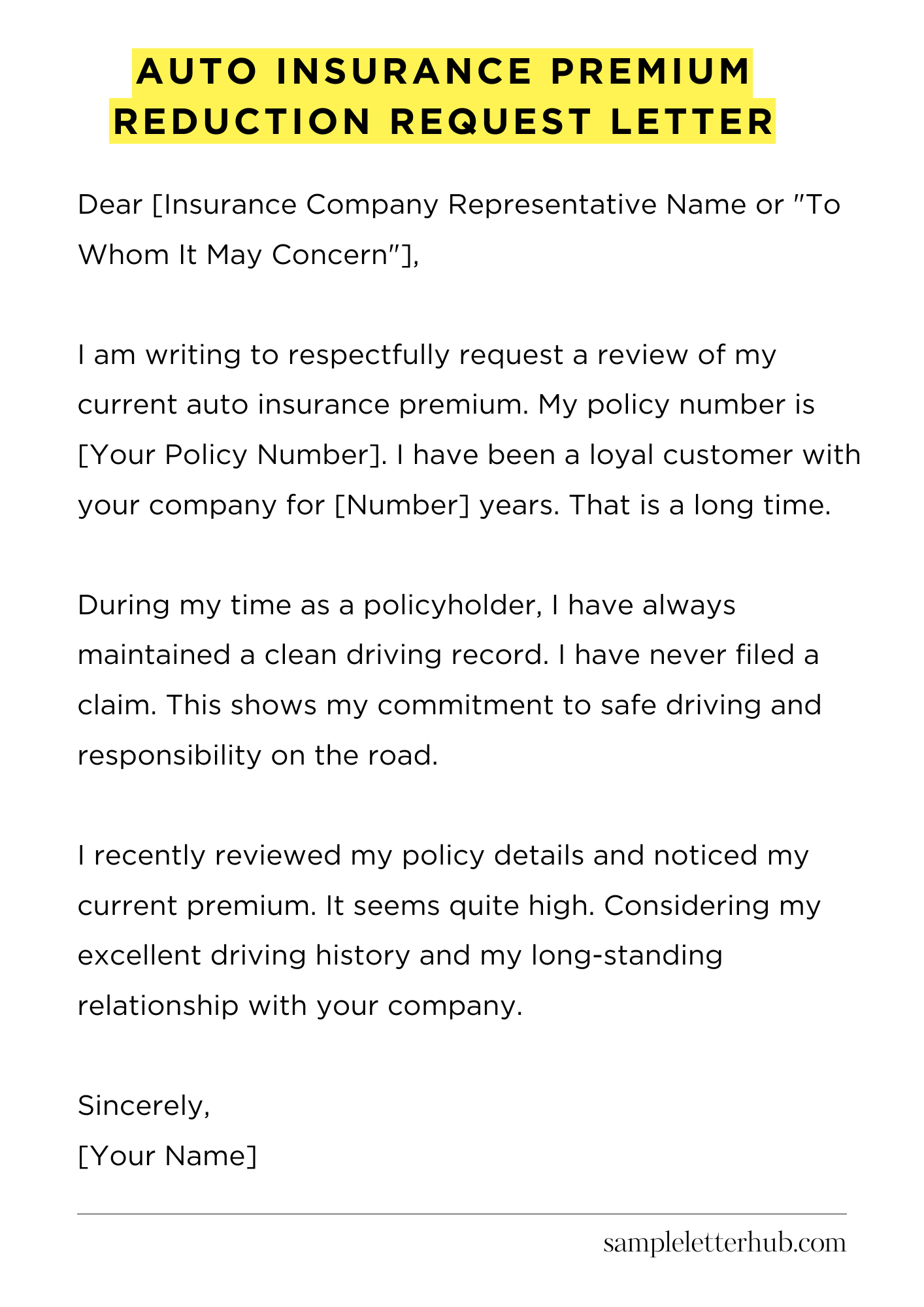
I am writing to respectfully request a review of my current auto insurance premium. My policy number is [Your Policy Number]. I have been a loyal customer with your company for [Number] years. That is a long time.
During my time as a policyholder, I have always maintained a clean driving record. I have never filed a claim. This shows my commitment to safe driving and responsibility on the road.
I recently reviewed my policy details and noticed my current premium. It seems quite high. Considering my excellent driving history and my long-standing relationship with your company, I believe I may qualify for a reduction. It’s always good to try, right?
I am also aware that I might be eligible for other discounts. These include things like a defensive driving course completion or bundling my auto insurance with other policies I have. Are there any other discounts I could be missing out on?
I would appreciate it if you could investigate the possibility of lowering my premium. Please let me know what options are available to me. I would like to save money.
Thank you for your time and consideration. I look forward to hearing from you soon.
Sincerely,
[Your Name]
How to Write Auto Insurance Premium Reduction Request Letter
Negotiating a lower auto insurance premium can feel daunting, but a well-crafted letter can significantly improve your odds. This guide will meticulously dissect the process, empowering you to advocate for a more advantageous rate.
1. Initiate with Salutation and Identification
Commence with a formal salutation. Address the letter to the appropriate representative at your insurance provider. You can typically find this information on your policy documents or by contacting their customer service.
State your full name, policy number, and the date the missive is being penned. This ensures clarity and expedites the processing of your request. Be direct; time is of the essence.
2. Articulate Your Rationale Clearly
The crux of your letter lies in the articulation of your rationale. Precisely state your objective: requesting a reduction in your auto insurance premium. Justify your request with compelling evidence.
Perhaps you have improved your driving record, demonstrating risk mitigation. Maybe you’ve recently installed safety features on your vehicle, consequently minimizing the probability of claims. Conversely, if there are recent policy changes affecting your current insurance, mentioning the same will strengthen your case.
3. Showcase Your Stellar Driving Record
Your driving history is a pivotal element. Highlight any positive aspects, such as a spotless driving record free from accidents or violations. Specify the number of claim-free years you’ve maintained. Attach documentation, such as a copy of your driving record, to substantiate your claims. A clean slate is a potent bargaining chip.
4. Enumerate Safety Enhancements
If you’ve augmented your vehicle’s safety features, be sure to note them. Detail the specific devices installed and the date of installation. Examples include anti-theft systems, advanced driver-assistance systems (ADAS), or reinforced safety glass. These additions can tangibly reduce your risk profile in the eyes of the insurer.
5. Explore Discount Eligibility
Investigate and explicitly mention any potential discounts for which you qualify but are not currently receiving. This might encompass discounts for bundling your auto and home insurance policies, being a member of a professional organization, or having multiple vehicles insured.
Thoroughly review your policy documents and research all available discounts. These savings can compound rapidly.
6. Propose a Reasonable Rate
While you should not demand a specific rate, proposing a target price can be beneficial. Research comparable rates from other insurers in your area.
This demonstrates you are informed about the market and encourages your insurer to remain competitive. Use this data, as supporting evidence, to make a calculated proposal; this will strengthen your negotiating position.
7. Conclude with a Courteous Closing and Call to Action
Conclude the letter with a professional closing, such as “Sincerely” or “Respectfully”. Reiterate your policy number and provide your contact information (phone number and email address). Request a timely response and explicitly state your preferred method of contact.
Express your gratitude for their consideration. This final touch leaves a positive impression, increasing the likelihood of a favorable outcome. Follow these steps, and you will be well on your way to securing a more affordable auto insurance rate.
FAQs about Auto Insurance Premium Reduction Request Letter
What is the purpose of an Auto Insurance Premium Reduction Request Letter?
The primary purpose of an Auto Insurance Premium Reduction Request Letter is to formally request a decrease in your auto insurance premium from your insurance provider.
This letter serves as a written record of your communication and provides supporting documentation or justification for why you believe a reduction is warranted. Common reasons include changes in circumstances, such as completing a defensive driving course, improving your driving record, or finding a lower rate from a competing insurer.
What information should I include in an Auto Insurance Premium Reduction Request Letter?
A well-structured letter should include your full name, address, policy number, and the date. Clearly state your request for a premium reduction. Provide specific reasons for your request, such as a clean driving record, completion of a safety course, or changes in vehicle usage.
Include supporting documentation, like a driving record or certificate of completion for a defensive driving course, and any other relevant information. It is also important to mention the desired effective date for the reduction.
How do I write an effective Auto Insurance Premium Reduction Request Letter?
To write an effective letter, be polite and professional in your tone. Clearly and concisely state your request and the reasons for it. Organize your information logically, using paragraphs to separate different points. Provide supporting documentation as attachments.
Proofread carefully for any errors in grammar or spelling. Keep a copy of the letter and any supporting documents for your records. Consider sending the letter via certified mail to confirm receipt and have proof of delivery.
What supporting documents should I include with my letter?
The specific supporting documents you include will depend on the reasons you are requesting a premium reduction. Common examples include a copy of your driving record, a certificate of completion for a defensive driving course, documentation of changes to your vehicle (e.g., the addition of safety features).
What are the possible outcomes after submitting the letter?
After submitting your letter, your insurance provider will review your request and the supporting documentation. Possible outcomes include approval of the premium reduction, a denial of the request, or a request for additional information.
If your request is approved, you will likely receive a revised policy or confirmation of the new premium. If denied, the insurer should provide a reason for the denial. It is important to carefully review any communication from your insurer and follow up if you have any questions or require clarification.
Related:
Resignation letter due to rude boss
Resignation letter moving to another state
Resignation letter due to illness of family member
Resignation letter due to study