

Need to lower your health insurance premium? A request letter for reduction of health insurance premium is the key. It’s a formal letter you send to your insurance provider. Its purpose? To ask them to reduce your monthly health insurance payments.
Writing this letter can feel tricky. Don’t worry, we’ve got you covered. This article shares sample request letters for reduction of health insurance premium. You’ll find different templates and examples. Use these to tailor your own request letter.
We’ve made it easy. Our sample letters simplify the process. They help you craft a compelling letter. You can then request a lower premium for your health insurance policy.
[Your Name]
[Your Address]
[Your Phone Number]
[Your Email Address]
[Date]
[Insurance Company Name]
[Insurance Company Address]
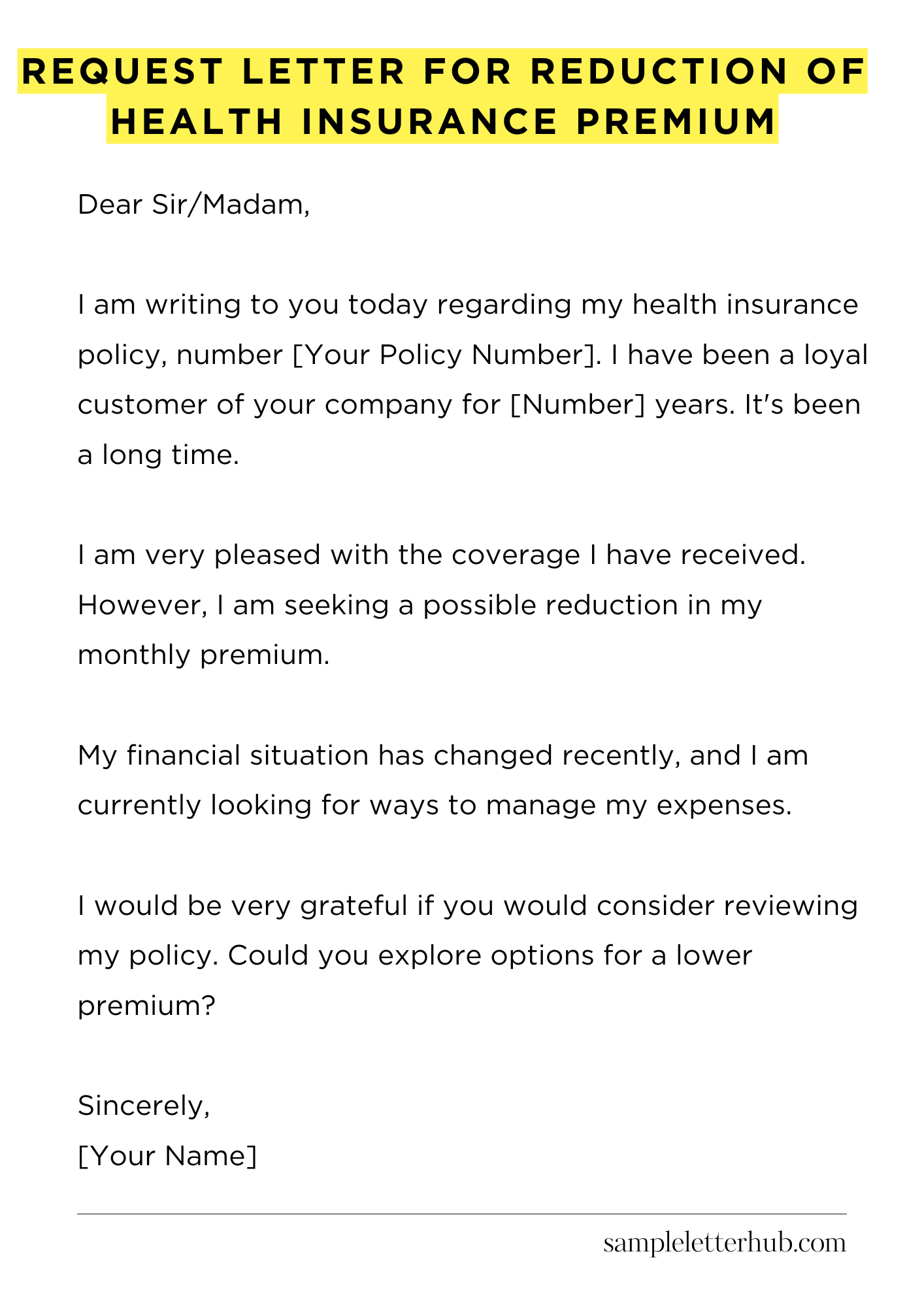
Dear Sir/Madam,
I am writing to you today regarding my health insurance policy, number [Your Policy Number]. I have been a loyal customer of your company for [Number] years. It’s been a long time.
I am very pleased with the coverage I have received. However, I am seeking a possible reduction in my monthly premium.
My financial situation has changed recently, and I am currently looking for ways to manage my expenses. Taking a close look at my budget, I noticed my health insurance premium. I need to make some adjustments.
I would be very grateful if you would consider reviewing my policy. Could you explore options for a lower premium? Perhaps a plan with a slightly higher deductible would be suitable for me. I understand there are several plans.
I am open to discussing alternative plans and options that would still provide me with adequate coverage while aligning with my current budget. I value the services provided by your company and hope to continue being a customer for many years to come. I hope we can find a solution together.
Thank you for your time and consideration. I look forward to hearing from you soon.
Sincerely,
[Your Name]
How to Write Request Letter for Reduction of Health Insurance Premium
1. Precursory Prerogatives: Gauging Your Eligibility
Before you even think about penning a missive to your insurance provider, you must determine your eligibility. Scrutinize your policy documents with meticulous care. Does your policy even permit premium adjustments?
Are there any stipulations regarding qualifying factors for reduction? These preliminaries are pivotal. If you neglect these, you risk wasting precious time and effort. Understand your existing policy to ascertain the feasibility of your request.
2. Assembling the Necessary Arsenal: Gathering Your Documentation
Prepare your supporting documentation meticulously. This isn’t merely about stringing words together. You will likely need to substantiate your rationale for a reduced premium.
Compile all documents that validate your assertions. These might include, but are not limited to, proof of life events, like marriage or having a new baby, new job or income. Be thorough; a lack of supporting evidence could severely undermine your appeal. The more solid your evidence, the stronger your case.
3. Structuring Your Overture: Crafting the Salutation and Introduction
Start your letter professionally, utilizing a formal salutation. Employ “Dear [Insurance Company Name] Representative” or, if known, “Dear Mr./Ms. [Representative’s Last Name]”.
The introduction should succinctly state your purpose – you are requesting a reduction of your health insurance premium. Include your policy number immediately to facilitate ease of identification. This establishes the context and gives them a clear understanding of the purpose of your letter.
4. The Cogent Core: Articulating Your Justification
This is the pivotal segment of your letter. Clearly, and with persuasive precision, present your reasons for requesting a premium reduction. Is your income reduced? Did you switch to a more affordable plan? Have life circumstances dramatically changed, demanding that you seek financial respite?
Whatever your rationale, delineate it lucidly. Provide specific details and cite relevant policy clauses, if applicable. A well-articulated justification is the cornerstone of a successful request.
5. Reinforcing the Case: Presenting Supporting Evidence
This builds on the “Cogent Core”. This is where you cite your supporting evidence. If you’re referencing a change in employment status, provide a copy of your new employment letter.
Include any pertinent documents to fortify your claims. Make sure you refer to them in your letter, e.g. “Enclosed, please find a copy of my employment offer.” Properly document your attachments. This strengthens your argument significantly.
6. The Formal Finale: Closing and Essential Information
Conclude your letter with a professional and courteous closing. Use phrases like, “Sincerely,” or “Respectfully,” followed by your full name. Provide your contact information, including your phone number and email address, in case the insurer needs to contact you for clarification.
A clear closing and contact information ensures a smooth and efficient response. Don’t forget to date your letter – this provides a timeline for processing.
7. Polishing and Dispatch: Proofreading and Submission
Before submitting your letter, proofread it meticulously. Ensure there are no grammatical errors or typographical slips. Verify the contact information for the insurance company.
Make a copy of the letter and all supporting documentation for your records. If possible, send the letter via certified mail with return receipt requested. This provides proof of delivery and ensures a paper trail. A final check for errors will give you the best chance of success.
FAQs about Request Letter for Reduction of Health Insurance Premium
What is a health insurance premium reduction request letter?
A health insurance premium reduction request letter is a formal written communication sent to your health insurance provider. It outlines your reasons for seeking a decrease in your monthly or annual premium. These reasons often include changes in circumstances like a reduction in income, a change in health status, or the discovery of more affordable plans.
What information should I include in my request letter?
Your letter should clearly state your policy number, the specific premium amount you’re requesting to be reduced, and the specific reason(s) for your request. Provide supporting documentation such as proof of income changes, updated health information, or quotes from competing insurers. Be polite, concise, and professional in your communication.
What are the common reasons for requesting a premium reduction?
Common reasons include a significant change in income (e.g., job loss, salary reduction), a shift in lifestyle (e.g., retirement), the availability of a cheaper, comparable plan, a demonstration of improved health status, or, in some cases, evidence of market adjustments that warrant a lower premium for similar coverage.
How do I write a compelling request letter that increases my chances of success?
To increase your chances, be clear, concise, and provide strong supporting evidence. Highlight the specific reasons for your request and quantify the impact. For instance, if your income has decreased by a specific percentage, state that figure.
Attach any supporting documents, such as pay stubs, medical reports, or quotes from other insurers. It is advisable to address the letter to the appropriate department within the insurance company.
What is the typical response time to a premium reduction request?
Response times vary among insurance providers. However, you should generally expect a response within 30-60 days. Follow up with the insurance company if you do not hear back within a reasonable timeframe.
Keep records of your communication, including copies of the letter and any supporting documents you sent, alongside the date sent, and the name of any representatives you speak to.
Related:
Resignation letter due to rude boss
Resignation letter moving to another state
Resignation letter due to illness of family member
Resignation letter due to study