

Need your insurance premium back? A refund request letter is your official way to ask for it. It’s a written document sent to your insurance provider. Its purpose is to clearly state why you believe a refund is due. This might be due to policy cancellation, overpayment, or other specific reasons.
Writing the perfect insurance premium refund request letter can feel tricky. Don’t worry, we’ve got you covered! We’re sharing helpful templates and examples. These sample letters will guide you.
Crafting a compelling letter is now simple. We provide various sample letters. Whether it’s for car insurance or home insurance, adapt them. Use these insurance refund letter templates to ensure a smooth refund request process.
[Your Name/Company Name]
[Your Address]
[Your City, Postal Code]
[Your Email]
[Your Phone Number]
[Date]
[Insurance Company Name]
[Insurance Company Address]
[Insurance Company City, Postal Code]
Subject: Request for Premium Refund – Policy Number [Your Policy Number]
Dear [Insurance Company Representative Name or “Customer Service Department”],
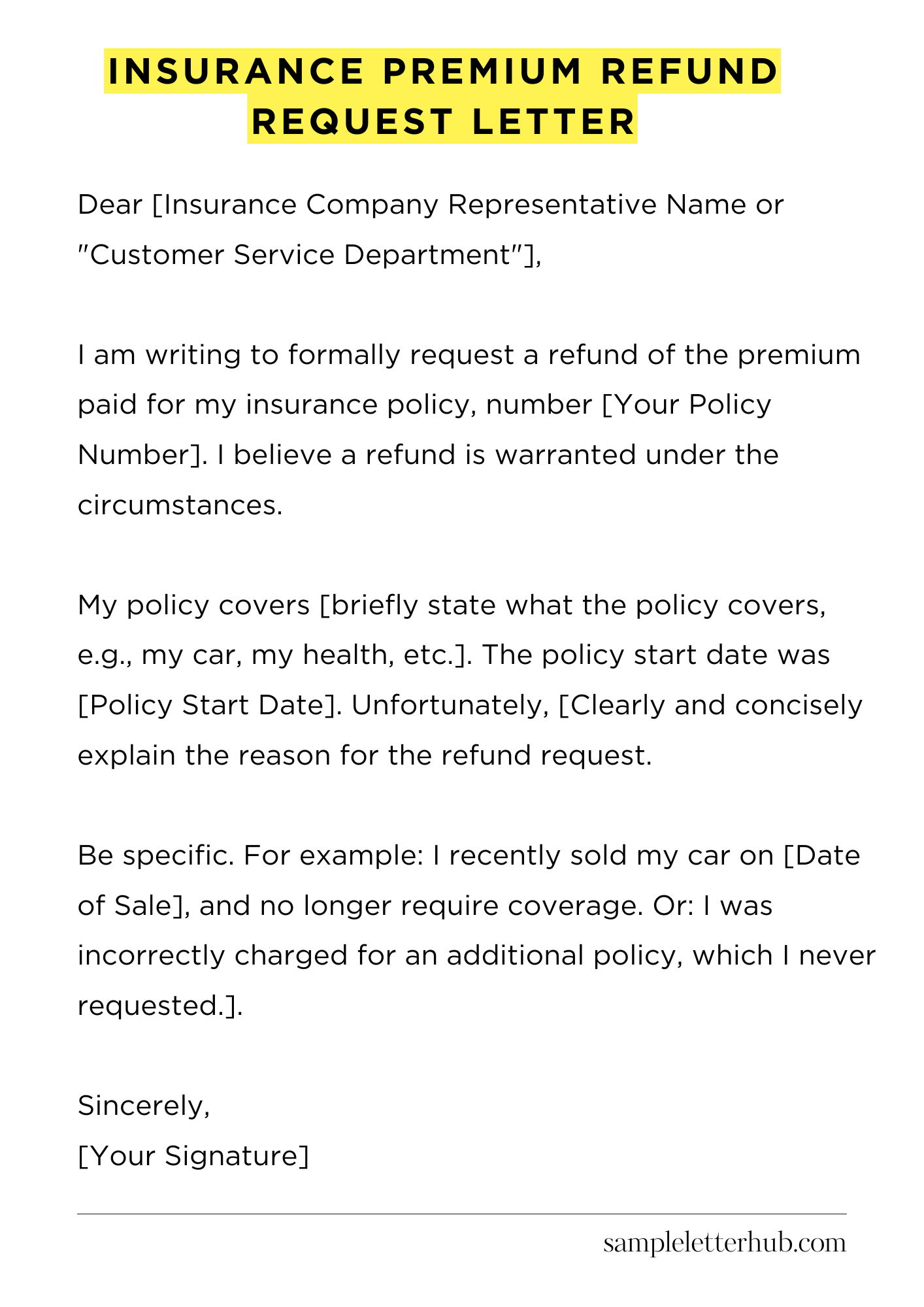
I am writing to formally request a refund of the premium paid for my insurance policy, number [Your Policy Number]. I believe a refund is warranted under the circumstances.
My policy covers [briefly state what the policy covers, e.g., my car, my health, etc.]. The policy start date was [Policy Start Date]. Unfortunately, [Clearly and concisely explain the reason for the refund request.
Be specific. For example: I recently sold my car on [Date of Sale], and no longer require coverage. Or: I was incorrectly charged for an additional policy, which I never requested.].
I have attached [List any supporting documents you are including, e.g., a copy of the car sale document, proof of overpayment, etc.]. This documentation will assist in processing my request. Please review them carefully.
Could you please process a refund for the unearned premium amount? I would appreciate it if the refund could be issued to [State how you want to receive the refund, e.g., my bank account, cheque, etc.].
My banking details are as follows: Bank Name: [Bank Name], Account Number: [Account Number], Routing Number: [Routing Number]. Receiving the refund via cheque is also acceptable.
I would be grateful if you could confirm receipt of this letter and the expected timeframe for the refund. I look forward to your prompt response and assistance in resolving this matter. Thank you for your time and attention to this request.
Sincerely,
[Your Signature]
How to Write Insurance Premium Refund Request Letter
Sometimes, life throws curveballs. Perhaps you’ve changed insurance providers, cancelled a policy, or believe you’re entitled to a refund.
Whatever the circumstance, a well-crafted insurance premium refund request letter is your clarion call to action. It’s your official, formal communication, and its efficacy hinges on clarity and precision. Here’s a step-by-step guide to ensure your missive achieves its intended objective: a prompt and favorable resolution.
1. Commence with the Essentials: Your Salutation and Identification
Begin your letter with a formal salutation. Address the letter to the appropriate department or individual within the insurance company. If you know the claims adjuster’s name, that’s ideal.
If not, use a general title such as “Claims Department.” Following the salutation, immediately provide unambiguous identification. Include your full name, policy number, address, and contact information. This is your personal watermark, ensuring the recipient can easily locate your policy details.
2. Articulate Your Plea: The Core of Your Request
The crux of your letter resides in its opening paragraphs. Concisely and explicitly state your request: a refund of insurance premiums. Specify the exact period you’re seeking a refund for.
Detail the reasons underpinning your request, be it policy cancellation, overpayment, or a change in coverage. Ensure your reasoning is cogent and supported by facts. Provide any pertinent dates, such as the effective date of cancellation or any relevant transactions.
3. Substantiate Your Claims: Supporting Documentation
This is where you bolster your case. Attach any supporting documentation that buttresses your claims. This might include a copy of your policy documents, proof of payment (cancelled checks, bank statements), correspondence related to the policy cancellation, or any other paperwork that validates your request.
The more corroborating evidence you provide, the stronger your position becomes. Think of it as piling up the evidentiary bricks needed to construct a compelling argument.
4. Specify the Recipient’s Action: Providing Clear Instructions
Clearly state what you want the insurance company to do. Be precise. Request the specific amount you are claiming, and indicate how you would like to receive the refund.
Do you prefer a check, direct deposit, or credit to a specific account? Provide all necessary details, such as bank account information or the address where the check should be mailed. Avoid ambiguity; clarity is paramount.
5. Maintain a Professional Demeanor: The Tone of your Letter
While you may feel frustrated, it’s crucial to maintain a professional and courteous tone throughout your letter. Refrain from accusatory language or inflammatory remarks. Instead, adopt a respectful and business-like approach. This increases the likelihood that your request will be taken seriously and processed efficiently. Remember, you’re seeking a solution, not engaging in a quarrel.
6. The Formal Closure and Signature: Wrapping up Your Letter
Conclude your letter with a formal closing, such as “Sincerely,” or “Respectfully.” Below your closing, leave space for your signature. Print your full name legibly beneath your signature. Date the letter. These final touches are essential for formalizing your communication.
7. Delivery and Follow-Up: Dispatching Your Letter
Send your letter via certified mail with return receipt requested. This provides proof of delivery and ensures the insurance company acknowledges receipt.
Keep a copy of the letter and all supporting documentation for your records. If you haven’t received a response within a reasonable timeframe (typically 30-45 days), follow up with a phone call or a subsequent letter. Persistence, within reasonable bounds, can be a virtue.
FAQs about Insurance Premium Refund Request Letter
Here are some of the most frequently asked questions regarding insurance premium refund request letters.
What is an insurance premium refund request letter?
An insurance premium refund request letter is a formal document written by a policyholder to their insurance company to request a refund of previously paid insurance premiums. This is typically done when a policy is canceled, a premium overpayment has occurred, or the policyholder believes they are entitled to a refund based on the policy terms.
What information should be included in an insurance premium refund request letter?
A comprehensive request letter should include the policyholder’s full name, address, and contact information. It must also include the policy number, the specific reason for the refund request (e.g., policy cancellation, overpayment), the amount of the refund requested, the dates of the premium payments, and the preferred method of receiving the refund (e.g., check, direct deposit).
It’s also wise to attach supporting documentation such as a copy of the cancelled policy or proof of overpayment.
When should I expect to receive my refund after submitting a request letter?
The timeframe for receiving a refund can vary depending on the insurance company’s internal procedures and the complexity of the request. However, most insurance companies aim to process refund requests within 30-60 days.
It is advisable to review the insurance policy documents for specific information regarding refund processing times. You should also follow up with the insurance company if you haven’t received the refund within a reasonable timeframe.
Can I request a refund for any reason?
The ability to request a refund depends on the specific terms and conditions of your insurance policy. Refunds are most commonly granted when a policy is canceled, there has been an overpayment, or in certain situations defined within the policy (e.g., death of the insured, specific policy changes).
It’s essential to carefully review your policy to understand the circumstances under which a refund may be eligible.
What happens if the insurance company denies my refund request?
If your refund request is denied, the insurance company should provide a written explanation outlining the reason for the denial. If you disagree with the decision, you have several options.
You can gather additional supporting documentation, contact the company’s customer service department to discuss the denial, or file a formal complaint. In some cases, you may have the option to pursue mediation or legal action, depending on the policy terms and the amount in dispute.
Related:
Resignation letter due to rude boss
Resignation letter moving to another state
Resignation letter due to illness of family member
Resignation letter due to study