

Need to lower your insurance costs? An insurance premium reduction request letter is your tool. It’s a formal way to ask your insurance company for a discount. The goal? To save money on your insurance premium.
Writing these letters can feel tricky. No worries! We’ve got you covered. We’ll share templates, examples, and samples of insurance premium reduction request letters. This will help you craft your own.
These sample letters simplify the process. They’re designed to be easy to adapt. You can use them for various insurance types. Get ready to write a strong insurance premium appeal today!
[Your Name]
[Your Address]
[Your Phone Number]
[Your Email Address]
[Date]
[Insurance Company Name]
[Insurance Company Address]
Subject: Request for Insurance Premium Reduction
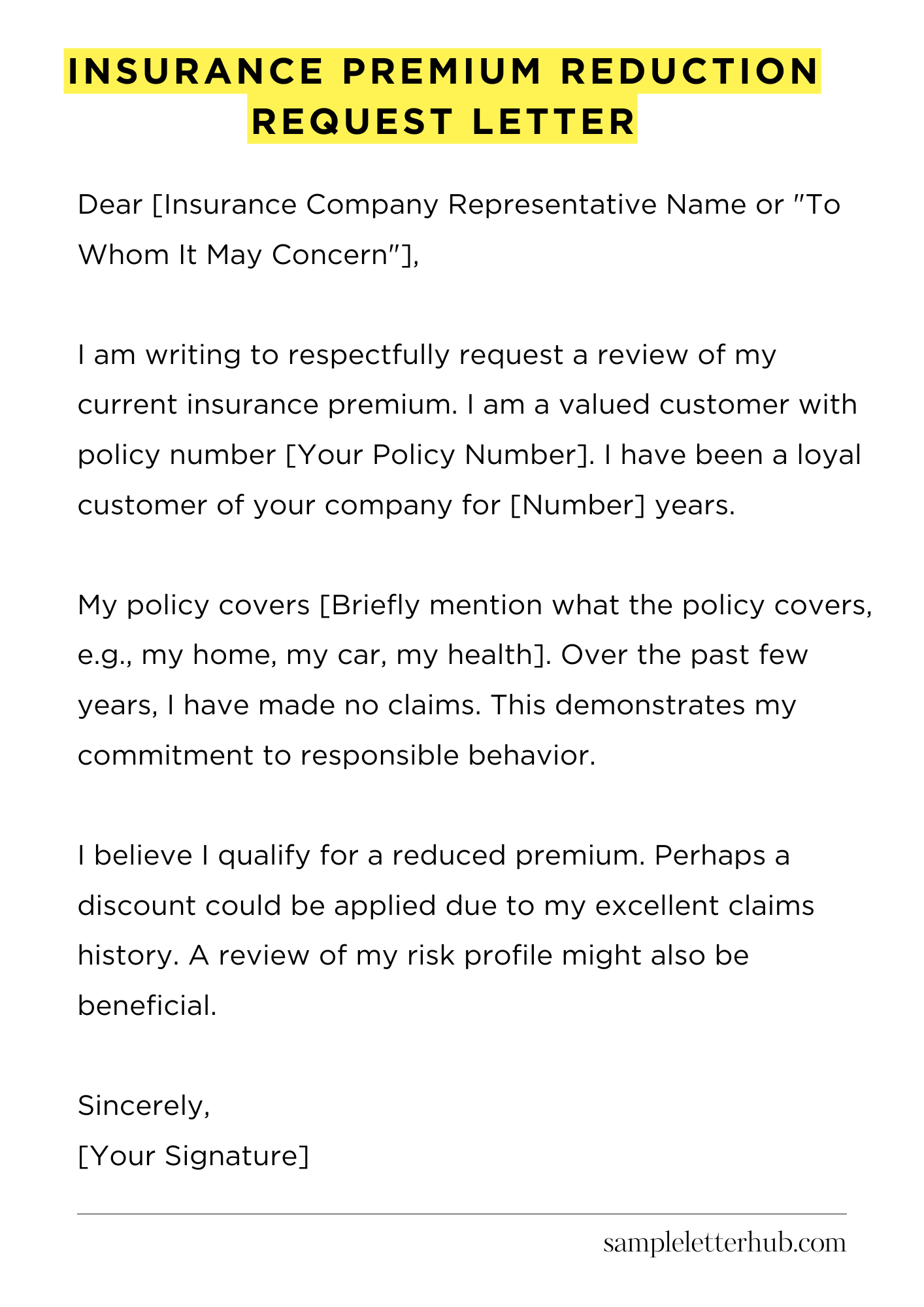
Dear [Insurance Company Representative Name or “To Whom It May Concern”],
I am writing to respectfully request a review of my current insurance premium. I am a valued customer with policy number [Your Policy Number]. I have been a loyal customer of your company for [Number] years.
My policy covers [Briefly mention what the policy covers, e.g., my home, my car, my health]. Over the past few years, I have made no claims. This demonstrates my commitment to responsible behavior.
I believe I qualify for a reduced premium. Perhaps a discount could be applied due to my excellent claims history. A review of my risk profile might also be beneficial.
I would appreciate it if you could consider my request. I am confident that a reduction would be beneficial for both of us. It would encourage my continued loyalty to your company.
I look forward to your positive response and a favorable adjustment to my premium. Thank you for your time and attention to this matter. I am available at your earliest convenience to discuss this further.
Sincerely,
[Your Signature]
How to Write Insurance Premium Reduction Request Letter
Navigating the labyrinthine world of insurance can sometimes feel like traversing an uncharted territory. One facet you might encounter is the need to petition for a reduction in your insurance premiums.
This process, while seemingly daunting, can be effectively managed with a well-crafted letter. Follow these steps to draft a persuasive and successful insurance premium reduction request.
1. Initiate: Grasp the Rationale
Before you even begin to arrange words on paper, you must first ascertain the reasons for your request. Why do you believe your premiums should be lowered? Have you enhanced your safety profile?
Did you recently eliminate certain risky behaviors? Have you successfully completed a defensive driving course? Understanding the underpinnings of your request is critical. You want a compelling argument; it will form the bedrock of your letter.
2. The Salutation: Address with Precision
Begin your letter with a formal salutation. Always address it to the correct department or, if known, the specific claims adjuster or underwriter overseeing your policy. Using their name personalizes the missive, increasing the chances of a favorable consideration.
“Dear Mr./Ms. [Last Name]” is a safe and respectful bet. If you can’t find a specific name, “To Whom It May Concern” is a reasonable fallback, but avoid it if you have a better option.
3. Introductory Preamble: State Your Intent
The opening paragraph should clearly articulate your purpose. Explicitly state you are requesting a reduction in your insurance premium. Mention your policy number for easy identification, which is a must-have.
Keep it succinct and to the point. For instance, “This letter serves as a formal request to review and, hopefully, reduce the premium for my auto insurance policy, number [Policy Number].”
4. Substantiating Evidence: Construct a Cogent Case
This is where you marshal your arguments and lay out the facts. Provide concrete, verifiable evidence to support your claims. Have you made improvements that reduce risk?
Do you have a better driving record with no at-fault accidents? Document any changes that demonstrate a diminished likelihood of a claim. Include dates, specific details, and attach copies of any supporting documentation (e.g., certificate of completion for a driver safety course) where pertinent. Be thorough; the more data you supply, the stronger your case will be.
5. The Heart of the Matter: Framing Your Request
In this section, directly and unequivocally request the premium reduction. Explain the amount you are seeking, or if you are willing to let the insurance provider decide, say that you want them to review the reduction.
For example, “I respectfully request a premium reduction of [percentage or dollar amount] on my policy, given the improvements outlined above.” or “Based on my improved driving record and safety measures, I request that you review my policy for a possible premium reduction”. This demonstrates your confidence.
6. Closing Affirmation: Express Gratitude and Reiterate Contact
Conclude your letter with a polite closing statement. Express your gratitude for their time and consideration. Reiterate your contact information, including your phone number and email address, for any necessary follow-up communication. A simple, “Thank you for your attention to this matter.
I am available at [phone number] or [email address] should you require additional information,” is sufficient.
7. The Final Flourish: Sign, Date, and Dispatch
Sign your name clearly above your typed name. Date the letter. Make sure you retain a copy for your records before sending. Send the letter via certified mail with a return receipt requested. This provides proof of delivery and ensures a paper trail. Consider this step as your personal guarantee of the process.
FAQs about Insurance Premium Reduction Request Letter
What is an Insurance Premium Reduction Request Letter?
An insurance premium reduction request letter is a formal written communication sent to an insurance provider. Its primary purpose is to ask the insurer to lower the premium for a specific insurance policy.
This request is typically made based on changes in the insured’s circumstances, such as improved risk factors (e.g., better driving record), the addition of safety features to a property, or the availability of new discounts.
What Information Should I Include in My Request Letter?
Your letter should clearly state your policy details (policy number, type of insurance). Explain the reasons for your request. Provide specific examples of how you’ve reduced your risk or qualify for a discount. Always include your contact information for the insurer to reach you. Be polite, concise, and ensure you date the letter.
What Are the Potential Benefits of Sending a Reduction Request Letter?
The primary benefit is a potential reduction in your insurance premiums. This can lead to significant cost savings over time. It may also open the door to discussions with your insurer about available discounts you weren’t previously aware of. Depending on the success, it can help make your insurance more affordable.
What if My Insurance Company Denies My Request?
If your insurer denies your request, don’t immediately give up. You can ask for a detailed explanation for the denial and review it carefully. Consider negotiating or providing further evidence. As a last resort, you can shop around with other insurance providers to get quotes and potentially find a better rate. You may also contact your state’s insurance commission.
How Can I Improve My Chances of a Successful Request?
To increase your chances of success, gather all supporting documentation, such as safety feature installation receipts or your driving record.
Submit a well-written, professional letter that is clearly written and polite. Be prepared to negotiate and compare rates from other providers. If you are a long term customer, highlight your loyalty. Also, ensure you are eligible for all discounts offered by your insurer.
Related:
Resignation letter due to rude boss
Resignation letter moving to another state
Resignation letter due to illness of family member
Resignation letter due to study