

Request for Renewal with Premium Reduction is a formal request. Its aim is to lower your insurance premium. This is done when you renew your insurance policy. You are asking your insurance provider to reconsider your rate.
We understand navigating insurance can be tricky. That’s why we’re here to help. We’ll provide you with handy templates. These are examples of “Request for Renewal with Premium Reduction” letters. They’re designed to make your life easier.
Need to draft a convincing insurance renewal letter? Look no further. Our samples will guide you. Use these to tailor your own insurance renewal request. We’ve got you covered with premium reduction letter samples and templates. Get started with these request for renewal examples today!
[Your Name/Company Name]
[Your Address]
[Your Phone Number]
[Your Email Address]
[Date]
[Insurance Company Name]
[Insurance Company Address]
Subject: Policy Renewal Request – Policy Number [Your Policy Number] and Premium Reduction
Dear [Insurance Company Representative Name/To Whom It May Concern],
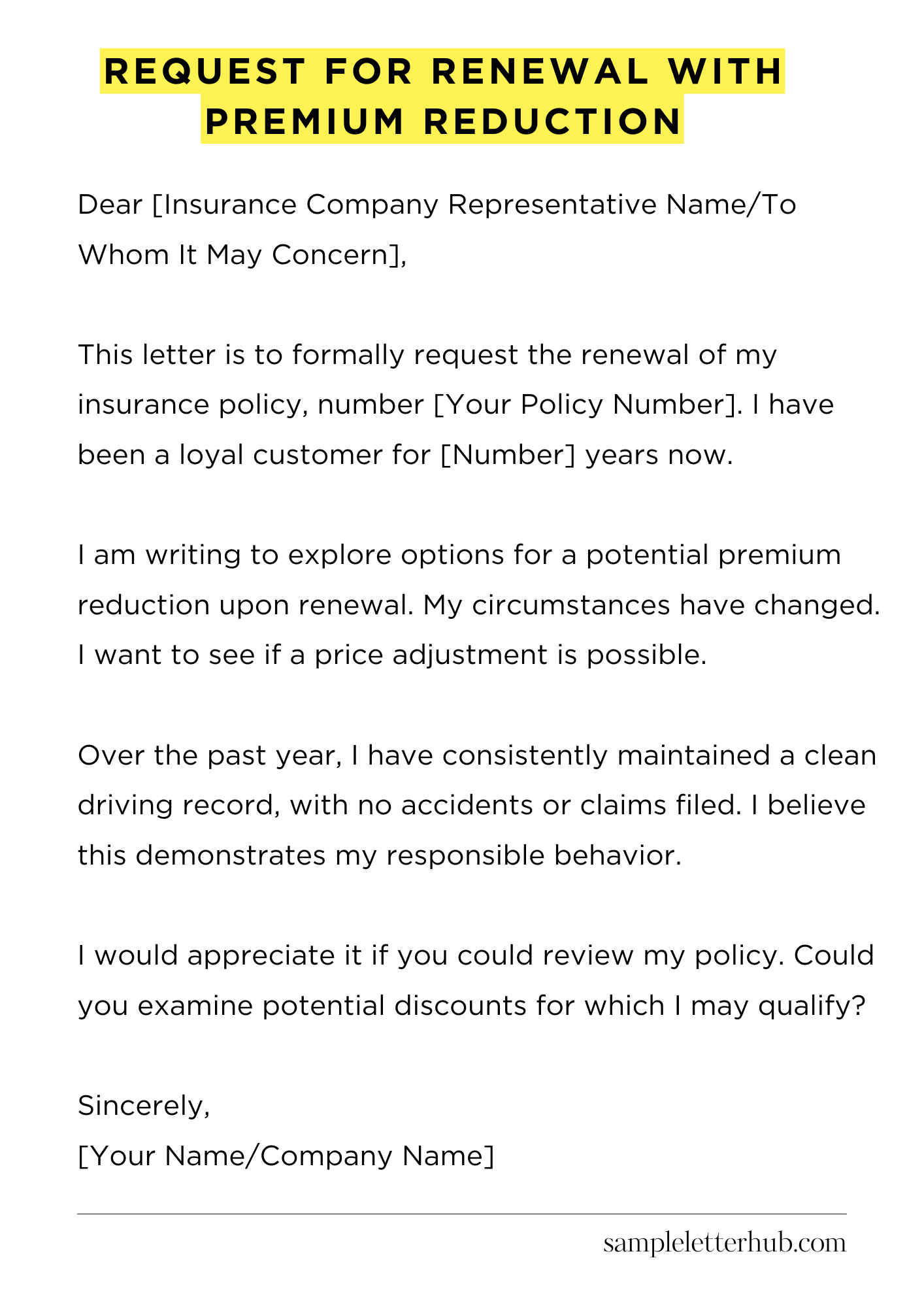
This letter is to formally request the renewal of my insurance policy, number [Your Policy Number]. I have been a loyal customer for [Number] years now. It has been a pleasure being with your company.
I am writing to explore options for a potential premium reduction upon renewal. My circumstances have changed. I want to see if a price adjustment is possible.
Over the past year, I have consistently maintained a clean driving record, with no accidents or claims filed. I believe this demonstrates my responsible behavior. The fact that I have a proven track record should be considered.
I would appreciate it if you could review my policy. Could you examine potential discounts for which I may qualify? I would be very thankful if there were lower premiums to be had.
Please let me know the updated premium amount, as well as any changes to my coverage. You can contact me by phone or email. I look forward to your prompt response and to continuing our business relationship.
Thank you for your time and consideration.
Sincerely,
[Your Name/Company Name]
How to Write Request for Renewal with Premium Reduction
Negotiating your insurance renewal can feel daunting, but it’s a strategically sound endeavor. A well-crafted letter can significantly influence your insurer’s decision.
This guide equips you with the tools to write a compelling request for a premium reduction, maximizing your chances of a favorable outcome. Preparing this is like preparing for a chess game, where your moves, in this case, the words, will either get you a Checkmate or loss.
1. Initiate: The Salutation and Introductory Proclamation
Commence with a professional salutation. Address the appropriate individual by name, if possible. Avoid generic greetings like “To Whom It May Concern.”
The introduction should concisely state your purpose: to request a renewal with a reduced premium. Clearly indicate your policy number and the specific type of coverage. This establishes the context immediately.
2. Explicate: Your Impeccable Record of Non-Claims
This is where you showcase your value to the insurer. Emphasize your history of responsible behavior. Detail your accident-free history, highlighting the length of time you’ve been a client. Mention any safety courses you’ve undertaken, or any measures you take to mitigate risk. Quantify your value. Any demonstration of risk mitigation should be included here.
3. Substantiate: Justification for Premium Review
Provide a strong justification for your request. Research and compare premiums offered by competing insurers. If you’ve received lower quotes, explicitly state the figures. Mention any improvements to your lifestyle or property that could affect risk. This could include, for example, installing a home security system. This is the heart of your argument; it needs to be watertight.
4. Negotiate: Suggesting a Concession
You can proactively suggest a specific percentage or dollar amount reduction. Be realistic. Demonstrate your understanding of the insurance landscape. Propose a balanced expectation. Avoid being unduly demanding. Aim for an agreement that is mutually agreeable. This is where you lay the first step to your aim.
5. Augment: Any Additional Supporting Information
Include any extra information that strengthens your case. Attach copies of supporting documentation, such as quotes from other insurers. If applicable, mention any affiliations or memberships that qualify you for discounts. Be thorough. These additional details serve to bolster your argument. A good practice would be the usage of supporting documents.
6. Conclude: The Formal Closing and Affirmation
End with a polite but firm closing. Reiterate your appreciation for their consideration. Express your desire to continue as a policyholder. State your willingness to discuss the matter further. Provide your contact information clearly. Make the conclusion succinct and leave a positive lasting impression.
7. Execute: Proofread, Deliver, and Follow-Up
Before submitting, meticulously proofread the letter for any errors in grammar, spelling, or punctuation. Ensure the tone is professional and polite.
If possible, send it via registered mail or email with delivery confirmation. If you don’t receive a response within a reasonable timeframe, follow up with a phone call or a polite email inquiry. Persistence, within reason, can often yield positive results. Always remember that your goal is to make sure you get the best deal.
FAQs about Request for Renewal with Premium Reduction
What is a Request for Renewal with Premium Reduction?
A Request for Renewal with Premium Reduction is a formal communication, typically sent by an insurance policyholder, to their insurance provider. It serves two primary purposes: to express the desire to continue the existing insurance coverage (renewal) and to seek a decrease in the premium amount.
This request usually outlines the reasons for the premium reduction, which might include changes in the risk profile, a good claims history, or the availability of new discounts.
What are the common reasons for requesting a premium reduction?
Policyholders commonly seek premium reductions for several reasons. These include a good claims history, demonstrating responsible behavior that minimizes the likelihood of future claims.
Another factor is a change in the insured’s risk profile, such as a decrease in the usage of a vehicle or increased security measures at a property.
Additionally, the availability of new discounts, such as those for bundling multiple policies or using advanced safety technologies, can also be a key factor. Furthermore, comparison with competitor quotes can also inform the decision to request a premium reduction.
How do I prepare a Request for Renewal with Premium Reduction?
To prepare an effective request, start by reviewing your current policy and understanding your coverage. Then, gather any supporting documentation, like proof of a good driving record, home security upgrades, or competitive quotes.
Clearly state your intention to renew your policy and specifically request a premium reduction. Provide detailed justifications for your request, citing the supporting documentation and relevant policy terms. Finally, express your willingness to discuss the request further and provide any additional information if needed.
What supporting documents should I include with my request?
The supporting documents you include depend on the reasons for your request. Common documents include: a copy of your current policy, driving records from the Department of Motor Vehicles (for auto insurance), recent home inspection reports (for home insurance), proof of security system installation.
Providing these documents strengthens your case and increases the likelihood of a positive outcome.
What happens after I submit my Request for Renewal with Premium Reduction?
After submitting your request, the insurance provider will review it along with any supporting documentation. They will then assess your eligibility for a premium reduction based on their underwriting guidelines and the specifics of your policy.
The provider will then notify you of their decision, which could be a full reduction, a partial reduction, or a denial. If the reduction is granted, you will receive a revised policy statement reflecting the new premium. If the request is denied, you may have an opportunity to discuss the decision with the provider and potentially seek clarification or explore alternative options.
Related:
Resignation letter due to rude boss
Resignation letter moving to another state
Resignation letter due to illness of family member
Resignation letter due to study