

Life happens. Sometimes, you miss an insurance payment. This could lead to policy cancellation. A request letter for insurance renewal after non-payment helps. It’s a formal way to ask your insurance company to reinstate your coverage. The letter explains the situation. It requests a second chance for insurance renewal.
Don’t worry about the writing process. We’re here to help. We’ll provide you with sample request letters. These are request letter for insurance renewal examples. You can use these templates as a starting point. Need a sample letter? We have you covered.
Our goal is simple. We want to make this easier for you. You’ll find different request letter formats. Choose the one that suits your needs. Writing an effective letter doesn’t have to be hard. Let’s get started with our letter examples!
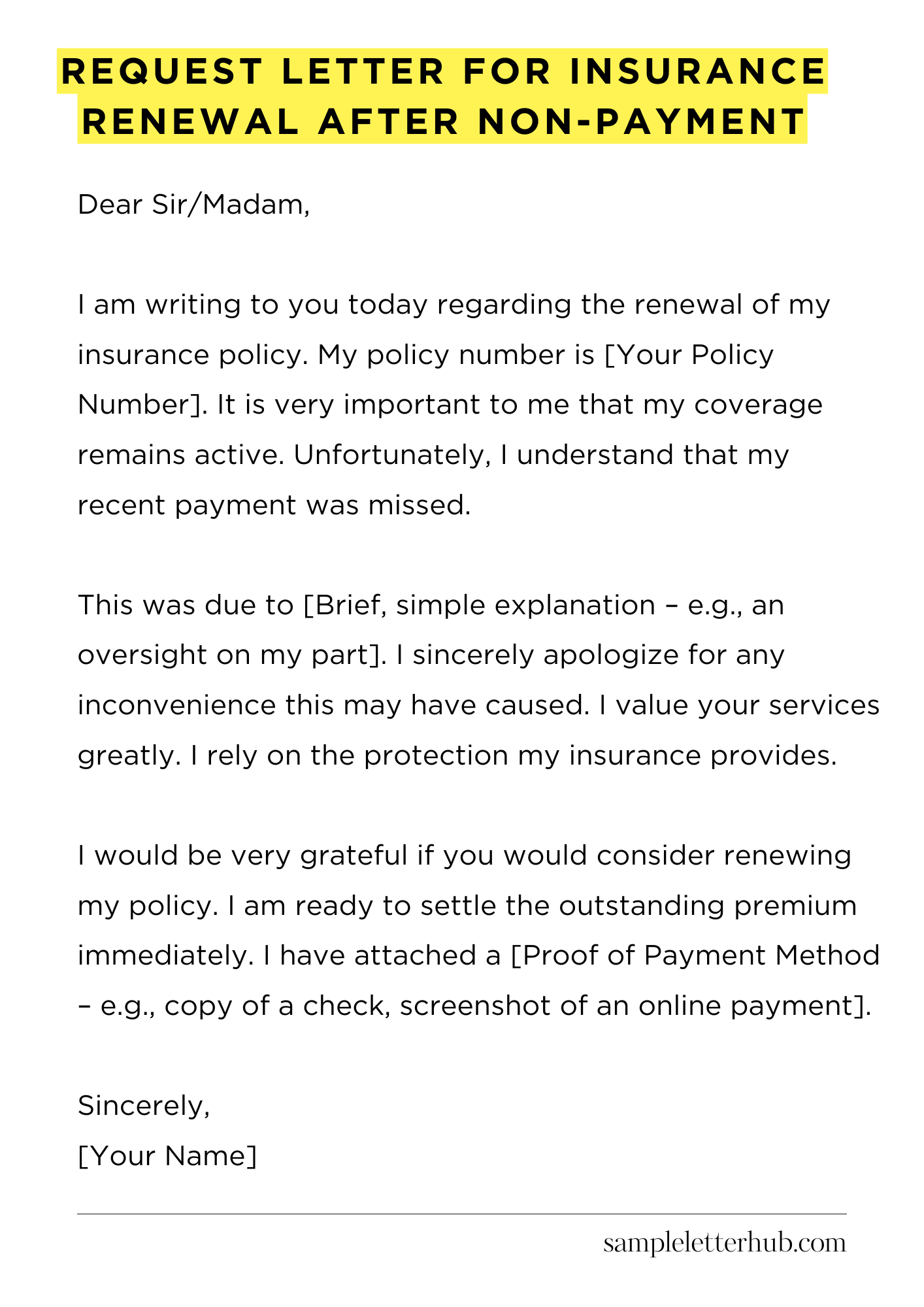
[Your Name]
[Your Address]
[Your Phone Number]
[Your Email Address]
[Date]
[Insurance Company Name]
[Insurance Company Address]
Subject: Request for Insurance Renewal – Policy Number [Your Policy Number]
Dear Sir/Madam,
I am writing to you today regarding the renewal of my insurance policy. My policy number is [Your Policy Number]. It is very important to me that my coverage remains active. Unfortunately, I understand that my recent payment was missed.
This was due to [Brief, simple explanation – e.g., an oversight on my part]. I sincerely apologize for any inconvenience this may have caused. I value your services greatly. I rely on the protection my insurance provides.
I would be very grateful if you would consider renewing my policy. I am ready to settle the outstanding premium immediately. I have attached a [Proof of Payment Method – e.g., copy of a check, screenshot of an online payment]. Please find it enclosed for your review.
Could you please confirm the process for reinstating my coverage? I would appreciate it if you could let me know the total amount due to get the policy back in good standing. This will allow me to settle it quickly. I want to make sure I am covered.
Thank you for your time and understanding in this matter. I eagerly await your positive response. I look forward to hearing from you soon.
Sincerely,
[Your Name]
How to Write Request Letter for Insurance Renewal After Non-Payment
Life throws curveballs. One such uninvited pitch can be overlooking an insurance premium payment, leading to policy lapse. Don’t despair; reviving your coverage is often achievable through a well-crafted request letter. This missive serves as your lifeline to reinstate your protection. This guide will walk you through the essential components of composing an effective letter to your insurer.
1. Commence with Proper Salutation
Begin your letter with a formal salutation. Address the letter to the appropriate department or individual at the insurance company. If you know the name of the claims adjuster or the specific department handling policy renewals, use it. For instance, “Dear Claims Department” or “Dear Mr./Ms. [Last Name]”.
Avoid generic greetings such as “To Whom It May Concern.” This demonstrates a personalized approach.
2. The Imperative: Policy Identification
Clearly state your policy number and the type of insurance (e.g., auto, home, health). Include the policy’s effective dates. This crucial information facilitates the insurer’s swift retrieval of your records and streamlines the processing of your request. Omission of this detail can induce unnecessary delays or even misidentification of your policy, the consequences of which could be severe.
3. Articulate the Request and Circumstances
In a direct and succinct manner, specify that you are requesting a renewal of your insurance policy despite the non-payment. Be transparent about why the payment was missed.
Was it an oversight, a temporary financial setback, or a mailing discrepancy? Explain the rationale with conciseness and truthfulness. This candidness can often sway the insurer in your favor. Note that the insurer might not accept your explanation; it is important to be factual.
4. Explain Mitigation and Corrective Actions
Elaborate on the steps you’ve undertaken to rectify the situation. Did you make the overdue payment promptly? Provide the payment date, the method, and any confirmation number.
If you haven’t paid yet, state your intention to do so and propose a realistic timeline for payment. Show them you are taking proactive measures. Offering to pay any late fees or interest charges associated with the reinstatement of the policy is also recommended. Demonstrating this intent is paramount.
5. Highlight the Benefits of a Continued Relationship
Remind the insurer of the existing, beneficial relationship. If you’ve been a loyal customer for years, mention it. Reference any claims history – especially if it’s favorable, such as a history of no claims.
Highlighting your commitment to the insurance company can act as an incentive for them to accommodate your request. Furthermore, stress the importance of continuous coverage to you. It’s an affirmation of your interest.
6. Reinforce the Desire for Renewal
Reiterate your strong desire for policy renewal. Reiterate that you value the security it provides. Express your understanding of the situation and the importance of adhering to payment schedules going forward. End with a polite and appreciative tone, such as “Thank you for your time and consideration in this matter.”
7. Essential: Closing and Contact Information
Conclude with a formal closing, like “Sincerely,” or “Respectfully.” Sign the letter and clearly type your full name. Include your current address, phone number, and email address.
This contact information enables the insurer to reach you quickly. Be certain that all of your contact details are accurate and current. Proofread the entire letter meticulously before submitting it.
FAQs about Request Letter for Insurance Renewal After Non-Payment
What is the primary purpose of a request letter for insurance renewal after non-payment?
The primary purpose of a request letter for insurance renewal after non-payment is to formally ask the insurance provider to reinstate a lapsed policy.
It provides the policyholder with an opportunity to explain the reasons for the missed payment, typically requesting a grace period or appealing to the insurer’s understanding. Furthermore, it aims to resume coverage and minimize potential gaps in protection.
What key information should be included in the request letter?
The request letter should include the policyholder’s full name, policy number, and contact information. It must clearly state the reason for the non-payment, providing details and supporting documentation, if applicable.
The letter should specifically request the policy’s reinstatement and the preferred method of payment for the outstanding premium. It’s also important to specify the desired renewal date and any specific conditions the policyholder would like to address.
What are the possible outcomes after sending the request letter?
Following the submission of the request letter, the insurance provider will review the details and decide whether to reinstate the policy. Possible outcomes include approval with a requirement for payment of the overdue premium, potential adjustments to the premium or coverage, or denial.
In some cases, the insurer may request additional information. Policyholders will receive a response outlining the decision and any necessary actions, along with the date of coverage.
How can a policyholder increase the chances of a successful renewal?
Policyholders can increase their chances of a successful renewal by being prompt, honest, and clear in the request letter. Providing a detailed explanation for the non-payment and including supporting documentation, such as medical bills or financial hardship details, can be beneficial.
It’s crucial to pay the outstanding premium promptly once instructed to do so and to respond to any inquiries from the insurance provider as quickly as possible. Demonstrating a history of responsible payment can also influence the insurer’s decision.
What are the legal implications if an insurance renewal request is denied?
If an insurance renewal request is denied, the policyholder is left without coverage, potentially exposing them to financial risks. The denial means the policy is officially terminated, and any claims made after the lapse will likely not be covered.
Legal implications vary depending on the jurisdiction and specific policy terms, and it is advisable to seek legal counsel to explore options, such as filing complaints with consumer protection agencies or seeking coverage from other insurance providers. Always be sure to check the specific terms and conditions.
Related:
Resignation letter due to rude boss
Resignation letter moving to another state
Resignation letter due to illness of family member
Resignation letter due to study