


Your homeowners insurance policy is important. It protects your biggest asset. A renew homeowners insurance policy letter is a crucial document. It confirms your coverage for another year. The insurance company sends it to you. It outlines policy details and renewal terms.
Writing this letter can feel daunting. Don’t worry, we’re here to help! We have great news. We are offering different renew homeowners insurance policy letter samples. These examples will act as a guide. They will make crafting your letter a breeze.
Whether you’re confirming coverage or addressing an issue, we’ve got you. Our renew homeowners insurance policy letter template collection will make your writing easy. Get ready to write a letter like a pro!
[Your Name/Insurance Company Name]
[Your Address]
[Your City, State, Zip Code]
[Date]
[Insurance Company Name/Policyholder Name]
[Insurance Company Address/Policyholder Address]
[Insurance Company City, State, Zip Code/Policyholder City, State, Zip Code]
Dear [Policyholder Name/Insurance Company Contact],
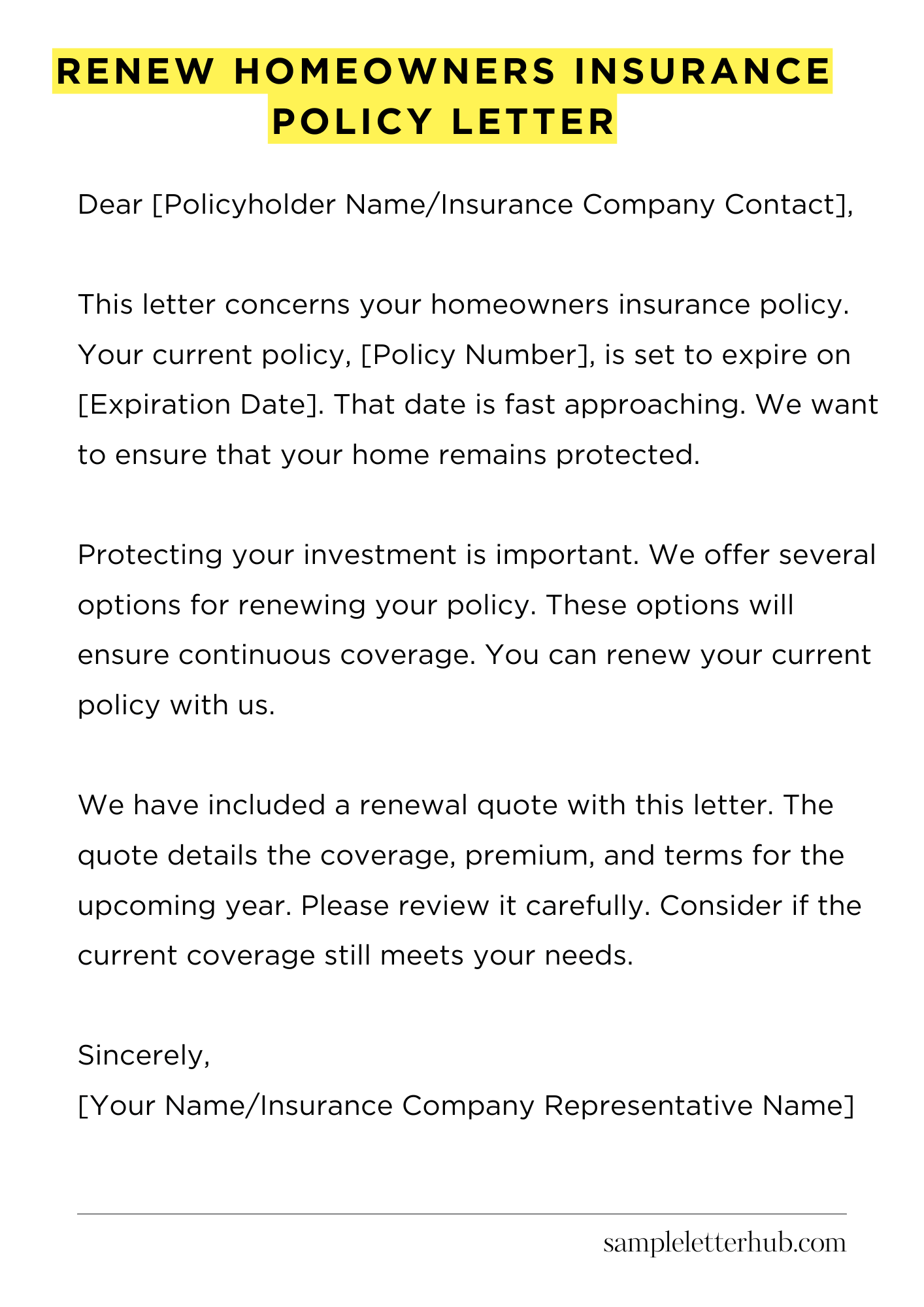
This letter concerns your homeowners insurance policy. Your current policy, [Policy Number], is set to expire on [Expiration Date]. That date is fast approaching. We want to ensure that your home remains protected.
Protecting your investment is important. We offer several options for renewing your policy. These options will ensure continuous coverage. You can renew your current policy with us. Or you can explore different coverage levels.
We have included a renewal quote with this letter. The quote details the coverage, premium, and terms for the upcoming year. Please review it carefully. Consider if the current coverage still meets your needs.
We also encourage you to assess your current home value. This includes any recent renovations or improvements. You may want to update your policy to reflect these changes. This ensures you have adequate coverage in the event of a claim.
To renew your policy, you can take a few simple steps. You can review the attached documents. Then you can choose the renewal option that best suits your needs. You can pay the premium by the deadline. We’ve made the process convenient for you.
You can renew online through our website, [Website Address]. This is the easiest and quickest way. You can also call us at [Phone Number] to speak with a customer service representative. We are here to answer any questions you have. Finally, you can mail back the renewal form. It is included with this letter.
Please renew your policy by [Renewal Deadline]. This allows us to process your renewal smoothly. Doing this will prevent any lapse in your coverage. We value your business. We look forward to continuing to protect your home.
Sincerely,
[Your Name/Insurance Company Representative Name]
How to Write Renew Homeowners Insurance Policy Letter
Renewing your homeowners insurance policy might seem like a mundane task, but proper documentation is key. A well-crafted renewal letter ensures a seamless transition and can sometimes even be leveraged for advantageous terms. Here’s a compendium of directives to guide you through composing a proficient renewal letter.
1. Initiate with Clarity and Precision
Your letter’s inception should be characterized by unwavering lucidity. Begin by unequivocally stating the purpose: to renew your homeowners insurance policy. Include your full name, address, and, crucially, your policy number. This initial segment acts as the epistolary compass, immediately orienting the recipient.
2. Dates, Dates, Dates – The Chronological Cornerstone
The date of the letter and the policy’s expiration date are of paramount importance. Clearly indicate both dates to establish the temporal framework for the renewal request. This circumvents any ambiguity and ensures the insurance company processes your renewal within the prescribed timeframe.
3. A Recapitulation of Coverage Demarcations
Provide a succinct summary of your current coverage. This might include the dwelling coverage amount, personal property coverage, liability limits, and any specific endorsements you possess. Reviewing your policy details before writing will help. This acts as a reminder for both you and the insurer and ensures that all pertinent aspects of your existing policy are acknowledged.
4. Deliberations on Modifications & Refinements
This is where you can broach any desired adjustments to your policy. If you’ve made improvements to your home that necessitate increased coverage, or if you want to explore the possibility of altering your deductible, now is the opportune moment to articulate these needs. Be explicit and provide supporting documentation if necessary.
5. The Financial Cadre: Premium Payment Details
Propose the proposed payment method. This clarifies your intentions regarding premium payment, streamlining the process and forestalling any potential delays. You might specify whether you intend to pay in full, opt for installments, or utilize a particular payment gateway. Provide a valid method of communication.
6. The Formal Closure: Professional Sign-Off
Conclude your letter with a professional and courteous closing, such as “Sincerely” or “Respectfully.” Sign your name legibly, and type your name beneath your signature. This act of formality underscores your intent and lends credibility to your correspondence.
7. The Culmination: Proofreading and Dispatch
Before dispatching your letter, rigorously proofread it. Scrutinize for grammatical errors, spelling mistakes, and any omissions of crucial information.
A meticulously crafted letter reflects your attention to detail and fosters a positive impression. Make sure you send your letter well in advance of the policy’s expiration date, and retain a copy for your records, as your personal sentinel of documentation.
FAQs about Renew Homeowners Insurance Policy Letter
What information is typically included in a homeowners insurance renewal letter?
A standard homeowners insurance renewal letter usually contains key details about your policy. This includes the policy number, the effective dates of the renewal period, the property address covered, a summary of your current coverage levels (dwelling, personal property, liability, etc.), and the premium amount for the upcoming term.
It will also typically provide information on any changes to your coverage or premium, such as updates due to inflation, changes in risk, or modifications you’ve requested. Contact information for your insurance provider or agent is also included for any questions or to make changes.
When should I expect to receive my homeowners insurance renewal letter?
You should generally receive your renewal letter approximately 30 to 45 days before your current policy expires.
This timeframe allows you ample time to review the details, compare it with other options if you’re considering a change, and contact your insurance provider with any questions or concerns. However, this timeframe can vary slightly depending on the insurance company and the state’s regulations.
What should I do if the renewal premium is higher than I expected?
If the renewal premium is higher than anticipated, you should first review the letter carefully to understand the reasons for the increase. Common factors include rising construction costs, inflation, changes in your home’s assessed value, and increased risk factors in your area (e.g., more frequent severe weather).
You should then contact your insurance agent or provider to discuss the increase. Inquire about the specific factors contributing to the higher premium. You might ask about potential discounts you may be eligible for, such as those for having a security system, impact-resistant windows, or bundling your home and auto insurance.
You could also request a review of your coverage to ensure it still meets your needs and to explore options for adjusting coverage levels to potentially lower the premium.
Can I make changes to my coverage when I receive the renewal letter?
Yes, you can typically make changes to your coverage when you receive the renewal letter. The letter provides an opportunity to review your policy and make adjustments based on your current needs and circumstances.
You can increase or decrease coverage limits, add or remove endorsements (like flood or earthquake coverage), update your personal information, or modify deductibles.
To make changes, contact your insurance agent or provider and clearly communicate the desired modifications. Be aware that changes to your coverage may affect your premium. It’s also important to confirm that the changes are accurately reflected in the final policy documents.
What happens if I don’t renew my homeowners insurance policy?
If you choose not to renew your homeowners insurance policy, the coverage will lapse on the expiration date specified in your current policy. This means you will no longer have financial protection for your home and belongings against covered perils like fire, theft, or weather damage.
If you have a mortgage, your lender likely requires you to maintain homeowners insurance, and they may purchase a policy for you and charge you for it if you fail to renew. In addition to financial risks, failure to renew could also lead to difficulty obtaining future coverage, as insurance companies assess your history of coverage when evaluating new applications.
Related:
Resignation letter due to rude boss
Resignation letter moving to another state
Resignation letter due to illness of family member
Resignation letter due to study