

A Fire Insurance Policy Cancellation Letter is a formal document. It is written to your insurance provider. You are telling them you want to cancel your fire insurance. The purpose is to officially end your fire insurance coverage. This protects you from future billing.
Need help writing that Fire Insurance Policy Cancellation Letter? You’re in the right place. We’ll give you ready-made templates. We have Fire Insurance Policy Cancellation Letter examples. Fire Insurance Cancellation Letter samples are also available. These will help you compose your own letter quickly.
We understand writing can be tricky. Don’t worry, these examples are designed for ease of use. Each Fire Insurance Policy Cancellation Letter template is easily customizable. You can adjust it to fit your specific needs. Get started now and take control of your fire insurance!
[Your Name/Company Name]
[Your Address]
[Your Phone Number]
[Your Email Address]
[Date]
[Insurance Company Name]
[Insurance Company Address]
Subject: Cancellation of Fire Insurance Policy – Policy Number [Your Policy Number]
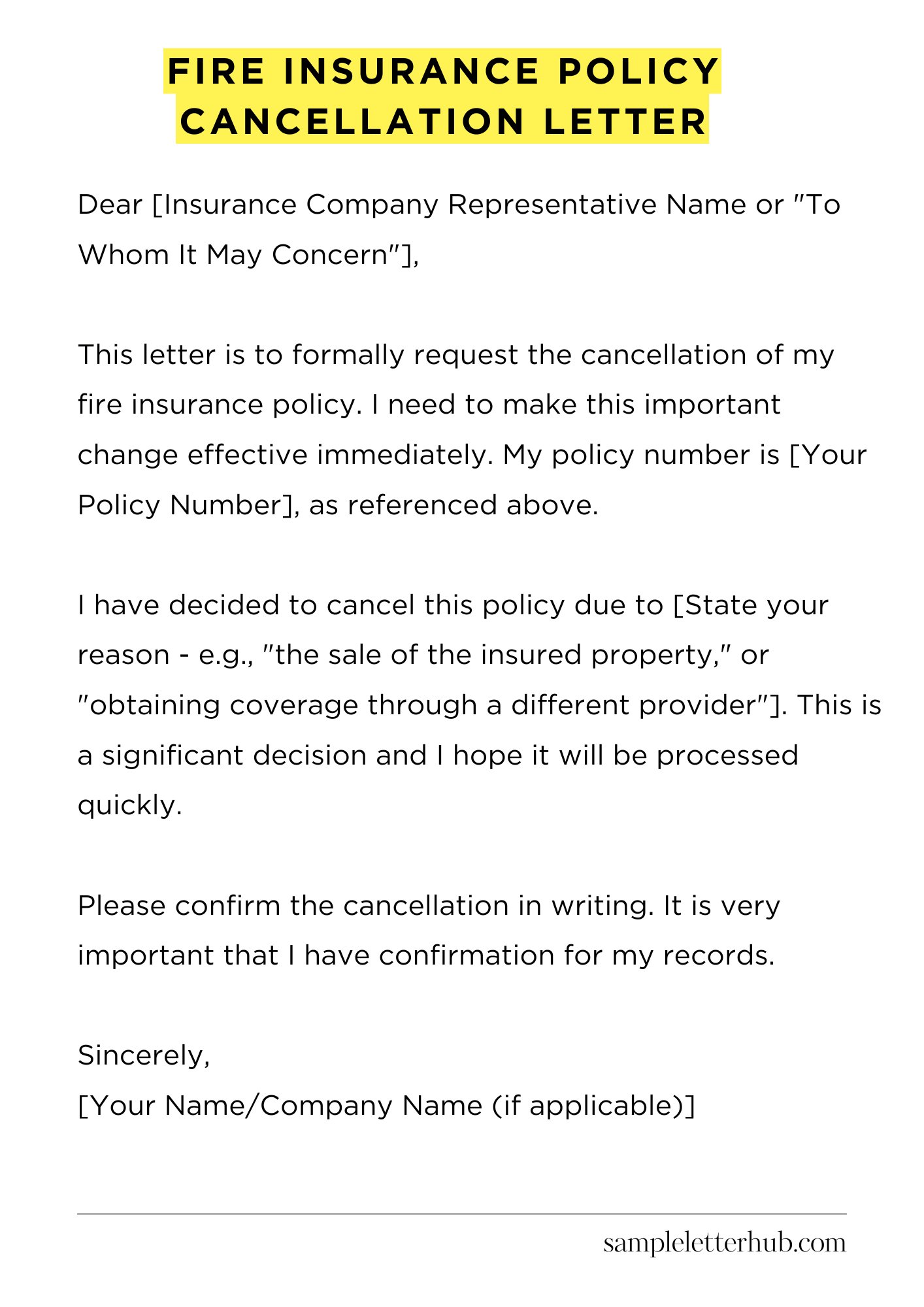
Dear [Insurance Company Representative Name or “To Whom It May Concern”],
This letter is to formally request the cancellation of my fire insurance policy. I need to make this important change effective immediately. My policy number is [Your Policy Number], as referenced above.
I have decided to cancel this policy due to [State your reason – e.g., “the sale of the insured property,” or “obtaining coverage through a different provider”]. This is a significant decision and I hope it will be processed quickly.
Please confirm the cancellation in writing. It is very important that I have confirmation for my records. The confirmation should include the effective date of cancellation, along with any details regarding a possible refund of premiums.
I would appreciate receiving this confirmation as soon as possible. Processing my request without any delay would be greatly appreciated. Thank you for your time and attention to this matter.
Sincerely,
[Your Name/Company Name (if applicable)]
How to Write Fire Insurance Policy Cancellation Letter
Canceling your fire insurance policy requires a degree of formality. There’s a proper protocol to follow. This is crucial to avoid any potential coverage snags or legal complications. Let’s delve into the pragmatic steps for crafting an effective fire insurance policy cancellation letter.
1. Commence with Proper Salutations
Your missive should begin with a professional salutation. This sets the tone for the entire communication. Always use the recipient’s proper title and name. If you are unsure, investigate this.
The correct form is essential. “Dear Mr./Ms. [Last Name]” is generally appropriate. If the contact person is unspecified, a more generic, yet formal, approach such as “To Whom It May Concern” is suitable.
2. Explicitly State Your Intent
The core of your letter must be a clear and unambiguous statement of your intent. Procrastination in this matter is not an option. State definitively that you are cancelling your fire insurance policy. Include the policy number. Provide the effective cancellation date. This is critical. Be direct and avoid any wishy-washy language.
3. Furnish Pertinent Policy Details
To facilitate the cancellation process, you need to provide the insurer with detailed information. This is to help them identify your policy. Include your full name, address, and the policy number associated with your fire insurance. Include the property address insured. Consider including the inception date of the policy. This will help them speed up things.
4. Explain the Rationale (Optional)
While not mandatory, briefly explaining the rationale behind your cancellation can be advantageous. Provide a concise explanation. For instance, if you are selling the property, relocating, or switching to a different insurer, mention this succinctly. This aids in transparency. This is not usually required, but it is a good way to stay on the good side of the insurer.
5. Stipulate the Refund Protocol (If Applicable)
Inquire about any potential refund of premiums. If you are eligible for a refund, specify how you would like to receive it. State your preference. Ask them to confirm this procedure in writing. Provide any necessary banking information, if required. This safeguards against future misunderstanding. This is for your records.
6. Conclude with a Professional Closing
A polished closing is pivotal. Your letter’s final words leave a lasting impression. Use a formal closing, such as “Sincerely,” “Yours truly,” or “Respectfully.” Sign your name above your typed name. If sending via postal mail, you should always sign the document. Proofread the entire letter meticulously before sending it.
7. Delivery and Documentation
How you submit the letter matters. Always retain a copy of your letter for your records. Consider sending the letter via certified mail with return receipt requested.
This provides proof of delivery. Alternatively, if your insurer accepts electronic communication, consider sending the letter via email. Ensure you keep a record of the sent email. Follow up with a phone call to confirm receipt and understanding of your request.
FAQs about Fire Insurance Policy Cancellation Letter
What is a fire insurance policy cancellation letter, and when is it necessary?
A fire insurance policy cancellation letter is a formal document used to notify an insurance company of the policyholder’s decision to terminate their fire insurance coverage.
It becomes necessary when the policyholder no longer requires the insurance, such as when a property is sold, the coverage is duplicated, or the policyholder finds a more suitable policy. The letter officially ends the insurance contract and can initiate the return of any unearned premiums.
What information should be included in a fire insurance policy cancellation letter?
A comprehensive cancellation letter should include the policyholder’s full name, address, and contact information. It must clearly state the intention to cancel the fire insurance policy, the policy number, the effective date of cancellation, and the reason for cancellation if desired.
It is also advisable to request confirmation of the cancellation and details about any potential refund of premiums. Signing and dating the letter are also essential.
How and when should I send my fire insurance policy cancellation letter?
The cancellation letter should be sent to the insurance company via a method that provides proof of delivery, such as certified mail with a return receipt requested.
This ensures that there is documented evidence that the insurance company received the notice. It is generally recommended to send the letter at least 30 days before the desired cancellation date, or as specified in the insurance policy terms, to allow sufficient processing time.
Can I get a refund of premiums after cancelling my fire insurance policy?
Whether a refund is available depends on the policy terms and the timing of the cancellation. If the policyholder cancels the policy before its expiration date, they are typically entitled to a refund of any unearned premiums. The amount of the refund is calculated based on the remaining period of the policy.
The cancellation letter often includes a request for the refund, and the insurance company will outline the refund process and amount.
What are the potential consequences of canceling my fire insurance policy?
Cancelling a fire insurance policy can have several consequences. First, without coverage, the property is no longer protected against financial losses from fire damage.
There may be legal implications as fire insurance is often required by mortgage lenders. Also, if a fire occurs after the cancellation date, the policyholder will be solely responsible for all associated costs. Therefore, it is important to ensure alternate coverage is in place or there is a valid reason for its cancellation.
Related:
Resignation letter due to rude boss
Resignation letter moving to another state
Resignation letter due to illness of family member
Resignation letter due to study