


A commercial insurance cancellation letter is a formal document. It notifies an insurance company of your intent. You are canceling your business insurance policy. The main purpose is to officially end the coverage. It protects you legally and ensures a clean break.
Need help writing that tricky commercial insurance cancellation letter? We’ve got you covered. This article offers helpful commercial insurance cancellation letter templates. You will find different commercial insurance cancellation letter samples. Our goal is to make it easy for you. Write the perfect commercial insurance cancellation letter fast!
These commercial insurance cancellation letter examples are ready to use. Just adapt them to your specific needs. Whether it’s general liability insurance or another type, we provide what you need. Save time and avoid confusion. Get started on your commercial insurance cancellation letter today!
[Your Name/Your Company Name]
[Your Address]
[Your City, Postal Code]
[Your Email]
[Your Phone Number]
[Date]
[Insurance Company Name]
[Insurance Company Address]
[Insurance Company City, Postal Code]
Subject: Cancellation of Commercial Insurance Policy – Policy Number [Policy Number]
Dear [Insurance Company Contact Person, if known, otherwise use “Sir/Madam”],
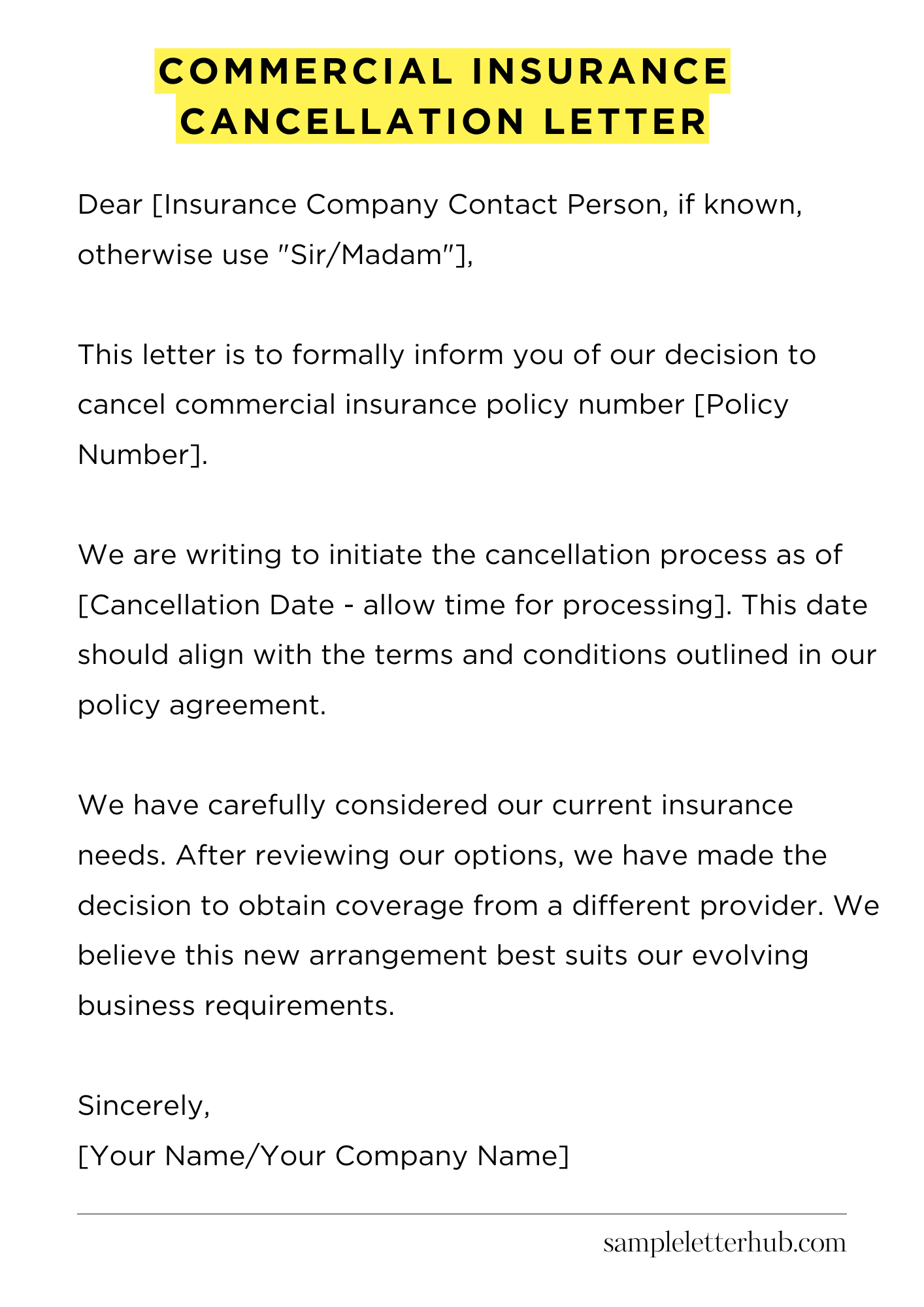
This letter is to formally inform you of our decision to cancel commercial insurance policy number [Policy Number]. We are writing to initiate the cancellation process as of [Cancellation Date – allow time for processing]. This date should align with the terms and conditions outlined in our policy agreement.
We have carefully considered our current insurance needs. After reviewing our options, we have made the decision to obtain coverage from a different provider. We believe this new arrangement best suits our evolving business requirements.
The reason for our cancellation is [Briefly state the reason, e.g., “more competitive rates,” “a change in our business operations,” or “restructuring our insurance portfolio.”]. You don’t need to go into too much detail. We would appreciate it if you could confirm the cancellation in writing.
Please provide us with a confirmation letter once the cancellation is processed.
The letter should include the effective date of cancellation. We would also like to receive information regarding any potential refund of premiums, if applicable. Please specify the amount and the timeframe for receiving the refund. We have included our preferred mailing address for this information above.
We look forward to your prompt response and confirmation. Thank you for your time and assistance in this matter. We value the service you have provided us.
Sincerely,
[Your Name/Your Company Name]
How to Write Commercial Insurance Cancellation Letter
Navigating the termination of a commercial insurance policy can be a complex endeavor. A well-crafted cancellation letter is paramount, serving as a formal declaration and initiating the process. Here’s how to ensure your letter meets the requisite standards and safeguards your interests:
1. Commence with Proper Salutation and Identification
Begin your letter with a formal salutation. Address it to the relevant department or individual at the insurance provider, often the Underwriting Department or a specific claims handler.
Accompany your salutation with crucial identifiers. Include your company’s full legal name, the policy number, and the specific type of commercial insurance policy you are canceling, like General Liability or Property Insurance. This preliminary step expedites processing and reduces the potential for misidentification.
2. Explicitly State the Cancellation Intent
Be unequivocally clear about your intention: to cancel the policy. Avoid ambiguity or circumlocution. Directly state that you are formally requesting the cancellation of the policy, citing the policy number for unequivocal reference. The clarity here is critical; it eliminates any potential for misinterpretation or future disputes.
3. Stipulate the Effective Date of Cancellation
Crucially, you must specify the desired effective date of cancellation. This is the date the policy’s coverage ceases to be valid. Adhere to the terms outlined in your insurance contract regarding the notice period required for cancellation, which can vary depending on jurisdiction and policy specifics.
Ensure this date aligns with your operational needs or the commencement of a new insurance policy to avoid coverage gaps.
4. Articulate the Reason for Cancellation (Optional but Recommended)
Although not always mandatory, providing a concise reason for cancellation can be advantageous. Whether you’re switching to a more cost-effective provider, ceasing business operations, or consolidating insurance coverage, detailing the rationale can foster a smoother cancellation process.
Be polite and professional; avoid accusatory language. This transparency can facilitate more amicable closure of the contractual agreement.
5. Address Premium Refunds (If Applicable)
Inquire about any potential premium refunds. If you’ve paid premiums in advance and are canceling the policy prior to its expiration date, you may be entitled to a pro-rata refund.
Explicitly state your request for a refund and specify the preferred method of reimbursement. Providing your banking details or the address where a check can be mailed helps expedite the process.
6. Confirm the Receipt of Confirmation
Request written confirmation of the cancellation. This is a crucial step to safeguard your records. Ask the insurer to provide written confirmation of the cancellation, including the effective date.
State that you would like a confirmation sent to your address or email, providing these details. Retain this confirmation for your records as indisputable proof of the termination of the insurance contract.
7. Execute with Professionalism and Maintain Records
Conclude your letter with a formal closing and include your full name, title, and the company’s contact information. Sign the letter manually for added authenticity.
Consider sending the letter via certified mail with return receipt requested to provide documented proof of delivery. Maintain a copy of the letter, the return receipt, and the cancellation confirmation in your business records for future reference. Diligence and accurate record-keeping are essential in any formal correspondence.
FAQs about Commercial Insurance Cancellation Letter
What is a commercial insurance cancellation letter?
A commercial insurance cancellation letter is a formal document sent by either the insurance provider or the policyholder to terminate a commercial insurance policy. It officially notifies the other party of the intent to cancel the insurance coverage and specifies the effective date of the cancellation.
What information should be included in a commercial insurance cancellation letter?
A cancellation letter should include essential details such as the policyholder’s name, the insurance company’s name, the policy number, the effective date of cancellation, and the reason for cancellation (if applicable). It should also be signed and dated by the appropriate party. The letter should be clear, concise, and professional.
How much notice is typically required before canceling a commercial insurance policy?
The required notice period for canceling a commercial insurance policy varies based on state regulations and the terms of the policy itself. Generally, it’s recommended to provide at least 30 days’ notice, but some policies may require 60 days or more. Review the specific policy documents to determine the required notice period.
What happens after a commercial insurance policy is canceled?
After a commercial insurance policy is canceled, the insurance coverage ends on the specified cancellation date. The policyholder may be entitled to a refund of any unearned premiums, which is the portion of the premium paid for the remaining coverage period. The policyholder should secure replacement coverage to avoid a lapse in protection.
Can a commercial insurance policy be reinstated after cancellation?
Reinstatement of a canceled commercial insurance policy is possible, but it depends on the insurance company’s policies and the specific circumstances of the cancellation.
The policyholder typically needs to apply for reinstatement, which may involve providing additional information, undergoing underwriting, and paying any outstanding premiums. Reinstatement is not guaranteed and is at the insurer’s discretion.
Related:
Resignation letter due to rude boss
Resignation letter moving to another state
Resignation letter due to illness of family member
Resignation letter due to study