

Moving can be exciting. But it also involves many tasks. One of these is updating your insurance policies. You might need to cancel your current insurance. This is often due to a relocation. A Cancel Insurance Policy Due to Relocation Letter formally requests this cancellation. It notifies your insurance provider of your move.
Writing this letter can seem daunting. That is why we are here! We will share templates, examples, and samples of these letters. We provide a variety of formats. We want to make it easy for you. You can quickly adapt any cancel insurance letter sample.
This article is your guide to crafting these essential documents. Whether it’s car insurance or home insurance, we have you covered. Our letter samples simplify the process. They help you stay organized during your move. Get ready to streamline your insurance cancellation needs.
[Your Name]
[Your Address]
[Your Phone Number]
[Your Email Address]
[Date]
[Insurance Company Name]
[Insurance Company Address]
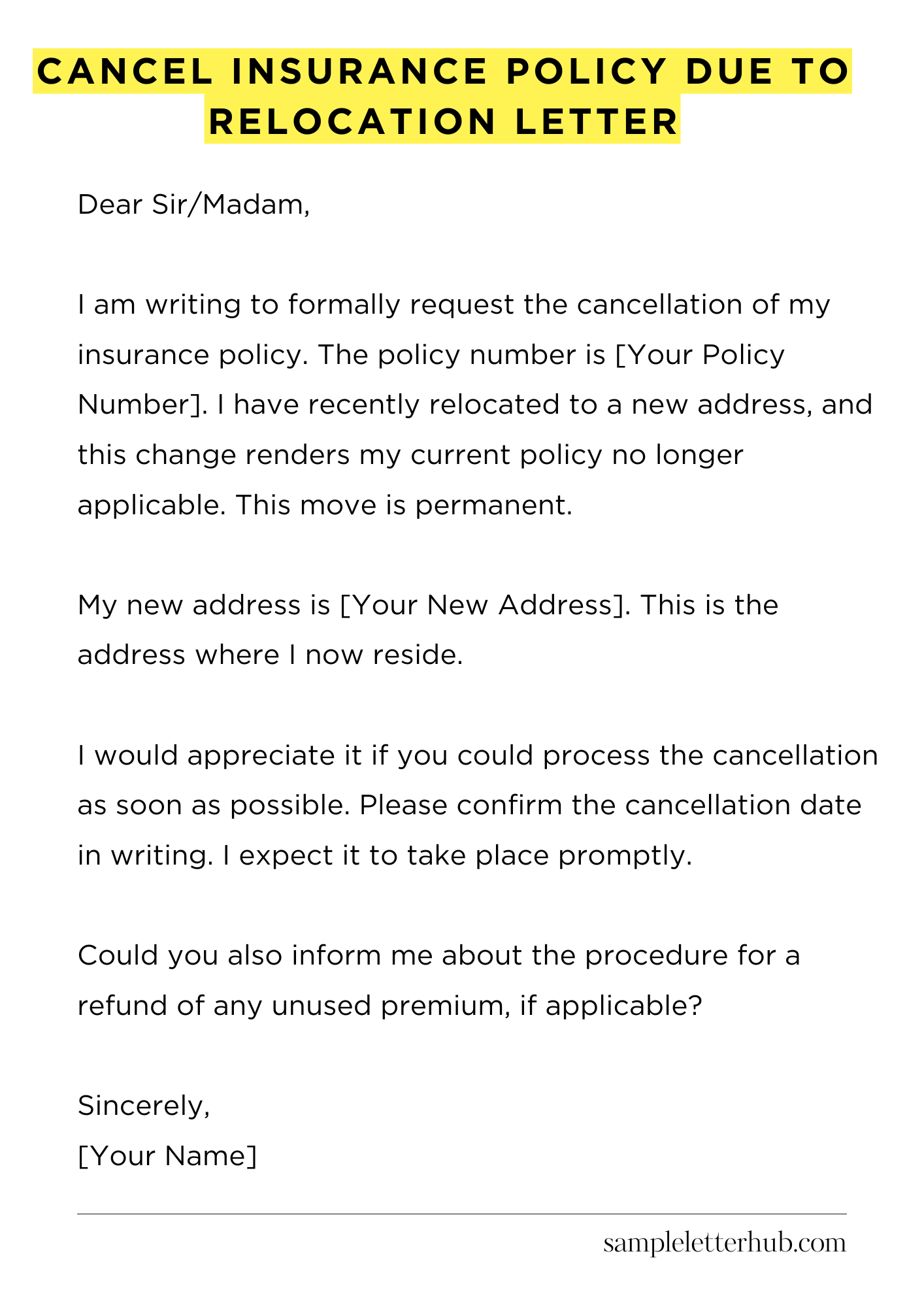
Dear Sir/Madam,
I am writing to formally request the cancellation of my insurance policy. The policy number is [Your Policy Number]. I have recently relocated to a new address, and this change renders my current policy no longer applicable. This move is permanent.
My new address is [Your New Address]. This is the address where I now reside.
I would appreciate it if you could process the cancellation as soon as possible. Please confirm the cancellation date in writing. I expect it to take place promptly.
Could you also inform me about the procedure for a refund of any unused premium, if applicable? I am keen to understand what the next steps are.
Thank you for your time and assistance in this matter. Your prompt attention will be greatly appreciated.
Sincerely,
[Your Name]
How to Write Cancel Insurance Policy Due to Relocation Letter
Relocating can be a logistical labyrinth, demanding you to navigate a complex web of tasks. One crucial, yet often overlooked, aspect of this process involves ensuring your insurance policies align with your new circumstances.
This necessitates crafting a well-structured “cancel insurance policy due to relocation” letter. Let’s delineate the essential components of composing such a missive.
1. Commence with Contact Particulars
Your missive commences with clarity. At the apex of the document, on the left-hand side, furnish your full name, address, and contact information. Below this, on the right-hand side, record the current date.
This provides immediate identification and enables the recipient to promptly acknowledge receipt and initiate contact if required. This is absolutely critical for effective communication. Ensure the information presented is meticulous and up-to-date.
2. Identify the Recipient and Policy Details
Directly below the date, delineate the recipient’s name, their title (e.g., Claims Manager), and the insurance company’s official mailing address. Next, explicitly cite the policy number(s) you wish to terminate. This is the cornerstone of your request, ensuring the insurance provider accurately identifies the relevant account(s). Precise and succinct information avoids any future perplexity.
3. Articulate Your Intent and Relocation Rationale
The core of your letter lies in your declaration. Commence with a formal salutation (e.g., “Dear [Recipient Name]”). Then, state your explicit intention to cancel the insurance policy(s) due to your relocation.
Briefly and clearly state that you are moving, and this is the paramount reason for cancellation. Be transparent and concise; this clarity facilitates a frictionless process. Don’t be verbose.
4. Specify the Effective Date of Cancellation
This is where you determine the temporal parameters of your request. Clearly specify the date on which you want the cancellation to be effectuated. Align this date with your actual relocation date or the date the policy is no longer needed at your old address.
It is crucial to determine this effective date precisely to avoid any inadvertent insurance coverage gaps. Communicate the effective date with absolute perspicacity.
5. Address Premium Refunds and Overpayment Reclamations
If you’ve prepaid premiums or believe you’re entitled to a refund, explicitly request it. This is a critical component for safeguarding your financial interests. Stipulate how you would like to receive any refund (e.g., check, direct deposit).
Provide the necessary details for this, like your bank account information. Be proactive in asking; don’t leave money on the table. Make sure to present your expectations clearly.
6. Furnish Contact Details and Express Gratitude
Reiterate your contact information, just in case the provider requires further clarification. Include your current mailing address, phone number, and email address. Conclude your letter with a professional closing (e.g., “Sincerely” or “Respectfully”) followed by your typed name and your signature above it.
Express gratitude for their attention to your request; it fosters a positive rapport and encourages a prompt response. Your professionalism makes it easier for them.
7. Diligence and Documentation
Before dispatching your letter, maintain a copy for your records. This is an essential practice for future reference, in case of any disputes. Consider sending the letter via certified mail with a return receipt requested.
This provides definitive proof of delivery and receipt. Keep track of all correspondence and document any telephone conversations. This diligence helps to ensure a smooth transition and serves as your protection.
FAQs about Cancel Insurance Policy Due to Relocation Letter
What is a relocation letter and why is it needed to cancel an insurance policy?
A relocation letter is a formal document, often requested by insurance providers, to verify that a policyholder is moving to a new address. This letter serves as proof that the policyholder is changing their primary residence, which may impact their coverage needs or eligibility for certain policies.
Insurance companies use this documentation to update their records, adjust premiums (if applicable based on the new location), and ensure accurate policy servicing.
What information should be included in a relocation letter for insurance cancellation?
A comprehensive relocation letter should include the policyholder’s full name, policy number, the current and new address, the effective date of the relocation (the date the policyholder will no longer be residing at the current address), and a clear statement requesting the cancellation of the insurance policy.
The letter may also need to be signed and dated by the policyholder. Some insurance companies may have specific templates or require additional details, so it’s best to check with your provider.
How does relocating affect my insurance premiums, and what should I expect when canceling?
Relocating can significantly affect your insurance premiums. Moving to a new location might influence premiums due to factors such as different risk profiles associated with the new area (e.g., crime rates, weather patterns), the cost of living, and local regulations.
When canceling your policy, you should expect to receive a refund for any unused premiums, often calculated from the cancellation date.
However, this depends on the specific terms of your policy. It’s crucial to review your policy documents and inquire with your insurer about cancellation fees and refund procedures.
What is the process for submitting a relocation letter to cancel my insurance?
The process for submitting a relocation letter typically involves the following steps: prepare a clear and concise letter with all required information (as described above). It’s recommended to contact your insurance provider to inquire about their preferred method (mail, email, or online portal) and any specific requirements.
Submit the letter to your insurance company. Keep a copy of the letter for your records, along with confirmation of receipt from the insurer. This will serve as proof in the event of any discrepancies.
Can I cancel my insurance policy immediately upon sending the relocation letter?
The effective date of cancellation may not always be immediate upon sending the relocation letter. The cancellation date usually aligns with the date you move and no longer require coverage at the current address, or a date specified in your policy or by your insurer.
It’s essential to communicate your desired cancellation date clearly in the letter and to confirm it with your insurance provider. You might need to provide proof of your move, like a lease agreement or utility bill, to finalize the cancellation.
Related:
Resignation letter due to rude boss
Resignation letter moving to another state
Resignation letter due to illness of family member
Resignation letter due to study