

Need to cancel your insurance policy? Switching insurance companies is common. You’ll need a letter to cancel policy due to switching companies. This letter officially informs your current insurance provider about your decision. It ensures a smooth transition to your new insurance.
Writing this letter can seem daunting. Don’t worry, we’re here to help. This article provides helpful templates. You’ll find examples of letter to cancel policy due to switching companies. These samples make writing your own letter easy.
Use these letter samples to save time. Tailor them to your specific situation. Quickly draft a clear, effective cancellation letter. Get ready to switch insurance policies with confidence.
[Your Name]
[Your Address]
[Your Phone Number]
[Your Email Address]
[Date]
[Insurance Company Name]
[Insurance Company Address]
Subject: Policy Cancellation – Policy Number [Your Policy Number]
Dear [Insurance Company Name],
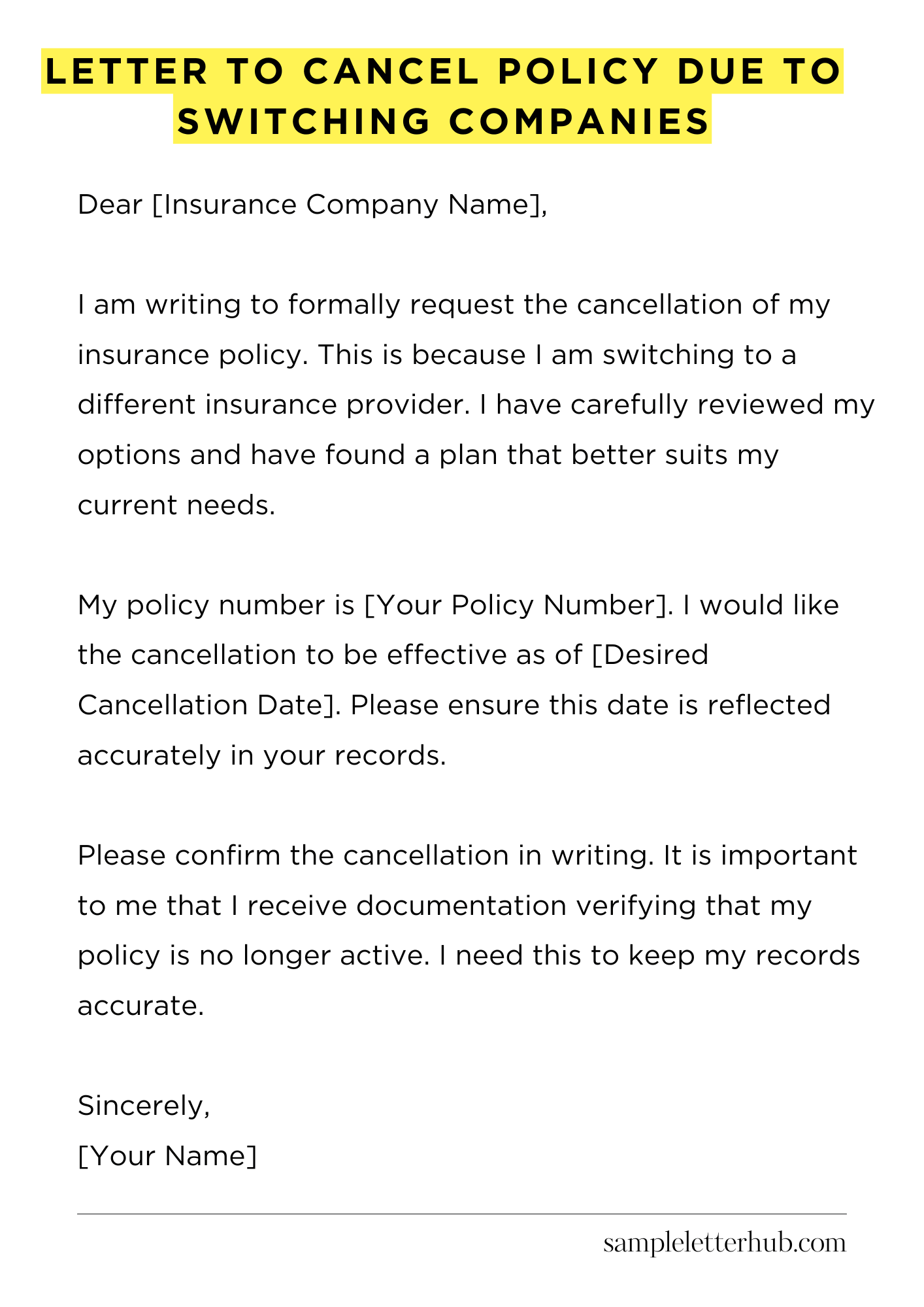
I am writing to formally request the cancellation of my insurance policy. This is because I am switching to a different insurance provider. I have carefully reviewed my options and have found a plan that better suits my current needs.
My policy number is [Your Policy Number]. I would like the cancellation to be effective as of [Desired Cancellation Date]. Please ensure this date is reflected accurately in your records. I hope this will not cause any inconvenience.
Please confirm the cancellation in writing. It is important to me that I receive documentation verifying that my policy is no longer active. I need this to keep my records accurate.
Could you also inform me about the procedure for a refund, if applicable? I understand that there may be a refund due to me, and I would appreciate it if you could provide details on how to receive it. Please let me know what steps I need to take.
Thank you for your time and assistance in this matter. I appreciate your prompt attention to my request. I look forward to your confirmation of the cancellation.
Sincerely,
[Your Name]
How to Write Letter to Cancel Policy Due to Switching Companies
1. Commence with Conciseness: The Opening Salvo
Your missive should immediately declare its purpose. State clearly, and without prevarication, that the intent of this letter is to formally request the cancellation of a specific insurance policy.
Include the precise policy number; this is crucial for efficient processing. A terse, yet professional greeting, such as “To Whom It May Concern,” is perfectly acceptable. Avoid overly effusive language; focus on clarity.
2. The Specifics: Detailing the Ins and Outs
Following your declaration, explicitly state the rationale for the cancellation. In this instance, you’re discontinuing coverage due to a recent change in your insurance provider.
You must indicate the effective date of your new policy. This provides the insurer with the information they need to avoid a period of being uninsured. State that the new coverage has already been initiated. Any overlap in coverage can lead to problems.
3. Reinforce the Resolve: Affirmative Action
Reiterate your unwavering intention. Rephrase the request for cancellation to leave no room for ambiguity. This step solidifies your position. Consider adding a sentence explicitly requesting confirmation of the cancellation via a subsequent communication. You must ensure you are not left unprotected.
4. Documentation Demands: Evidence Is Key
Include any supporting documentation that reinforces your claim. While not always mandatory, providing a copy of your new insurance policy’s declarations page will accelerate the process. This can demonstrate the effective date and coverage details of your new insurance. Think of it as presenting corroborative evidence.
5. Financial Frontier: Delving into the Details of Dough
Address any relevant financial details. Inquire about the process for any potential refund of unearned premiums. Request that any refund due be issued by check, or if preferred, via the original payment method. Providing explicit instructions minimizes delays. Make it as easy as possible for them to fulfill your request.
6. Final Flourish: The Closing Act
Conclude your letter with a professional closing. Use a formal salutation such as “Sincerely” or “Respectfully”. Include your full name, address, phone number, and email address. This provides the insurer with all essential contact information to easily reach you. Ensure all the information is accurate and easily readable.
7. The Art of Attestation: Proof of Transmission
Prior to dispatch, consider sending your letter via certified mail with a return receipt requested. This provides definitive proof of delivery and acknowledgement of receipt. This is invaluable if any disputes arise. Retain a copy of the letter, along with any enclosures, for your personal records. It is a good practice.
FAQs about Letter to Cancel Policy Due to Switching Companies
What information should I include in a letter to cancel my insurance policy when switching to a new company?
Your cancellation letter should clearly state your intent to cancel the policy, the policy number, the effective date of cancellation (which should align with the start date of your new policy), and your full name and contact information.
It is also advisable to include the name of your new insurance provider and, if applicable, the reason for cancellation (e.g., lower premiums, better coverage). You may also need to include your signature.
When should I send the cancellation letter, and how should I send it to ensure it is received?
Send the letter as soon as you have confirmed coverage with your new insurance provider. Ideally, send it at least a week or two before your new policy’s effective date to allow time for processing.
For proof of receipt, it’s recommended to send the letter via certified mail with return receipt requested. This provides documentation that the insurance company received your cancellation request. You can also consider sending a copy via email and keeping a copy for your records.
Will I receive a refund after canceling my insurance policy mid-term?
Whether you receive a refund depends on the terms of your policy and the cancellation date. If you cancel mid-term, you may be entitled to a refund of any unused premiums.
The refund amount is typically calculated from the date of cancellation to the end of the policy period. Review your policy documents to understand the specific refund process and any applicable fees. Contact your insurance provider to inquire about their refund policy.
What happens if I don’t cancel my old policy before my new one starts?
If you fail to cancel your old policy, you may be charged for duplicate coverage. You will be responsible for paying premiums for both policies until the old one is properly canceled. Furthermore, in the event of a claim, it can complicate the process, potentially leading to delays or denial of coverage if both policies are active.
Can I cancel my policy even if I haven’t paid all my premiums?
Yes, you can generally cancel your policy even if you have outstanding premium payments. However, the insurance company may deduct the unpaid premiums from any refund owed to you.
Additionally, the cancellation might not be effective until all outstanding payments are settled. Be aware that non-payment of premiums could affect your credit score or lead to collection activities. Always inquire with the insurance provider regarding how to handle any outstanding balances during the cancellation process.
Related:
Resignation letter due to rude boss
Resignation letter moving to another state
Resignation letter due to illness of family member
Resignation letter due to study