

So, your insurance premiums went up? That means your insurance costs more. You have a right to cancel your policy. A “Letter to Cancel Policy After Premium Increase” is the official document. Its purpose? To inform your insurance provider you want to cancel. This is due to the increased premium.
We understand navigating this can be tricky. Writing the perfect letter to cancel policy can be daunting. Don’t worry, we’ve got you covered. We’ll provide several letter to cancel insurance templates. You will also find examples and sample letters to cancel insurance here. We will give you a head start for your insurance cancellation letter.
Our cancellation letter templates are easy to adapt. Use these insurance cancellation letter examples to save time. These samples will guide you through the process. Get ready to easily draft your own letter of cancellation. You can finally take control of your insurance policy cancellation!
[Your Name]
[Your Address]
[Your Phone Number]
[Your Email Address]
[Date]
[Insurance Company Name]
[Insurance Company Address]
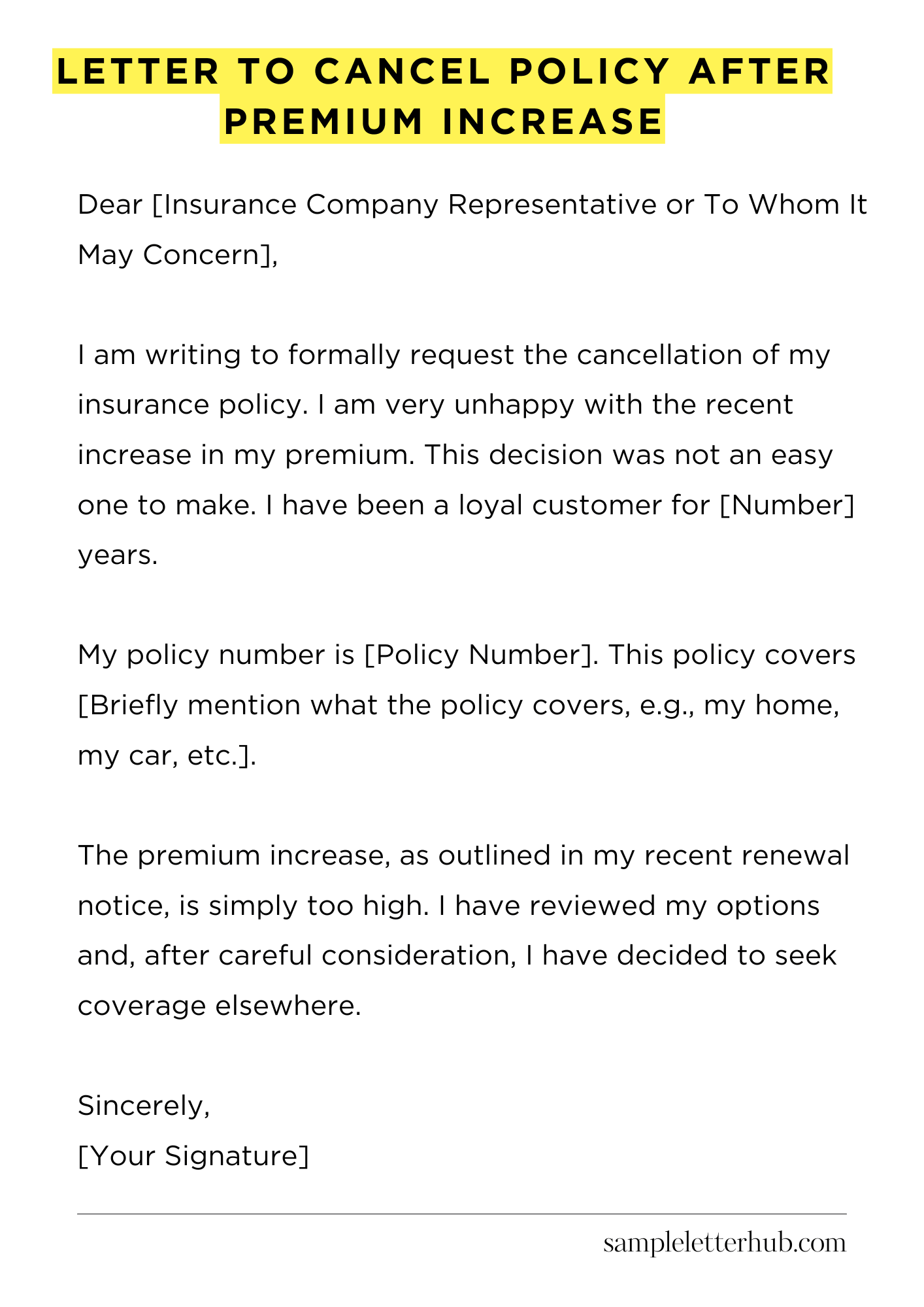
Dear [Insurance Company Representative or To Whom It May Concern],
I am writing to formally request the cancellation of my insurance policy. I am very unhappy with the recent increase in my premium. This decision was not an easy one to make. I have been a loyal customer for [Number] years.
My policy number is [Policy Number]. This policy covers [Briefly mention what the policy covers, e.g., my home, my car, etc.].
The premium increase, as outlined in my recent renewal notice, is simply too high. I have reviewed my options and, after careful consideration, I have decided to seek coverage elsewhere. This choice aligns with my current financial circumstances.
Please consider this letter as official notification of my intent to cancel the policy. Kindly process the cancellation and inform me of the final date of coverage. I would appreciate it if you could also let me know about any applicable refunds due. Please send any related documents to the address listed above.
Thank you for your time and attention to this matter. I appreciate your assistance in finalizing this request and hope you understand my decision. I look forward to hearing from you soon regarding the cancellation process.
Sincerely,
[Your Signature]
How to Write Letter to Cancel Policy After Premium Increase
Your insurance premium has skyrocketed, and you’ve made the judicious decision to seek alternatives. Canceling your current policy is a straightforward process, but a well-crafted letter is crucial to ensure a seamless transition and potentially reclaim any unearned premiums. Here’s how to pen a letter that gets the job done.
1. Commence with the Essentials: Your Salutation and Header
Start with a professional salutation. Address the letter to the correct department within your insurance provider. Locate the mailing address or specific department responsible for policy cancellations.
Use “Dear [Name of Contact Person or Department]:” or a more formal “To Whom It May Concern:” if you can’t find a specific contact. Immediately above the salutation, furnish your full name, address, policy number, and the date. This provides immediate identification and efficient processing.
2. Declare Your Intent: State Your Purpose Unambiguously
The first paragraph should explicitly state your intent: to cancel your insurance policy. Avoid meandering. Be direct and clear. For example, write, “This letter serves as formal notification that I, [Your Full Name], policy number [Your Policy Number], am requesting to cancel my insurance policy, effective [Desired Cancellation Date].”
This establishes a firm foundation for the rest of your communication.
3. Articulate the Rationale: Address the Premium Increase
Briefly but forcefully state the reason for your cancellation. Given the situation, mention the premium increase. Something along the lines of, “The recent and substantial increase in my premium has prompted me to seek more cost-effective options.” You don’t need to belabor the point. This section serves to justify your action, preventing the impression of arbitrary behavior.
4. Specify the Effective Date: Clarity on Timeline
Clearly indicate the date you want your cancellation to take effect. This is critical to ensure coverage doesn’t unintentionally lapse before your new policy kicks in.
Consider the timing; do you want immediate cancellation, or do you want the cancellation to coincide with a particular date? Phrase it simply, such as, “I request that my policy be canceled effective [Date].” Verify the company’s policy on cancellation dates and associated timeframes.
5. Address Refunds and Unearned Premiums: Clarify Financial Matters
Inquire about any potential refund of unearned premiums. State how you would like to receive the refund. The exact wording might look like this: “Please confirm the amount of any unearned premium and provide instructions on how I will receive my refund. I would prefer to receive the refund via [Check/Direct Deposit].” This proactive step demonstrates financial astuteness.
6. Confirm Receipt and Documentation: Keep a Paper Trail
Request confirmation of your cancellation in writing. This is crucial for your records. Include language like: “Kindly send written confirmation of this cancellation to the address above. I will retain a copy of this letter for my records.” This safeguards against potential disputes later. Include any supporting documentation, like the premium increase notice, to solidify your case.
7. Conclude and Sign Off: Finalizing the Process
Conclude with a polite but assertive closing. Use a professional closing such as “Sincerely,” or “Respectfully,” followed by your full name. Below your typed name, leave space for your signature.
Print the letter, sign it, and keep a copy for yourself. Mail the original via certified mail with return receipt requested to confirm it’s been delivered. This comprehensive approach will ensure you can sever ties with your current insurer efficiently.
FAQs about Letter to Cancel Policy After Premium Increase
What is the primary reason for sending a letter to cancel an insurance policy after a premium increase?
The main reason to send a cancellation letter after a premium increase is to formally notify the insurance provider that you are declining the new, higher premium. This allows you to avoid paying the increased amount and seek more affordable insurance coverage elsewhere.
What specific information should be included in the cancellation letter?
A comprehensive cancellation letter should include: your full name, address, and policy number; the date of the letter; a clear statement of your intent to cancel the policy; the effective date of cancellation (usually the end of the current billing cycle); a request for confirmation of the cancellation; and your contact information for any follow-up.
What is the best way to deliver the cancellation letter to the insurance provider?
It is recommended to send the cancellation letter via certified mail with return receipt requested. This provides proof that the insurance company received the letter and the date of receipt. You can also send the letter via email if the insurance company accepts cancellations via email, but keep proof of sending and ensure you receive a confirmation.
Will I receive a refund after canceling my policy due to a premium increase?
Whether you receive a refund depends on your payment schedule and the cancellation date. If you’ve paid premiums in advance, you may be entitled to a pro-rated refund for the unused portion of the policy. The insurance company should provide details on any refund due and the method of payment.
What are the potential consequences of failing to cancel my policy after a premium increase?
If you fail to cancel your policy after a premium increase, you’ll be responsible for paying the higher premium. This means ongoing and sometimes substantial financial obligations.
Additionally, if you don’t cancel and fail to pay the increased premium, the policy may be canceled for non-payment, which could negatively affect your credit score and make it more difficult and expensive to obtain insurance in the future.
Related:
Resignation letter due to rude boss
Resignation letter moving to another state
Resignation letter due to illness of family member
Resignation letter due to study