

Sometimes, travel plans change. Life throws curveballs. When this happens, you might need to cancel your trip. A Travel Insurance Cancellation Request Letter is the official way to ask your insurance provider to cancel your policy. The letter’s purpose is to formally request cancellation and, depending on your policy, potentially receive a refund of your premium.
We’ve all been there, staring at a blank page. Writing can be tricky, especially when you’re dealing with insurance. Don’t worry! This article provides several Travel Insurance Cancellation Request Letter templates and examples. We’ll give you samples to help you write your own letter. Think of it as your writing cheat sheet.
We want to make it easy. We’ll show you how to structure your cancellation request letter. You’ll find different formats. Choose the one that suits your needs. Your travel insurance cancellation process will be much smoother. Get ready to write!
[Your Name]
[Your Address]
[Your Phone Number]
[Your Email Address]
[Date]
[Travel Insurance Company Name]
[Travel Insurance Company Address]
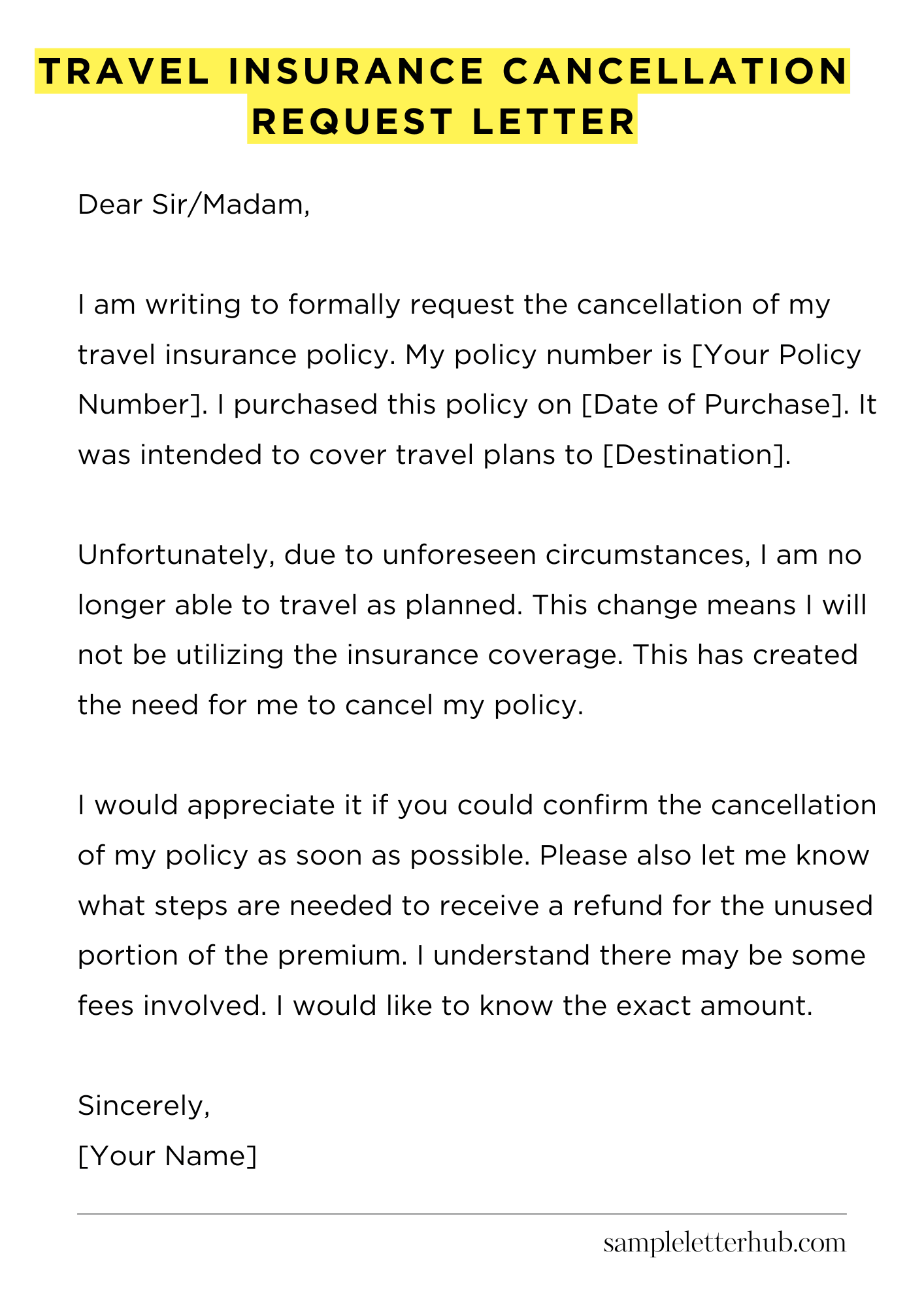
Dear Sir/Madam,
I am writing to formally request the cancellation of my travel insurance policy. My policy number is [Your Policy Number]. I purchased this policy on [Date of Purchase]. It was intended to cover travel plans to [Destination].
Unfortunately, due to unforeseen circumstances, I am no longer able to travel as planned. This change means I will not be utilizing the insurance coverage. This has created the need for me to cancel my policy.
I would appreciate it if you could confirm the cancellation of my policy as soon as possible. Please also let me know what steps are needed to receive a refund for the unused portion of the premium. I understand there may be some fees involved. I would like to know the exact amount.
I have attached copies of [any supporting documents, e.g., proof of cancelled travel, flight cancellations]. These documents will help you process my request quickly.
Thank you for your time and attention to this matter. I look forward to your prompt response. Your quick assistance will be greatly appreciated.
Sincerely,
[Your Name]
How to Write Travel Insurance Cancellation Request Letter
Life is unpredictable, and sometimes, even the best-laid travel plans go awry. Circumstances change, and you might find yourself needing to cancel your trip.
If you’ve purchased travel insurance, you might be entitled to a refund. However, you’ll need to submit a formal cancellation request. Let’s delineate the crucial steps to compose a compelling travel insurance cancellation request letter.
1. Commence with Proper Salutation and Identification
Begin your missive with a formal salutation. “Dear [Insurance Provider Name]” or “To Whom It May Concern” are acceptable. Immediately after, provide comprehensive identification. Include your full name, address, policy number, and any other relevant identification information.
This ensures the insurance provider can promptly locate your policy details within their system. Omitting this step can lead to significant delays.
2. Clearly State Your Intent: The Nucleus of Your Request
The foremost objective of your letter is to explicitly state your intent: to request the cancellation of your travel insurance policy. Use direct and unequivocal language. Something like: “I am writing to formally request the cancellation of travel insurance policy number [Policy Number].” Don’t mince words. Clarity is paramount.
3. Articulate the Reason for Cancellation: Justifying Your Demands
Provide a clear and concise explanation for why you’re canceling your policy. Your reason will likely be a prerequisite for your refund eligibility.
Common reasons include trip cancellation due to illness, family emergencies, or unexpected work obligations. Be specific. It’s often necessary to provide supporting documentation to substantiate your claims. For instance, a doctor’s note in case of sickness, or a copy of a death certificate in case of a bereavement.
4. Furnish Supporting Documentation: Bolstering Your Case
This section is crucial; attach all supporting documentation. This may include copies of flight cancellation notices, medical reports, death certificates, or any other documents that validate your reasons for canceling the trip.
Make sure copies are clear and legible. This evidence is the armature upon which your claim rests. Remember, the absence of sufficient substantiation can lead to your request being denied.
5. Specify Your Desired Action and Mode of Reimbursement
Explicitly state what action you’re requesting. Do you want a full refund? A partial refund? Clearly articulate your desired outcome. Also, specify your preferred method of reimbursement.
Provide details such as your bank account information (account holder name, bank name, account number, and swift code) if a bank transfer is your preferred method. Alternatively, you might opt for a check, in which case you need to specify your mailing address. Ambiguity here is a significant impediment to timely processing.
6. Include a Polite Closing and Contact Information
Conclude your letter with a polite closing, such as “Sincerely” or “Respectfully.” Provide your full name, signature, and contact information, including your phone number and email address.
This ensures the insurance provider can easily contact you for any clarification or further information. Ensure that all the provided details are accurate. Proofread your letter meticulously before dispatching it.
7. Delivery and Follow-Up: The Culmination of Your Efforts
Send your letter via a method that provides proof of delivery, such as registered mail or certified mail with return receipt requested. This ensures that you have documentation confirming that the insurance provider received your letter. Keep a copy of the letter and all supporting documents for your records.
After sending the letter, follow up with the insurance provider after a reasonable timeframe (typically 2-4 weeks) to confirm receipt and inquire about the status of your request. Persistent, yet polite, follow-up can often expedite the process.
FAQs about Travel Insurance Cancellation Request Letter
What is the primary purpose of a travel insurance cancellation request letter?
The main function of a travel insurance cancellation request letter is to formally notify the insurance provider of your decision to cancel your travel insurance policy. It serves as a written record of your request, initiating the cancellation process and potentially allowing for a refund of premiums, depending on the policy’s terms and conditions.
What essential information should be included in a travel insurance cancellation request letter?
A comprehensive cancellation request letter typically includes your full name, address, and policy number. It should clearly state your intent to cancel the policy, specify the effective date of cancellation, and may explain the reason for cancellation (though this isn’t always mandatory). Providing contact details for the insurance company and your own contact information is also crucial.
When is the best time to send a travel insurance cancellation request letter?
The optimal time to send the cancellation letter depends on the policy’s terms. However, it’s generally best to submit the request as soon as possible after deciding to cancel.
This maximizes your chances of receiving a full or partial refund, as most policies have cancellation windows where refunds are available. Reviewing your policy document regarding cancellation deadlines is always recommended.
How should I submit my travel insurance cancellation request letter?
The submission method often depends on the insurance provider. The policy document or insurance website will usually specify the preferred method. Common options include sending the letter via certified mail (for proof of delivery), email (if accepted by the insurer), or through an online portal if one is available. Always retain a copy of the letter for your records.
What happens after I submit my travel insurance cancellation request letter?
After submitting the letter, the insurance company will process your request. They might contact you to confirm the cancellation or seek additional information. You should receive a written confirmation of the cancellation, including the date it takes effect and details about any refund due. It’s essential to keep this confirmation for your records.
Related:
Resignation letter due to rude boss
Resignation letter moving to another state
Resignation letter due to illness of family member
Resignation letter due to study