

Selling your car? You’ll likely need an insurance cancellation request due to selling car. This means you tell your car insurance company you no longer need coverage. The purpose? To stop paying premiums for a vehicle you no longer own. It’s that simple!
Need to craft this crucial insurance cancellation letter? No sweat! We’ve got you covered. This article offers helpful samples and templates of an insurance cancellation request due to selling car. Consider these your shortcuts to canceling your car insurance policy like a pro.
These templates are designed for easy use. Adapt them to fit your situation. From basic requests to more detailed scenarios, we’ll guide you. Get ready to bid farewell to your car insurance bills efficiently. Let’s get started!
[Your Name]
[Your Address]
[Your Phone Number]
[Your Email Address]
[Date]
[Insurance Company Name]
[Insurance Company Address]
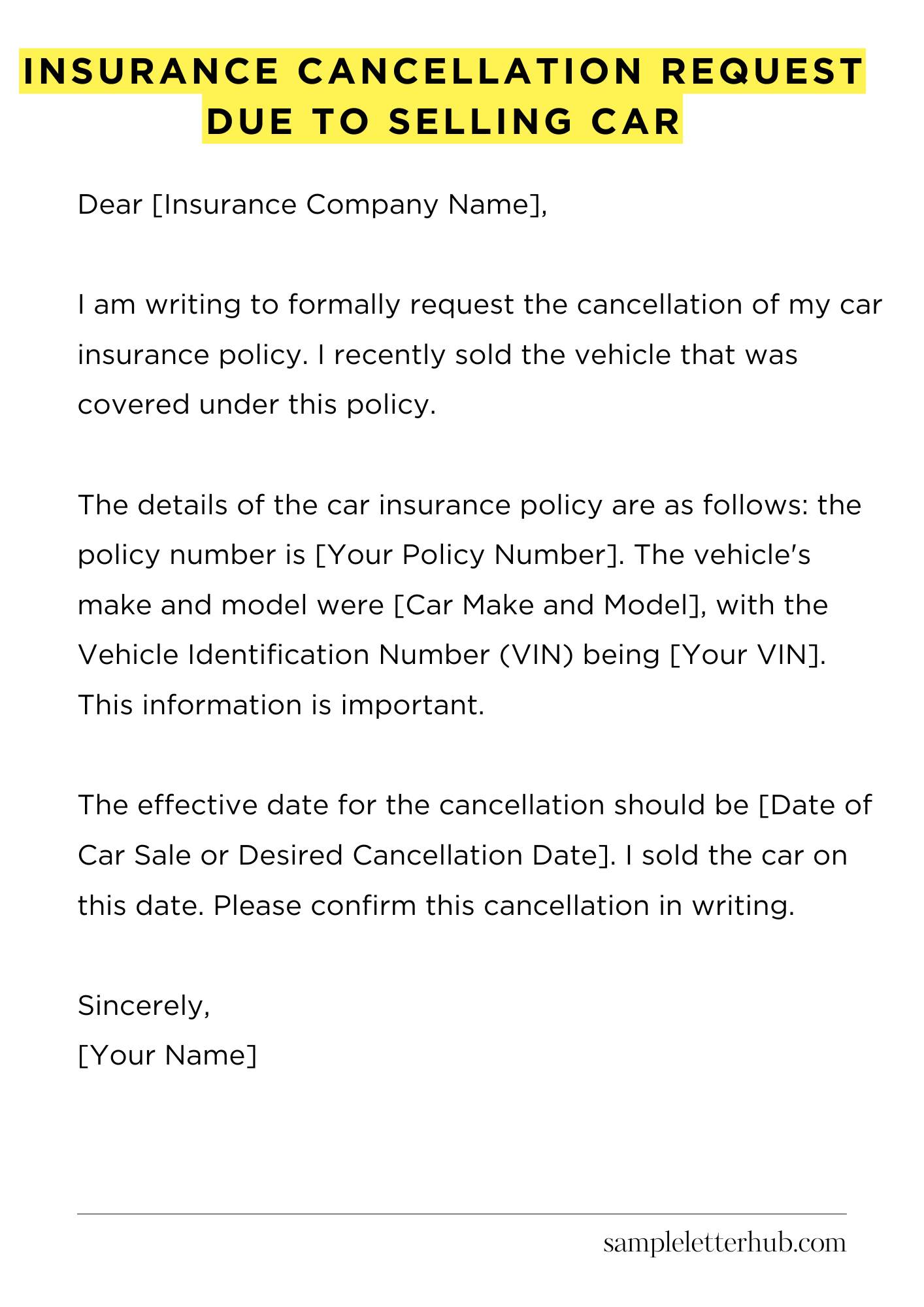
Dear [Insurance Company Name],
I am writing to formally request the cancellation of my car insurance policy. I recently sold the vehicle that was covered under this policy.
The details of the car insurance policy are as follows: the policy number is [Your Policy Number]. The vehicle’s make and model were [Car Make and Model], with the Vehicle Identification Number (VIN) being [Your VIN]. This information is important.
The effective date for the cancellation should be [Date of Car Sale or Desired Cancellation Date]. I sold the car on this date. Please confirm this cancellation in writing.
Could you please also provide information regarding any potential refund of premiums? I would like to know the process for receiving any eligible refund that may be due to me. I would appreciate it if the refund could be issued to me at the address above.
Thank you for your prompt attention to this matter. I look forward to receiving confirmation and details regarding the refund soon. I appreciate your assistance.
Sincerely,
[Your Name]
How to Write Insurance Cancellation Request Due to Selling Car
Selling your car is a significant life event, and one crucial aspect that frequently gets overlooked is canceling your auto insurance. It is an important task that safeguards you from any continued financial liabilities. This guide will navigate you through the process of writing an effective insurance cancellation request following the sale of your vehicle. Let’s start!
1. Initiate the Process: Gather Your Intel
Before you even begin crafting your letter, compile all the pertinent information. This preparatory stage is critical. You’ll need your insurance policy number, the date you sold your car, the buyer’s details (if available or required by your insurer), and the vehicle’s specifics (make, model, VIN).
Documenting the odometer reading at the time of the sale can also be prudent. This initial groundwork will streamline the writing process.
2. The Salutation: A Formal Beginning
Commence your letter with a formal salutation. Address it to the insurance company’s cancellation department or the specific agent you’ve been dealing with. Use “Dear [Insurance Company Name] Cancellation Department” or “Dear [Agent’s Name]”. Maintaining a professional tone from the outset sets a respectful precedent.
3. Clearly State Your Intent: The Core Message
The central purpose of your letter is to explicitly request the cancellation of your auto insurance policy. State this upfront in a clear, concise manner. Use a declarative sentence. For example: “This letter is to formally request the cancellation of my auto insurance policy, effective [Date of Sale].” This directness ensures there’s no ambiguity about your intentions.
4. Furnish the Essential Data: The Pillars of Your Request
Now, furnish the critical information necessary for the cancellation. Include your policy number, the date the vehicle was sold, and the vehicle identification number (VIN). If you have the buyer’s information, add it, although it is not often required. Specify the exact date you transferred ownership, because this is the date your liability ceases.
5. Substantiate the Circumstances: Justify Your Action
In a brief, compelling sentence, explain the reason for your request. The vehicle has been sold. The narrative does not need to be long; brevity is your ally. For example: “The vehicle, with VIN [VIN number], was sold on [Date of Sale].” This provides context and validates your request’s legitimacy.
6. Confirm Refund Details and Offer Contact: The Practicalities
Inquire about a possible refund for any unused portion of your premium. Clearly state how you want to receive the refund (e.g., check, bank transfer). Provide your current mailing address or bank account details, as required. Include your contact information (phone number and email address) for any follow-up questions or correspondence. Always keep them ready to be contacted.
7. Concluding with Professionalism: Closure and Acknowledgment
End your letter with a professional closing, such as “Sincerely” or “Respectfully”. Sign your full name above a typed version of it. Consider including a statement requesting confirmation of the cancellation in writing.
Acknowledgment, in writing, provides you with concrete evidence of the policy’s termination, safeguarding you from any future issues. Mail your letter via certified mail with return receipt requested to maintain proof. This final step guarantees accountability and peace of mind.
FAQs about Insurance Cancellation Request Due to Selling Car
How do I formally request to cancel my car insurance after selling my vehicle?
You will typically need to contact your insurance provider directly. This can often be done via phone, email, or through an online portal if they offer this service.
Be prepared to provide the date of the vehicle sale, the vehicle’s details (VIN, make, model), and your policy information. Some insurers may require proof of sale, such as a bill of sale or a copy of the vehicle title transfer.
Be sure to document your communication with the insurance company, noting the date, time, and the name of the representative you spoke with.
What documentation do I need to provide to my insurance company to cancel my policy?
The required documentation often includes the vehicle’s details, such as the VIN, make, and model. Many insurers will also require the date of sale and proof that the vehicle has been sold.
Acceptable proof often includes a bill of sale, a copy of the title with your signature indicating the sale, or a document from the DMV. Always confirm with your specific insurance provider the exact documents they require to avoid delays in processing your request.
When will my insurance cancellation take effect, and will I receive a refund?
The effective date of cancellation is generally the date the vehicle was sold. However, this can vary slightly depending on your insurer’s policy. The exact time the cancellation takes effect should be stated in your policy.
You are typically entitled to a refund for the unused portion of your premium, calculated from the effective cancellation date. The refund process and timing vary, but the insurance company should provide you with details.
What happens if I forget to cancel my insurance after selling my car?
If you forget to cancel your insurance, you will continue to be billed for premiums. You might be paying for coverage you no longer need. Additionally, without actively cancelling, it can lead to potential complications in the future.
Contact your insurer as soon as you realize the oversight. You can get a refund for the period you paid for after the sale date if you inform them with proof of sale.
Can I transfer my existing car insurance to my new vehicle after selling my old car?
In many cases, yes. If you are purchasing a new vehicle, you can transfer the remaining term of your existing policy to the new car. You will likely need to contact your insurer to update your policy with the new vehicle’s details and any adjustments to coverage or premiums based on the new car’s characteristics.
This is a common practice to maintain continuous coverage and avoid a lapse in insurance.
Related:
Resignation letter due to rude boss
Resignation letter moving to another state
Resignation letter due to illness of family member
Resignation letter due to study