

Sometimes, your insurance claim doesn’t go as planned. You might disagree with the initial assessment. A request letter for second evaluation of insurance claim allows you to appeal this decision. The goal is to have your claim re-examined by the insurance company. This letter explains why you believe the initial evaluation was incorrect.
This article is your guide. We’ll provide you with sample letters. Need a sample request letter for insurance claim review? Looking for templates for insurance claim appeals? We’ve got you covered. This is the place for example letters to help you. Get ready to write your perfect appeal.
Writing these letters can be tricky. We aim to simplify the process. Our examples cover various scenarios. These insurance claim appeal letter samples are easy to adapt. You can tailor them to your specific needs. Good luck!
[Your Name/Your Company Name]
[Your Address]
[Your Phone Number]
[Your Email Address]
[Date]
[Insurance Company Name]
[Insurance Company Address]
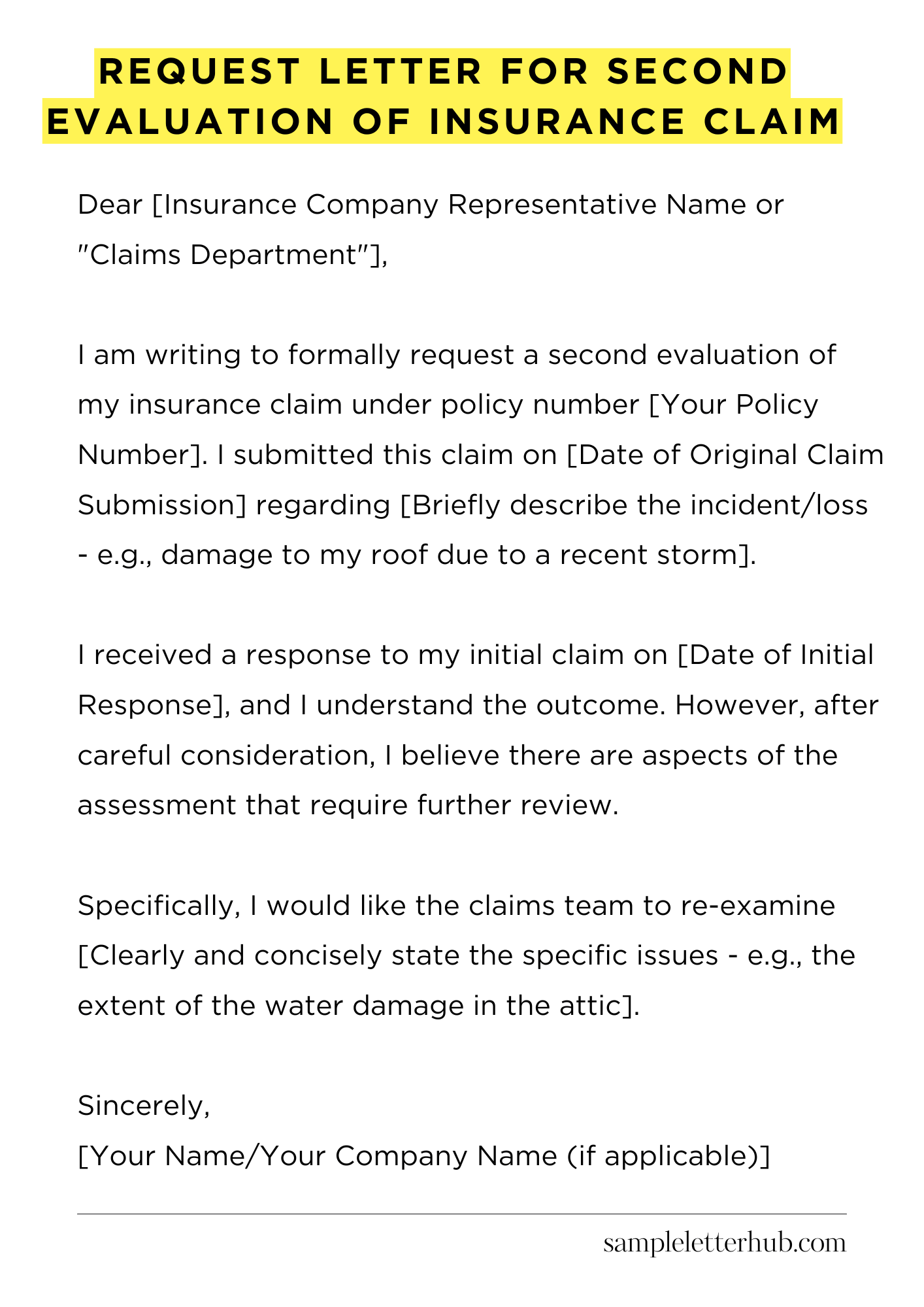
Subject: Request for Second Evaluation of Insurance Claim – Policy Number [Your Policy Number]
Dear [Insurance Company Representative Name or “Claims Department”],
I am writing to formally request a second evaluation of my insurance claim under policy number [Your Policy Number]. I submitted this claim on [Date of Original Claim Submission] regarding [Briefly describe the incident/loss – e.g., damage to my roof due to a recent storm].
I received a response to my initial claim on [Date of Initial Response], and I understand the outcome. However, after careful consideration, I believe there are aspects of the assessment that require further review. The initial assessment, unfortunately, didn’t fully capture all the damage that occurred.
Specifically, I would like the claims team to re-examine [Clearly and concisely state the specific issues – e.g., the extent of the water damage in the attic].
I have recently acquired additional information which I believe is important for a full understanding of the situation. This additional information includes [List the supporting documentation you are providing – e.g., photographs, a contractor’s detailed estimate, etc.].
Enclosed with this letter are copies of the supporting documentation. This information provides greater clarity regarding the extent of the damage. My hope is that the additional data will help paint a more accurate picture.
I am confident that a second evaluation will lead to a more equitable outcome. It’s truly important that all the damage is properly assessed.
Thank you for your time and attention to this matter. I look forward to hearing from you soon regarding the status of my request. Please feel free to contact me at your convenience if you require any further clarification or information. I am available at the phone number listed above.
Sincerely,
[Your Name/Your Company Name (if applicable)]
How to Write Request Letter for Second Evaluation of Insurance Claim
Sometimes, the initial assessment of your insurance claim doesn’t align with the reality of the situation. This can be frustrating, but fortunately, you often have the right to request a second evaluation.
This allows you the opportunity to furnish further evidence or clarify aspects that might have been overlooked. Here’s how to pen an effective request letter to facilitate a re-evaluation of your insurance claim.
1. Commence with a Cogent Salutation
Begin your letter with a formal and respectful salutation. Use “Dear [Insurance Adjuster’s Name]” or if you do not know the name, address the letter to “Claims Department”. This sets a professional tone from the very outset. Precision in the beginning always aids.
2. Explicitly State Your Purpose
The cardinal rule is clarity. In the opening paragraph, unequivocally state that you are requesting a second evaluation of your insurance claim. Mention the claim number, policy number, and the date the claim was initially filed. This is crucial for their records. Be direct and avoid ambiguity.
3. Recount the Pertinent Facts with Exactitude
Provide a concise yet comprehensive account of the events that led to the claim. Stick to the facts, avoiding conjecture or emotive language. Detail the damage or loss incurred, the date it occurred, and any relevant details that bolster your case. This should be as accurate as your memory serves.
4. Critique the Initial Evaluation Methodically
Politely, yet firmly, explain why you believe the initial evaluation was insufficient. Be specific: cite any discrepancies between the adjuster’s assessment and the actual damage.
If you have additional evidence, like repair estimates, photographs, or witness statements, briefly mention them here, assuring the recipient that they are enclosed with the letter. This is where your argument takes flight.
5. Furnish Supportive Documentation – Thoroughly
Attach all the documentation that supports your request. This might include:
- Photographs of the damage or loss.
- Repair estimates from reputable contractors.
- Police reports (if applicable).
- Witness statements.
- Any other documents that validate your claim.
Ensure that all documents are clearly labeled and referenced within your letter. This will allow the adjuster to easily identify and review them.
6. Articulate Your Desired Outcome Clearly
State precisely what you hope to achieve with the re-evaluation. Do you seek a different settlement amount? Are you looking for coverage of specific damages the initial assessment overlooked? Being clear about your expectations prevents misunderstandings and facilitates a more focused review. This is the heart of your plea.
7. Conclude with Professionalism and Expectation
Conclude your letter with a polite closing, such as “Sincerely” or “Respectfully”. Include your full name, address, phone number, and email address.
Express your willingness to provide additional information if needed. It is also good practice to add “I look forward to your prompt response and a fair reassessment of my claim” to politely end your letter. Finally, ensure you keep a copy of the letter and all supporting documentation for your records.
FAQs about Request Letter for Second Evaluation of Insurance Claim
What is the primary purpose of a request letter for a second evaluation of an insurance claim?
The primary purpose of a request letter for a second evaluation is to formally appeal an initial decision made by the insurance company regarding a claim.
It aims to present additional information, evidence, or arguments to support the policyholder’s belief that the initial assessment was inaccurate or incomplete, ultimately seeking a more favorable outcome, such as increased compensation or coverage.
What specific information should be included in a request letter for a second evaluation?
A comprehensive request letter should include the policyholder’s contact information, the policy number, the claim number, a clear explanation of why the initial decision is being challenged (e.g., discrepancies in the assessment, overlooked damages), and a detailed presentation of new evidence, such as additional documentation, photographs, expert opinions, or receipts.
It’s crucial to reference the specific sections of the policy that support the claim and clearly state the desired outcome.
What is the typical timeframe for submitting a request for a second evaluation?
The timeframe for submitting a request for a second evaluation is typically defined within the insurance policy itself or by state regulations. Policyholders should carefully review their policy documents to determine the specific deadline.
Generally, there’s a specific window, such as 30, 60, or 90 days from the date of the initial claim denial or unfavorable decision. It’s crucial to adhere to this timeframe to maintain the right to appeal.
How should the policyholder address disagreements with the initial assessment in the letter?
The policyholder should address disagreements with the initial assessment in a clear, concise, and objective manner. Avoid emotional language and focus on presenting factual evidence that contradicts the insurer’s findings.
Identify specific points of contention, explain why the initial assessment is believed to be inaccurate, and support these claims with verifiable data and documentation. Referencing specific policy provisions that support the claim is also beneficial.
What are the possible outcomes after submitting a request for a second evaluation?
After submitting a request for a second evaluation, the possible outcomes include a reversal of the initial decision in favor of the policyholder, a partial adjustment to the original decision, or a confirmation of the original decision.
The insurance company may request further information or conduct another investigation. If the second evaluation does not yield a satisfactory result, the policyholder may have further options, such as mediation, arbitration, or legal action, depending on the policy terms and applicable laws.
Related:
Resignation letter due to rude boss
Resignation letter moving to another state
Resignation letter due to illness of family member
Resignation letter due to study