

Ever have a medical claim denied? A Claim Reassessment Request Letter is your tool. It’s how you ask an insurance company to review a denied claim. The goal? To hopefully get them to reconsider their decision and pay for your medical services. This is important for medical bill situations.
Feeling overwhelmed? Don’t worry. We have you covered. This article offers several Claim Reassessment Request Letter samples. We’ll provide different letter templates and examples. You can use these to create your own effective letter. Crafting a strong request becomes much easier.
We understand navigating this process is tricky. Our goal is to simplify things. These sample letters will help you understand the format. They’ll also provide the language needed for a clear, concise claim appeal. Get ready to write with confidence.
[Your Name]
[Your Address]
[Your Phone Number]
[Your Email Address]
[Date]
[Insurance Company Name]
[Insurance Company Address]
Subject: Claim Reassessment Request – [Claim Number]
Dear Sir/Madam,
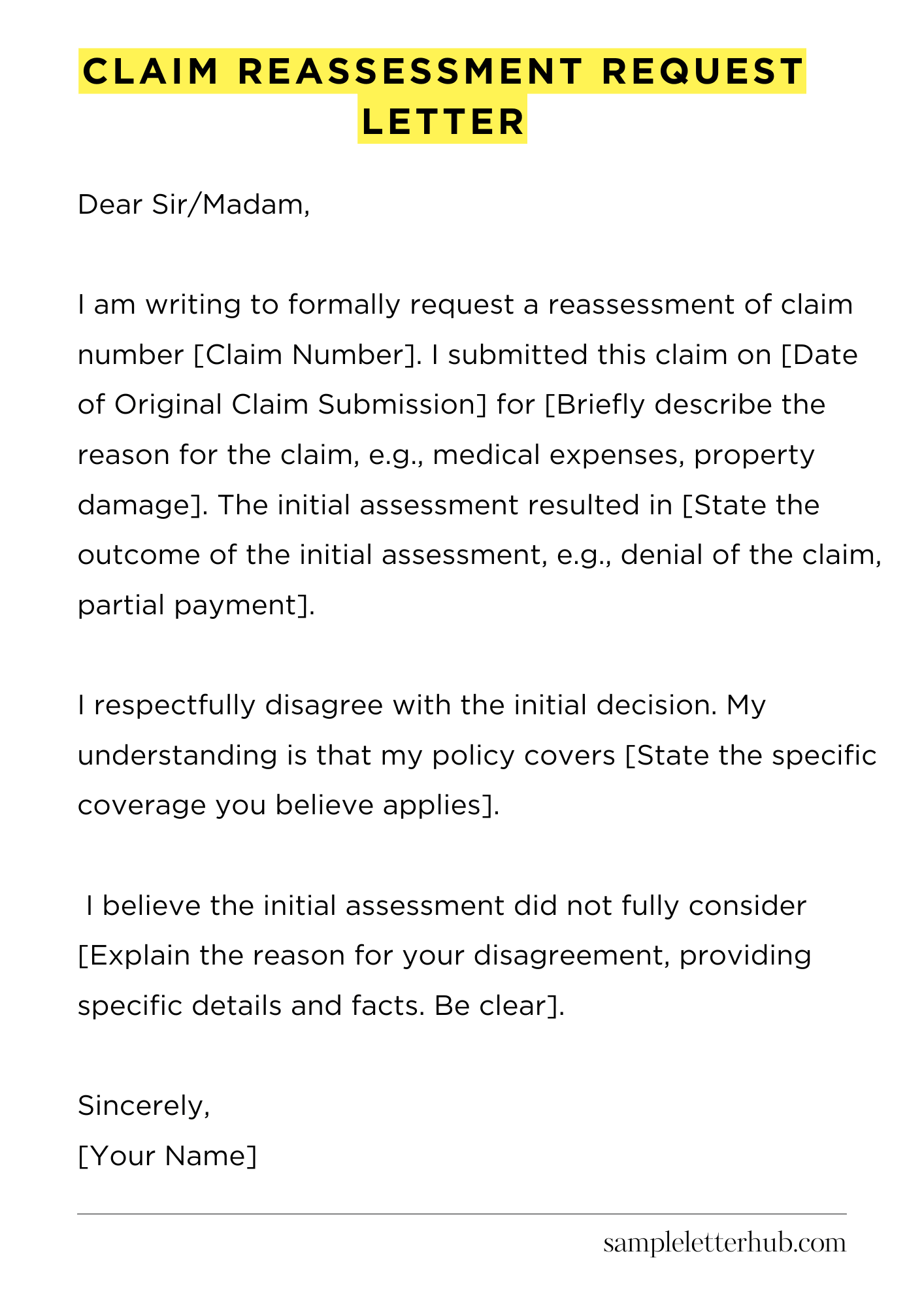
I am writing to formally request a reassessment of claim number [Claim Number]. I submitted this claim on [Date of Original Claim Submission] for [Briefly describe the reason for the claim, e.g., medical expenses, property damage]. The initial assessment resulted in [State the outcome of the initial assessment, e.g., denial of the claim, partial payment].
I respectfully disagree with the initial decision. My understanding is that my policy covers [State the specific coverage you believe applies]. I believe the initial assessment did not fully consider [Explain the reason for your disagreement, providing specific details and facts. Be clear]. I am enclosing supporting documentation that further clarifies the situation.
These documents include [List the documents you are including, e.g., original receipts, medical reports, photographs]. These should help illustrate my case. I am confident that these documents will help in your reassessment.
I kindly request that you review my claim again. Please take into account the provided information. I would appreciate it if you could reconsider your original decision. I am looking forward to a positive response.
Thank you for your time and attention to this matter. I am available to answer any questions. You can reach me at the above phone number.
Sincerely,
[Your Name]
How to Write a Claim Reassessment Request Letter
A claim reassessment request letter is a formal document. It is your formal appeal to rectify a denied or inadequately processed claim. This missive is your chance to vindicate your position and secure the benefits you are rightfully owed.
Successfully navigating this process requires a methodical approach and a keen attention to detail. Let’s delineate the pivotal steps involved in composing a compelling claim reassessment request.
1. Commence with Meticulous Documentation
Before you even begin to draft your letter, gather all pertinent documentation. This is the cornerstone of your appeal. This includes the initial claim denial notice, any supporting medical records, invoices, receipts, and any other evidence that buttresses your case. Organize these documents meticulously. Ensure everything is easily accessible for reference.
Make copies of everything; you will want to have one for your records. This initial phase sets the stage for a strong and persuasive argument.
2. Precise Identification of the Issue
Carefully analyze the denial notice. Determine the precise reasons cited for the claim’s rejection. Scrutinize the language employed by the insurance company or relevant agency.
They will usually provide specific explanations or codes. Identify any ambiguities or misinterpretations. This understanding will dictate your approach. You must formulate a clear and concise rebuttal.
3. Crafting the Salutation and Introduction
Begin your letter with a formal salutation. Employ a professional tone, addressing it to the appropriate individual or department. In your introduction, succinctly state the purpose of your letter.
Briefly identify the claim in question, referencing the claim number and relevant dates. Let the reader understand the core of your appeal. Maintain a respectful yet assertive demeanor throughout the letter.
4. Articulating Your Justification
This section constitutes the core of your argument. Clearly and persuasively articulate the reasons why the claim should be reassessed. Refer to the specific denial reasons.
Provide a detailed explanation, addressing each point raised by the denying party. Cite specific clauses from your insurance policy or relevant regulations, if applicable. Support your statements with the documentation you gathered. Don’t be vague; demonstrate how the documentation supports your claims.
5. Incorporating Supporting Evidence Strategically
Integrate your supporting evidence strategically within your argument. Directly reference the specific documents that corroborate your claims.
For example, “As demonstrated in the attached medical report from Dr. Smith, dated October 26, 2024…” or “Invoice #12345, enclosed, clearly itemizes the services rendered.” Organize your supporting documents in a logical sequence. Ensure each document is clearly labeled and easy to locate.
6. The Call to Action and Concluding Remarks
Conclude your letter with a clear and concise call to action. State precisely what you expect the recipient to do, whether it’s reconsidering the claim, correcting an error, or providing further clarification.
Specify a reasonable timeframe for a response. Reiterate your commitment to cooperation. Thank the recipient for their time and consideration. Conclude with a formal closing and your signature.
7. Polishing and Dispatch
Before sending your letter, thoroughly proofread it. Check for grammatical errors, spelling mistakes, and clarity of expression. Ensure all relevant documents are included and properly attached.
Make a copy of the completed letter and all attachments for your records. Send the letter via certified mail with return receipt requested. This provides proof of delivery and ensures you have documentation of the communication. Finally, retain all records related to the claim reassessment process.
FAQs about Claim Reassessment Request Letter
What is a Claim Reassessment Request Letter, and when is it necessary?
A Claim Reassessment Request Letter is a formal written document used to dispute a decision made by an insurance company, government agency, or other organization regarding a claim.
It’s necessary when you believe there has been an error in the initial assessment of your claim, resulting in a denial or an unsatisfactory payout. This letter allows you to formally request a review of the decision based on new information, evidence, or a disagreement with the interpretation of the claim terms.
What information should be included in a Claim Reassessment Request Letter?
A comprehensive Claim Reassessment Request Letter should include your personal information (name, address, policy/claim number), a clear statement of the original claim and the disputed decision, a detailed explanation of why you disagree with the decision, and any supporting documentation (medical records, invoices, photos, etc.) that supports your position.
It is crucial to be factual, organized, and polite, even if you are frustrated with the initial decision. Always reference the original claim information to ensure clarity.
What is the typical timeframe for filing a Claim Reassessment Request Letter?
The timeframe for filing a Claim Reassessment Request Letter varies depending on the specific policy, organization, or governing regulations.
It is essential to carefully review the terms and conditions related to your claim, as they will usually specify a deadline for submitting a reassessment request. Missing this deadline could result in the denial of your request. These deadlines may range from 30 days to a year, but checking the original claim documents is critical.
What happens after I submit a Claim Reassessment Request Letter?
After you submit the letter, the insurance company or organization will typically review your request and the supporting documentation you provided.
They may contact you for further information or clarification. The review process can take several weeks or even months, depending on the complexity of the claim.
The organization will then issue a new decision, which could uphold the original decision, modify it in your favor, or fully accept your claim. You’ll receive a written notification of their decision.
What if my Claim Reassessment Request is denied, and I still disagree with the decision?
If your Claim Reassessment Request is denied, you may have further options depending on the type of claim and the organization involved.
These options could include appealing to a higher-level review process within the organization, pursuing mediation or arbitration, or, in some cases, filing a lawsuit. Research the applicable appeals process, gather additional supporting evidence, and consider consulting with a legal professional to understand your rights and the best course of action.
Related:
Resignation letter due to rude boss
Resignation letter moving to another state
Resignation letter due to illness of family member
Resignation letter due to study