

Dealing with a burst pipe can be a homeowner’s nightmare. Filing an insurance claim is the first step. Sometimes, your claim gets denied or the payout is too low. A dispute letter for burst pipe insurance claim is your chance to fight back. It’s a formal way to challenge the insurance company’s decision. Its purpose is to get the coverage you deserve.
Do you feel lost on how to write a good dispute letter? We understand it. Crafting the perfect dispute letter for burst pipe insurance claim can be tricky. Don’t worry, we’ve got you covered. We’ll provide you with handy templates, examples, and samples of the perfect letter.
We want to make the process easy. Our sample dispute letters are here to help. You can adapt them to your specific situation. Writing your insurance claim dispute will be simpler. Get ready to stand up for yourself!
[Your Name]
[Your Address]
[Your Phone Number]
[Your Email Address]
[Date]
[Insurance Company Name]
[Insurance Company Address]
Subject: Dispute of Insurance Claim – Burst Pipe at [Property Address]
Dear [Claims Adjuster Name or “To Whom It May Concern”],
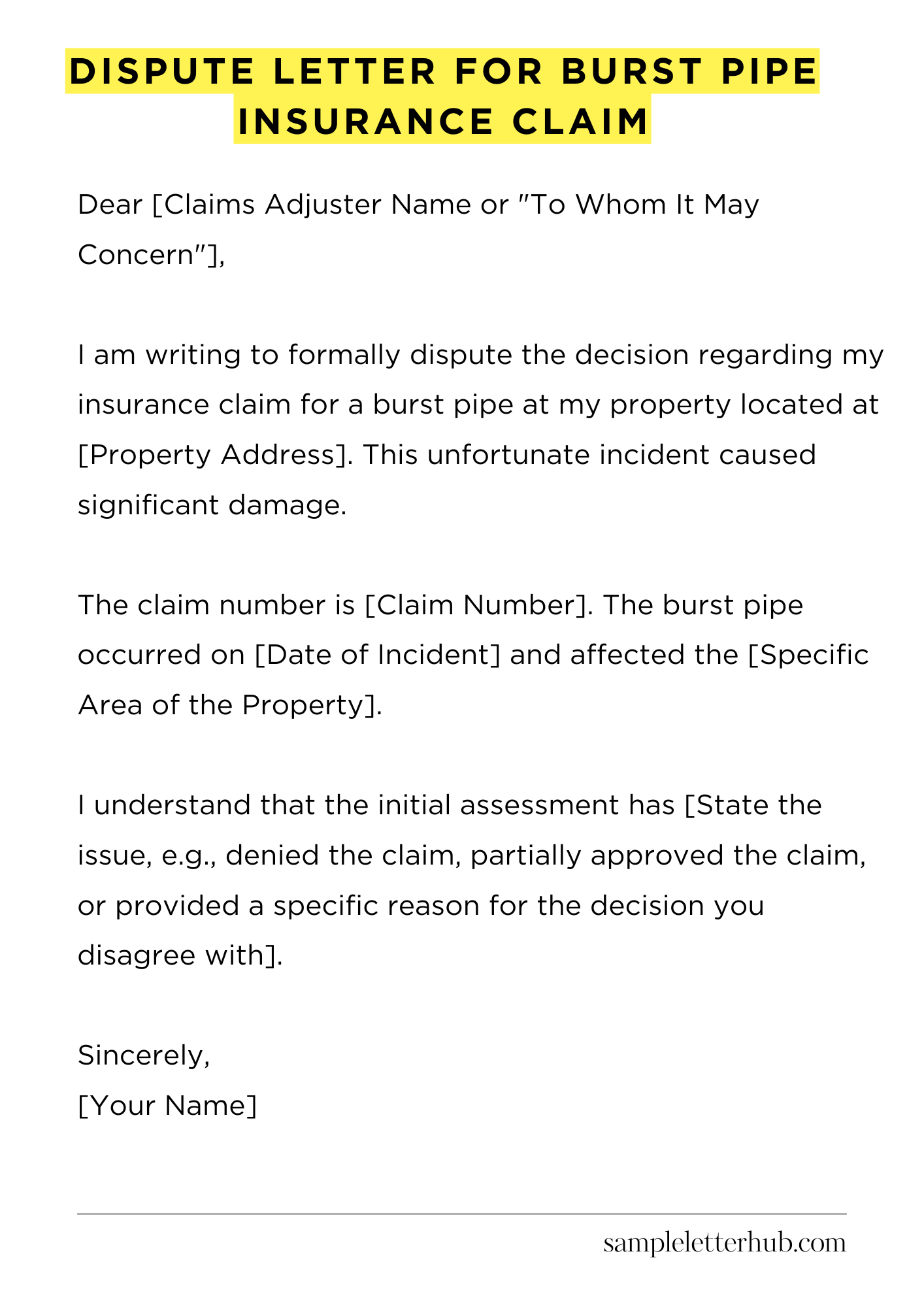
I am writing to formally dispute the decision regarding my insurance claim for a burst pipe at my property located at [Property Address]. This unfortunate incident caused significant damage. I submitted a claim on [Date of Claim Submission], seeking coverage for the resulting water damage.
The claim number is [Claim Number]. The burst pipe occurred on [Date of Incident] and affected the [Specific Area of the Property].
I understand that the initial assessment has [State the issue, e.g., denied the claim, partially approved the claim, or provided a specific reason for the decision you disagree with]. However, I believe this decision is incorrect for the following reasons. The damage was due to the sudden failure of a pipe.
[Provide a concise and clear explanation of why you disagree with the decision. Back up your statements with facts. Use bullet points if necessary. For example:]
- [Point 1: State the reason. For example: The damage was caused by a sudden freeze.] This is supported by [Provide supporting evidence, e.g., photographs, witness statements, or documentation].
- [Point 2: State another reason, e.g., The policy covers damage from burst pipes.]
- [Point 3: Provide a final point. For example, the pipe was new]
I have attached [List any supporting documentation, e.g., photographs, repair estimates, witness statements, or plumbing reports]. These documents further support my claim and clarify the extent of the damage.
I am seeking a review of the initial assessment. My understanding of the insurance policy is that this type of damage is covered. I respectfully request that you reconsider your decision based on the information provided.
I am available to discuss this matter further at your convenience. You can reach me at the phone number or email address listed above. I look forward to your prompt response and a resolution to this issue.
Sincerely,
[Your Name]
How to Write Dispute Letter for Burst Pipe Insurance Claim
A burst pipe can be a harrowing experience, and navigating the subsequent insurance claim can often feel equally daunting. If you find yourself in disagreement with your insurer’s assessment or payout, crafting a compelling dispute letter is your next crucial step.
Let’s dissect the anatomy of an effective dispute letter, ensuring your voice is heard and your claim is given the proper consideration.
1. Commence with a Concise Header
Your letter’s header should be an exemplar of clarity. Begin with your full name, address, phone number, and email address. Below this, on the right side, delineate the date, followed by the insurer’s name, their claims department’s address, and the policy number. This straightforward commencement sets the stage for a well-organized and professional communication.
2. Subject Line: A Beacon of Clarity
Don’t underestimate the power of a crisp subject line. Immediately alert the recipient to the letter’s purpose. Something like “Dispute of Insurance Claim – Policy Number [Your Policy Number] – Burst Pipe at [Your Address]” is both direct and unambiguous. This prevents your missive from being lost in a blizzard of paperwork.
3. Formal Salutation: Etiquette is Key
Address the claims adjuster or the specific individual assigned to your case, if known. If not, a generic yet respectful salutation like “Dear Claims Department” or “To Whom It May Concern” is perfectly acceptable. Maintain a professional tone throughout the letter; it’s a critical component.
4. A Succinct Recapitulation of the Events
Provide a brief, factual chronicle of the burst pipe incident. Include the date the pipe burst, the location, and a concise explanation of the damage incurred. Emphasize the timeline leading to your claim submission. Keep it to the point. No need for florid descriptions here.
5. Articulate the Heart of Your Grievance
This is where you clearly state your dispute. Explicitly identify the specific aspects of the claim with which you disagree. This might involve the assessed damage amount, the denial of certain repairs, or a disagreement over the cause of the burst pipe.
Cite specific policy provisions that you believe have been misinterpreted or misapplied. Include copies of any documentation that bolsters your case, such as photographs, contractor estimates, or expert reports. Make your points with irrefutable clarity.
6. The Imperative: A Call to Action
Clearly state what you are seeking. This could be a reconsideration of the damage assessment, a reevaluation of the denied repairs, or a complete reversal of the claim denial.
Specify a reasonable timeframe for the insurer’s response. Be assertive, but always stay respectful in tone. This directs the insurance company on the steps they need to take and what you expect from them.
7. Concluding with Professionalism: The Sign-Off
End your letter with a formal closing, such as “Sincerely” or “Respectfully,” followed by your full name, your signature (if sending a physical letter), and your contact information.
If you’re sending via email, it’s still prudent to include your phone number. Keeping a copy of the letter, as well as any attached documentation, is important for your records. This creates a solid, unshakeable foundation for your dispute.
FAQs about Dispute Letter for Burst Pipe Insurance Claim
Understanding the process of disputing a burst pipe insurance claim is crucial for homeowners. Here are some frequently asked questions:
What is a dispute letter for a burst pipe insurance claim?
A dispute letter, also known as a denial letter, is a formal written communication sent to your insurance company when you disagree with their decision regarding your burst pipe insurance claim.
This could be due to a denial of the claim, a disagreement over the amount of the settlement, or issues with the scope of the covered damages. The letter outlines your specific reasons for disagreement and provides supporting evidence to substantiate your position.
What information should be included in a dispute letter?
A comprehensive dispute letter should include the following: your policy number, the date of the burst pipe incident, a clear statement of what you are disputing, the specific reasons for your disagreement.
It’s also important to state what resolution you are seeking (e.g., full coverage, additional payment).
What are common reasons for insurance claim denials or underpayments related to burst pipes?
Insurance companies often deny or underpay burst pipe claims for several reasons.
These include: Pre-existing conditions or lack of proper maintenance on the property, insufficient coverage limits in your policy, a claim not filed within the specified timeframe, the insurance company deeming the damage a result of wear and tear, and disputes about the cause of the burst pipe or the extent of the resulting damage.
Also, failing to mitigate further damage after the burst can lead to claim issues.
How can I gather evidence to support my dispute?
Gathering robust evidence is critical. This includes documenting the burst pipe damage with detailed photos and videos.
Obtain multiple repair estimates from reputable contractors, keeping itemized lists of damaged property, receipts for any temporary repairs performed, and a copy of your insurance policy. If applicable, gather expert opinions, such as reports from a plumber or building inspector, to determine the cause and extent of the damage.
What happens after I send a dispute letter?
Once you send the dispute letter, the insurance company is obligated to review it.
They will likely re-evaluate your claim, which may include further investigation, reviewing the additional documentation you provided, and potentially contacting you for clarification.
They may then issue a revised decision. If you remain dissatisfied, you may need to escalate the dispute through the insurance company’s internal appeal process or consider mediation, arbitration, or legal action depending on the laws of the jurisdiction in which the property is located.
Related:
Resignation letter due to rude boss
Resignation letter moving to another state
Resignation letter due to illness of family member
Resignation letter due to study