


Dealing with insurance can be frustrating. Sometimes, insurance companies delay or deny claims. An appeal letter for delayed insurance claim is a formal way to challenge this delay. Its main purpose is to convince the insurer to reconsider its decision and expedite your claim. It’s a crucial step to get the compensation you deserve.
Writing an effective appeal letter can seem daunting. Don’t worry, we’ve got you covered. We’ll provide you with various appeal letter for delayed insurance claim templates. These sample appeal letters are designed to assist you. Find the perfect template that suits your needs. You can easily adapt these insurance claim appeal letter examples to your specific situation.
We aim to make it easy for you. Our goal is to empower you to write a strong delayed insurance claim appeal letter. Choose a template. Customize it. Submit it. Getting your insurance claim approved just became a little easier.
[Your Name/Your Company Name]
[Your Address]
[Your Phone Number]
[Your Email Address]
[Date]
[Insurance Company Name]
[Insurance Company Address]
Subject: Appeal for Delayed Insurance Claim – Policy Number [Your Policy Number]
Dear [Insurance Adjuster Name or “Claims Department”],
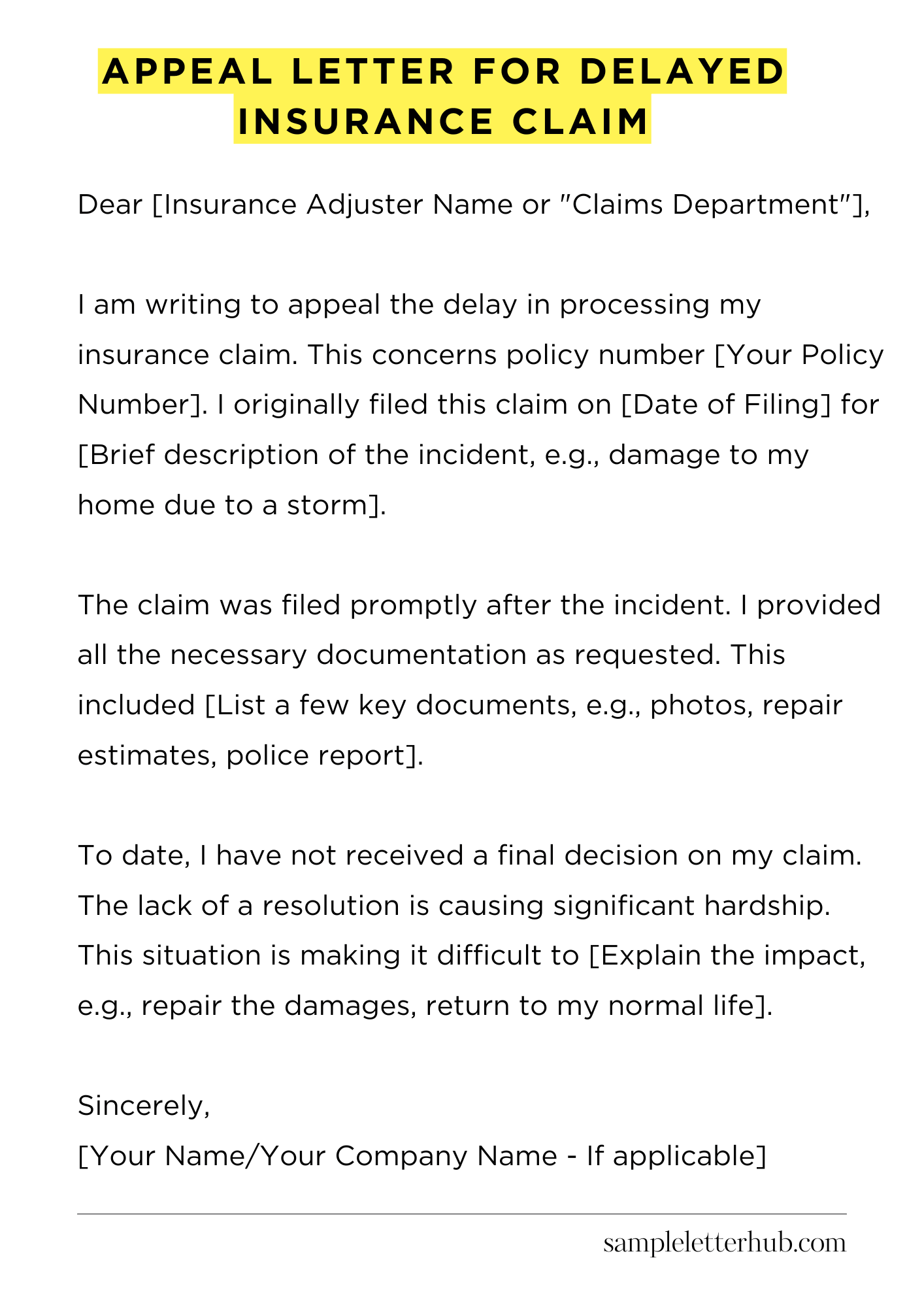
I am writing to appeal the delay in processing my insurance claim. This concerns policy number [Your Policy Number]. I originally filed this claim on [Date of Filing] for [Brief description of the incident, e.g., damage to my home due to a storm].
The claim was filed promptly after the incident. I provided all the necessary documentation as requested. This included [List a few key documents, e.g., photos, repair estimates, police report]. I followed all the initial instructions diligently.
To date, I have not received a final decision on my claim. The lack of a resolution is causing significant hardship. This situation is making it difficult to [Explain the impact, e.g., repair the damages, return to my normal life].
I have contacted your office on [Dates of Contact] to inquire about the status. Each time, I was told [Summarize the responses you received]. While I understand that investigations can take time, the extended delay is concerning.
I kindly request that you expedite the review of my claim. Could you please provide an updated timeline for when I can expect a decision? Your prompt attention to this matter would be greatly appreciated. I am available to answer any further questions you may have.
Thank you for your time and consideration.
Sincerely,
[Your Name/Your Company Name – If applicable]
How to Write Appeal Letter for Delayed Insurance Claim
Insurance claims, a labyrinthine process, can sometimes stall. When your claim languishes in bureaucratic limbo, an appeal letter becomes your primary instrument of redress.
A well-crafted appeal is not just a letter; it is a persuasive document designed to galvanize action. It’s a formal communication. Here’s a comprehensive guide to composing a compelling appeal for your delayed insurance claim:
1. Initiate: The Salutation and Introductory Prolegomenon
Begin with a formal salutation. Address the letter to the specific claims adjuster, if possible, or the claims department manager. Instead, you can utilize, “To Whom It May Concern”.
Then, succinctly state the purpose of your letter in the opening paragraph. Immediately, assert your intent to appeal the delayed decision on your insurance claim. In this initial preamble, furnish pertinent information, including your policy number, claim number, and the date the claim was initially submitted.
2. Narrate the Predicament: Exposing the Chronological Conundrum
The core of your appeal lies in detailing the specifics. Here, provide a meticulous chronicle of events. Start from the inception of the incident that instigated your claim.
Then, include the date of the claim submission and any subsequent communications with the insurance company. Be sure to incorporate dates, times, and the names of individuals you communicated with. Highlight any inconsistencies or inadequacies in the insurer’s actions. Your aim is to illustrate how the delay has caused you disadvantage.
3. Substantiate: The Corroborating Collateral
Reinforce your argument with compelling evidence. Attach copies of all relevant documentation. This might include police reports, medical records, photographs, invoices, and any other evidence that bolsters your claim.
Categorically enumerate each document in a list, making it easy for the recipient to grasp the totality of your evidence. Ensure all attached material is readily intelligible and organized for effortless perusal.
4. Articulate the Grievance: Explicating the Perceived Injustice
Clearly state why you believe the delay is unwarranted. Did the insurance company fail to meet a stipulated timeframe? Did they request unnecessary documentation?
Outline the specific reasons why the delay is unacceptable, emphasizing the impact it has had on you. Did you incur financial losses due to the delay? Did it hinder access to essential medical care? Be explicit and resolute in your assertions.
5. Cite the Precedent: Leveraging Policy Provisions
Delve into the details of your insurance policy. Identify specific clauses or stipulations that the insurance company may have disregarded.
Refer to any regulations or industry standards that the insurer may have contravened. By alluding to these stipulations, you demonstrate your understanding of the terms and conditions of your policy. This tactic underscores the validity of your claim, reinforcing its legitimacy.
6. Demand Rectification: Requesting Prompt Resolution
Concisely outline your desired resolution. Request a specific timeline within which you expect a decision on your claim. State the exact compensation or action you seek. Be firm, but maintain a respectful tone. This section clearly communicates your expectations. It reinforces the purpose of your letter. It leaves no ambiguity about your requirements.
7. Conclusion: The Parting Benediction
Conclude your letter with a formal closing, such as “Sincerely” or “Respectfully”. Include your full name, address, phone number, and email address. Sign the letter manually, if possible.
Retain a copy for your records. Consider sending the letter via certified mail with a return receipt requested. This provides proof that the insurance company received your appeal. This strategy also serves as a final, decisive gesture.
FAQs about Appeal Letter for Delayed Insurance Claim
What is a delayed insurance claim, and why might an appeal be necessary?
A delayed insurance claim refers to a situation where the insurance company has not processed or made a decision on your claim within a reasonable timeframe, as defined by the policy or relevant regulations.
An appeal becomes necessary when you believe the delay is unwarranted, causing you financial hardship or other damages, and you want to expedite the process or challenge a potential denial due to the delay.
What information should I include in an appeal letter for a delayed insurance claim?
An effective appeal letter should include your policy number, claim number, the date the claim was initially filed, a detailed description of the incident or loss, all supporting documentation (medical records, police reports, receipts, etc.), the specific reasons you believe the delay is unacceptable.
What is the typical timeframe for an insurance company to respond to an appeal letter regarding a delayed claim?
The response timeframe varies based on state laws and the insurance policy. However, most states have regulations outlining maximum processing times for claims and appeals.
You should review your policy documents and any applicable state regulations. Expect a response, or at least an acknowledgment of receipt of your appeal, within 30 to 60 days. The insurer should inform you of the status of your claim.
What are my options if the insurance company denies my appeal or continues to delay the claim?
If your appeal is denied or the delay persists, you may have several options. These include filing a complaint with your state’s insurance regulatory agency, seeking assistance from a consumer protection agency, requesting mediation or arbitration.
How can I prove that the insurance company’s delay has caused me financial or other types of damages?
To prove damages caused by the delay, you must provide supporting documentation. This can include bills, invoices, receipts for expenses incurred due to the delay, documentation of lost wages or income, medical records showing worsened health conditions, and evidence of emotional distress or hardship.
Keep meticulous records of all communications, expenses, and impacts related to the delayed claim to strengthen your case.
Related:
Resignation letter due to rude boss
Resignation letter moving to another state
Resignation letter due to illness of family member
Resignation letter due to study