


You’ve been in a car accident, and your insurance claim got denied. Now what? An appeal letter for auto accident insurance denial is your next step. Its purpose? To formally challenge the denial and fight for the compensation you deserve. It’s how you can try to get your claim approved after it was initially rejected.
This situation can be overwhelming. Writing an appeal letter seems daunting. But don’t worry. This article is here to help. We’re sharing handy appeal letter for auto accident insurance denial templates, examples, and samples. We want to make it easy for you to write your own letter.
We’ll break down the process. We will offer simple letter structures to help with your insurance appeal. You’ll find different sample letters here. Using these examples, you can create a strong appeal letter in no time.
[Your Name]
[Your Address]
[Your Phone Number]
[Your Email Address]
[Date]
[Insurance Company Name]
[Insurance Company Address]
Subject: Appeal of Claim Denial – Policy Number [Your Policy Number] – Accident of [Date of Accident]
Dear Claims Department,
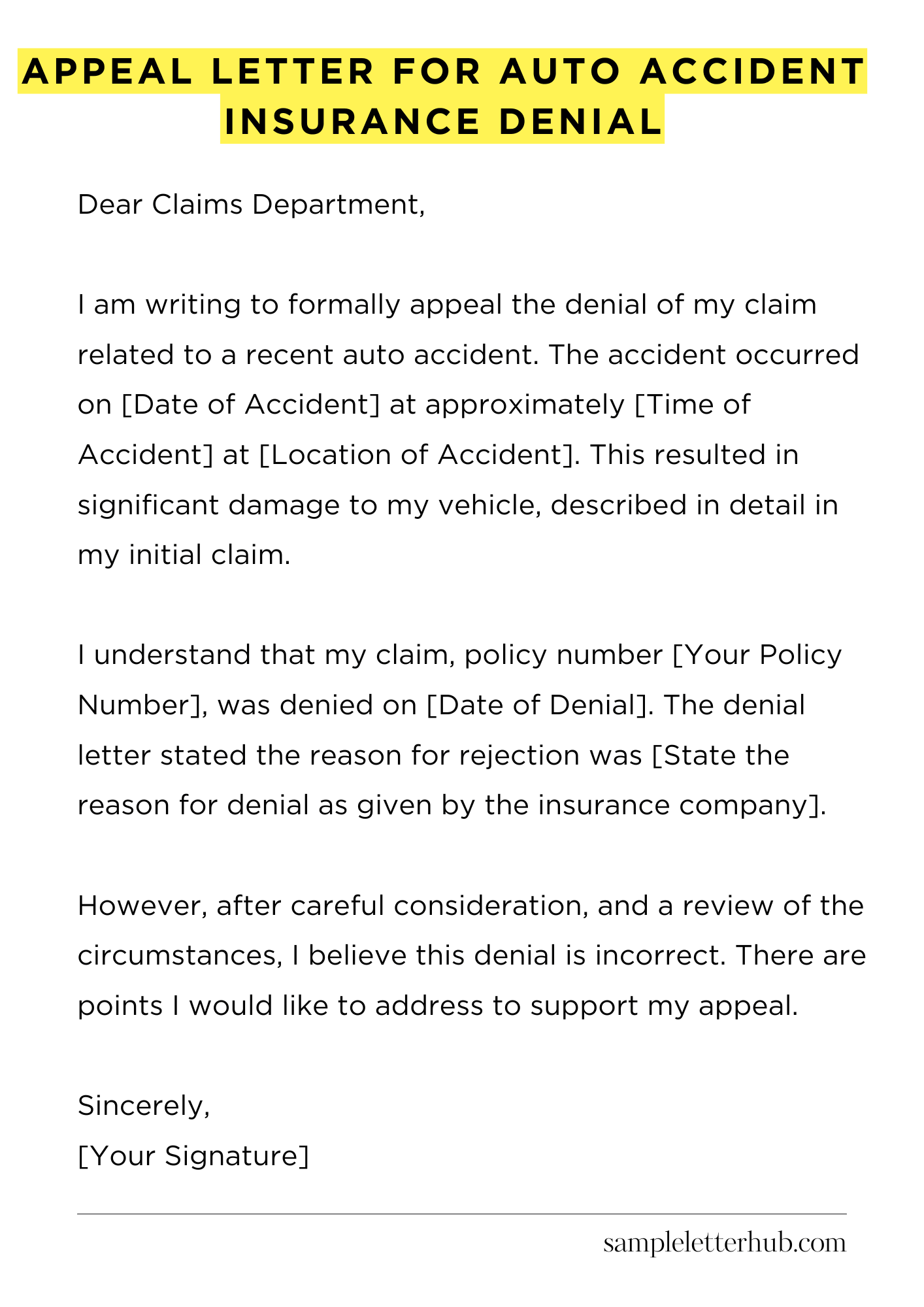
I am writing to formally appeal the denial of my claim related to a recent auto accident. The accident occurred on [Date of Accident] at approximately [Time of Accident] at [Location of Accident]. This resulted in significant damage to my vehicle, described in detail in my initial claim.
I understand that my claim, policy number [Your Policy Number], was denied on [Date of Denial]. The denial letter stated the reason for rejection was [State the reason for denial as given by the insurance company].
However, after careful consideration, and a review of the circumstances, I believe this denial is incorrect. There are points I would like to address to support my appeal.
Firstly, the initial assessment of the accident may have overlooked crucial details. The other driver [briefly describe the other driver’s actions – e.g., failed to yield, ran a red light]. These actions directly contributed to the collision. This caused a great deal of damage, and put me in a state of shock.
Secondly, I have attached supporting documentation that I believe clarifies the situation and refutes the stated reason for the denial. This includes [List the documents you are including – e.g., police report, witness statements, photographs, repair estimates].
The police report clearly indicates [summarize what the police report says in your favor]. Further, the witness statement from [Witness Name] corroborates my account of events. It completely verifies what happened at the scene.
I believe these documents provide sufficient evidence to demonstrate that the denial of my claim was unwarranted. I was not at fault in this accident. Therefore, I respectfully request that you reconsider my claim and reverse the denial. I am also seeking compensation for the damages.
I am available to discuss this matter further and answer any questions you may have. Please contact me at your earliest convenience. I am available to speak on the phone on weekdays after 5 p.m.
Thank you for your time and consideration.
Sincerely,
[Your Signature]
How to Write Appeal Letter for Auto Accident Insurance Denial
Receiving a denial for your auto accident claim can feel like a punch to the gut. The insurance company might have rejected your claim, but don’t surrender just yet. You have recourse: an appeal letter. Crafting a compelling appeal is critical. Here’s a comprehensive guide to navigate this process, ensuring your letter resonates with clarity and purpose.
1. Scrutinize the Denial Letter Meticulously
Before you even consider putting pen to paper (or fingers to keyboard), thoroughly dissect the insurance company’s denial letter. Unravel the specific justifications for the rejection.
What explicit reasons are cited? Is it a lack of evidence, a policy violation, or perhaps a dispute over liability? Identify the exact stipulations the insurer has asserted. This will form the bedrock of your counterarguments.
2. Gather Your Arsenal of Evidence
Your appeal letter will falter without solid supporting evidence. Amass every document, artifact, and testimonial that bolsters your claim. This includes, but is not limited to, the police report, photographs of the accident scene and vehicle damage, medical records, witness statements, and any communication you had with the insurer previously.
Think of this as assembling the pieces of a complex jigsaw puzzle, each fragment contributing to the overarching picture of your case.
3. Frame Your Letter with a Polished Salutation and Introduction
The commencement of your letter is your initial opportunity to captivate the reader. Begin with a formal salutation, addressing the claims adjuster or the designated appeals department. In the introduction, succinctly state the purpose of your letter: to formally appeal the denial of your auto accident claim.
Include your claim number, policy number, and the date of the accident. Maintain a tone of respectful persistence; avoid sounding accusatory.
4. Articulate Your Counterarguments with Precision
This is the crux of your appeal. Address each specific reason the insurer provided for denying your claim, one by one. For each reason, articulate your counterarguments clearly and persuasively.
Support your assertions with evidence. For example, if the denial was based on a lack of witness testimony, reiterate the witness accounts, attach their statements, or provide contact information for the witnesses. Be logical, presenting your case methodically, and use straightforward language.
5. Cite Pertinent Policy Provisions and Laws (If Applicable)
To strengthen your case, reference specific policy provisions that support your claim. Carefully examine your insurance policy, identifying clauses that substantiate your right to coverage.
If there are state laws that are applicable to your situation, you can also bring them to their notice. This demonstrates your awareness of the contractual obligations and legal framework surrounding your claim.
6. Conclude with a Firm Request for Reconsideration
In your conclusion, politely but firmly request that the insurance company reconsider its initial decision. Reiterate your expectation of a positive resolution, given the evidence you have provided.
Specify a reasonable timeframe for them to respond to your appeal, generally within thirty days. Express your willingness to provide additional information, if necessary. End with a professional closing and your signature.
7. Proofread and Dispatch with a Robust Delivery Method
Before dispatching your letter, meticulously proofread it for any grammatical errors or typos. Ensure the language is clear, concise, and professional. Consider sending your appeal letter via certified mail with a return receipt requested.
This ensures proof of delivery and provides documentation of when the insurer received your appeal. Keep a copy of the letter and all supporting documentation for your records. The appeal process can be tricky, so make sure your every step is documented.
FAQs about Appeal Letter for Auto Accident Insurance Denial
What is the purpose of an appeal letter for an auto accident insurance denial?
The primary purpose of an appeal letter is to formally request that the insurance company reconsider its decision to deny your claim. It serves as a documented effort to present additional information, evidence, or arguments to support your claim for coverage and potentially overturn the initial denial. The goal is to receive compensation for damages or injuries sustained in the auto accident.
What information should I include in an appeal letter?
An effective appeal letter should contain key information. This includes your policy number, the date of the accident, the date of the denial letter, and a clear statement of why you believe the denial is incorrect.
You should provide detailed explanations, relevant evidence (photos, police reports, witness statements, medical records), and a clear request for reconsideration. Refer to specific policy clauses that you believe support your claim.
What are the common reasons for auto accident insurance claim denials?
Insurance claims can be denied for several reasons. These include: lack of coverage based on policy terms, failure to report the accident promptly, insufficient evidence to support the claim, pre-existing conditions (in the case of medical claims), misrepresentation or fraud in the claim, or disputes about liability.
Understanding the reason for the denial (stated in the denial letter) is crucial for formulating a successful appeal.
What is the timeframe for submitting an appeal letter?
The timeframe for submitting an appeal varies based on the insurance company and the laws of the jurisdiction. The denial letter will typically specify a deadline, which is crucial to adhere to.
Missing the deadline may result in the loss of your right to appeal. Review the denial letter carefully and submit your appeal within the stated time frame, often within 30-90 days from the date of the denial.
What happens after I submit my appeal letter?
After you submit your appeal letter, the insurance company will review your submission and any supporting documentation. The process can vary, but generally, they will investigate the matter again.
They might request additional information or evidence. The insurer will then make a final decision, which can be an acceptance of your claim, a denial (possibly with the option for further legal action), or a negotiation to settle the claim. You will receive written notification of their decision.
Related:
Resignation letter due to rude boss
Resignation letter moving to another state
Resignation letter due to illness of family member
Resignation letter due to study