

Dealing with home insurance can be tricky. Sometimes, your home insurance claim gets denied or only partially paid. That’s where a home insurance claim dispute letter comes in. It’s your official way of telling your insurance company you disagree with their decision. The goal? To convince them to reconsider and pay your claim fairly.
Ready to fight for your claim? We’ve got you covered. We’ll provide samples and examples of home insurance claim dispute letters. You can adapt them to your specific situation. Consider it your secret weapon in this process. These templates will help you create a strong and effective dispute letter.
Crafting the perfect letter can feel daunting. That’s why we’ve simplified things. Our easy-to-use letter templates will guide you. Writing a winning home insurance claim dispute is now within your reach. Let’s get started.
[Your Name/Your Company Name]
[Your Address]
[Your City, Postal Code]
[Your Email]
[Your Phone Number]
[Date]
[Insurance Company Name]
[Insurance Company Address]
[Insurance Company City, Postal Code]
Subject: Claim Dispute – Policy Number [Your Policy Number] – Regarding Damage at [Your Address]
Dear Sir/Madam,
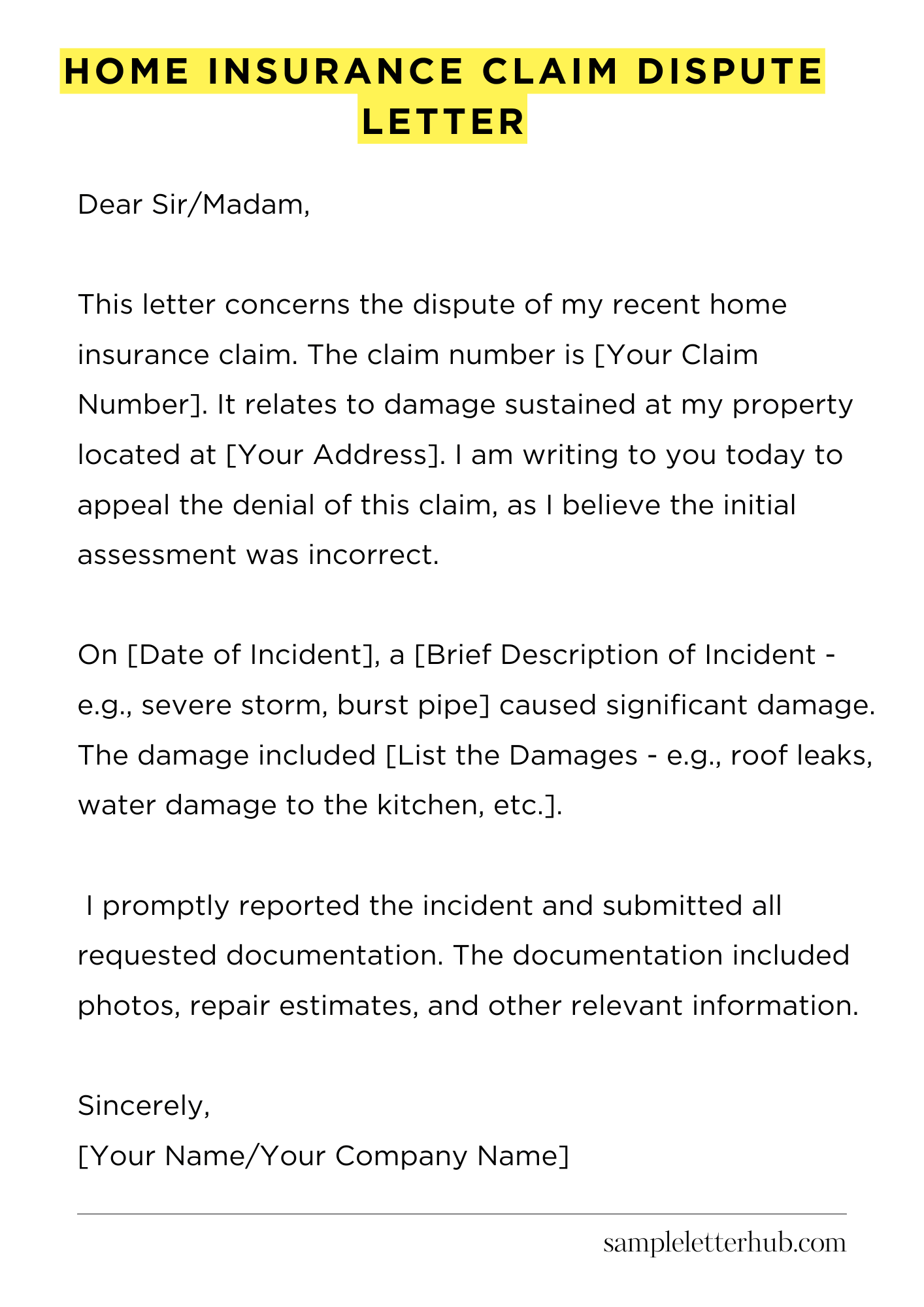
This letter concerns the dispute of my recent home insurance claim. The claim number is [Your Claim Number]. It relates to damage sustained at my property located at [Your Address]. I am writing to you today to appeal the denial of this claim, as I believe the initial assessment was incorrect.
On [Date of Incident], a [Brief Description of Incident – e.g., severe storm, burst pipe] caused significant damage. The damage included [List the Damages – e.g., roof leaks, water damage to the kitchen, etc.]. I promptly reported the incident and submitted all requested documentation. The documentation included photos, repair estimates, and other relevant information.
Your initial assessment, however, denied the claim. The denial cited [State the Reason for Denial – e.g., lack of coverage, pre-existing condition, etc.]. I respectfully disagree with this decision for the following reasons.
Firstly, [Explain your Reason 1 with detailed information]. For example, the damage was clearly caused by a covered peril. Secondly, [Explain your Reason 2 in detail]. This highlights the importance of the coverage. Finally, [Explain your Reason 3, providing additional supporting information]. This provides further insight into the situation.
I believe the denial overlooks key details of my policy. I have reviewed my policy document carefully, and I believe the damage is indeed covered. I am confident that a re-evaluation of the claim, taking these points into account, will lead to a different outcome. I would like the opportunity to discuss this further with a representative from your company.
To support my claim, I have attached [List any additional documents you are including – e.g., updated repair estimates, additional photos, etc.]. Please consider this information in your review of my claim. I would appreciate it if you could contact me within [Number] days to discuss this matter further.
Thank you for your time and attention to this important matter.
Sincerely,
[Your Name/Your Company Name]
How to Write Home Insurance Claim Dispute Letter
1. Commence with Precise Identification
First things first, you’ll need to clearly and concisely identify your position. Begin by stating your full name, address, and policy number. Don’t be vague; precision is paramount. Immediately after, clearly identify the insurance company’s name and the specific claim number you are disputing.
This meticulous approach lays a strong foundation. This ensures that the insurance provider understands the subject of your correspondence at a glance.
2. Articulate the Grievance Concisely
Next, explicitly detail the nature of your disagreement. This is where you explain the specifics of the claim denial or the inadequacy of the payout. Avoid rambling. Get directly to the point.
State the precise reason(s) why you believe the insurance company’s decision is incorrect. Was the damage misassessed? Were essential repairs omitted? You should offer a pithy summary of the insurance company’s stance and the reasons why you disagree.
3. Furnish Supporting Documentation
This section is critical. Your letter needs substantiation. Compile and meticulously organize all relevant supporting documentation. This can include photographs of the damage, repair estimates, invoices, police reports (if applicable), and any other supporting evidence that fortifies your claim. Enclose copies of these documents, keeping originals safely in your possession.
Ensure that each document is clearly labeled and referenced within your letter. The more evidence you present, the stronger your case will be.
4. Analyze the Policy’s Tenets
Carefully review your home insurance policy. Scrutinize the clauses relevant to your claim. Cite specific policy provisions that support your position. For instance, if the denial hinges on an exclusion, analyze the exclusion’s applicability to your situation.
Argue why the exclusion is not applicable, or why the damage falls under a covered peril. Reference the specific policy language in your letter, using clear and unambiguous wording.
5. Present a Call to Action
Clearly state what resolution you are seeking. Do you want the claim reconsidered? Are you requesting a specific payout amount? Are you seeking further investigation of the damage?
Clearly delineate your desired outcome. Provide a reasonable timeframe for the insurance company to respond to your letter and take the appropriate action. This demonstrates that you have a specific goal in mind.
6. Ensure a Professional Demeanor
Maintain a professional and respectful tone throughout your letter. Refrain from accusatory language or emotional outbursts. Even when expressing your frustration, remain objective. Use formal language and proper grammar. This enhances the credibility of your arguments. The insurance company is more likely to take your concerns seriously.
7. Finalize and Distribute the missive
Before sending your letter, proofread it carefully. Check for any errors in spelling, grammar, and punctuation. Make sure all your information is accurate. Send your letter via certified mail with return receipt requested. This provides proof that the insurance company received your correspondence.
Retain a copy of the letter and all supporting documentation for your records. This ensures that you have a comprehensive record of your claim dispute.
FAQs about Home Insurance Claim Dispute Letter
What is a Home Insurance Claim Dispute Letter?
A home insurance claim dispute letter is a formal document you send to your insurance provider to challenge their decision regarding a claim. It outlines the reasons why you believe the claim was wrongly denied or underpaid, providing evidence and arguments to support your position.
What should I include in a Home Insurance Claim Dispute Letter?
A comprehensive dispute letter should include the following: your policy information (policy number, etc.), the date of the loss or damage, a clear description of the disputed claim, the reasons you disagree with the insurer’s decision, supporting evidence (photos, videos, repair estimates, etc.), and a specific request for a resolution (e.g., payment for repairs).
It should be polite, professional, and fact-based.
What are common reasons for disputing a home insurance claim?
Common reasons include: denial of coverage based on policy exclusions (you believe the exclusion doesn’t apply), disagreements about the extent of damage, inadequate payment for repairs or replacement, disagreements about the cause of damage, and the insurance company not following policy terms.
How do I file a Home Insurance Claim Dispute Letter?
Most insurance policies require you to file a dispute in writing, often via certified mail with return receipt requested to provide proof that your letter was received. Review your policy for specific instructions on how to file a dispute. Keep a copy of the letter and all supporting documentation for your records.
What happens after I send a Home Insurance Claim Dispute Letter?
After receiving your letter, the insurance company will review your dispute and supporting documentation. They may request additional information, conduct further investigation, or send an adjuster to re-evaluate the damage.
They will then issue a decision, which may include overturning their previous decision, offering a settlement, or upholding their original denial. If you’re not satisfied with their response, you may have the option to escalate the dispute further, potentially through mediation, arbitration, or legal action.
Related:
Resignation letter due to rude boss
Resignation letter moving to another state
Resignation letter due to illness of family member
Resignation letter due to study