

A Claim Settlement Negotiation Letter is a formal communication. It’s used to discuss a claim. The goal? To reach an agreement. You want to settle the claim amicably. This letter helps to achieve that.
Facing a claim can be stressful. Writing the perfect claim settlement negotiation letter is crucial. We’ve got you covered. This article offers ready-to-use samples. Letter samples will guide your writing.
We’ll provide a variety of letter templates. Choose the one that suits your needs. Need a demand letter for claim settlement? We have it. Explore these examples to draft your own claim negotiation letter. You are ready to start.
[Your Name/Company Name]
[Your Address]
[Your Phone Number]
[Your Email Address]
[Date]
[Insurance Company Name/Recipient Name]
[Insurance Company Address/Recipient Address]
Subject: Claim Settlement Negotiation – Policy Number [Your Policy Number] – Claim Number [Your Claim Number]
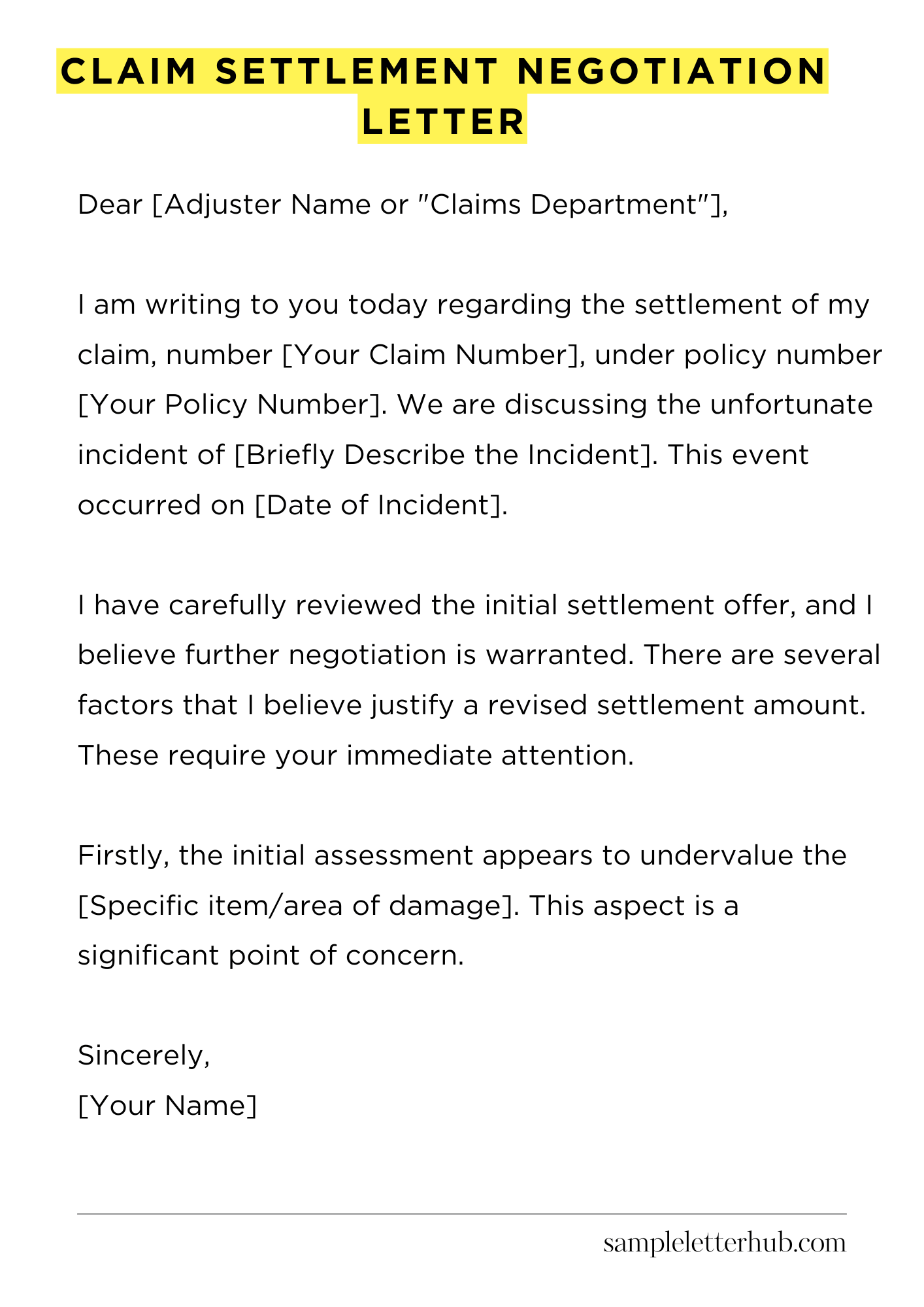
Dear [Adjuster Name or “Claims Department”],
I am writing to you today regarding the settlement of my claim, number [Your Claim Number], under policy number [Your Policy Number]. We are discussing the unfortunate incident of [Briefly Describe the Incident]. This event occurred on [Date of Incident].
I have carefully reviewed the initial settlement offer, and I believe further negotiation is warranted. There are several factors that I believe justify a revised settlement amount. These require your immediate attention.
Firstly, the initial assessment appears to undervalue the [Specific item/area of damage]. This aspect is a significant point of concern. The documented damage, as detailed in the original claim filing and supporting documents, includes [List specific damages or losses].
The subsequent valuation assigned to this damage appears considerably lower than fair market value. I can provide further evidence to support this claim, if required.
Secondly, I would like to highlight the impact of [Specific consequence of the incident – e.g., lost wages, medical expenses]. This caused a ripple effect.
Supporting documentation for these losses, including [List supporting documents], has already been submitted. The initial offer does not fully address these additional costs, which are directly related to the incident.
Finally, I also believe the proposed settlement fails to consider [Other relevant factors, such as depreciation, replacement costs, etc.]. This oversight is important. I am confident that a revised settlement, reflecting a more accurate and comprehensive assessment of the damages and related expenses, would be more equitable.
Therefore, I respectfully request that you reconsider the initial settlement offer. I am available to discuss this matter further at your earliest convenience. Please contact me at [Your Phone Number] or [Your Email Address]. I look forward to a prompt and fair resolution. I anticipate a fair and reasonable outcome.
Sincerely,
[Your Name]
How to Write Claim Settlement Negotiation Letter
1. Initiate the Correspondence with Precision
The commencement of your claim settlement negotiation letter is paramount; it’s the genesis of your argument. Begin with a formal salutation. Specify the exact date, your name, address, and contact information.
Next, meticulously state the recipient’s information: their name, title, company, and mailing address. Ensure the “Re:” line clearly articulates the subject—the claim number is often essential.
2. Articulate the Foundation of Your Claim
This is where you unearth the salient points of your grievance. Describe the incident or circumstance that led to the claim. Provide a succinct, yet comprehensive narrative. Include crucial facts, dates, and locations.
Reference any supporting documentation, such as police reports, contracts, or photographs. Be perspicacious in your recounting; clarity is king in this domain.
3. Detail the Damages and Losses Sustained
A rigorous account of your damages is non-negotiable. Itemize all losses, whether financial, property-related, or otherwise. Substantiate your claims with concrete evidence.
Present receipts, invoices, estimates, or any other proof of your losses. Accurately calculate the total amount of your claim. Be meticulous; the more thorough your accounting, the stronger your position.
4. Analyze the Liability and Fault
Address the issue of liability—who is at fault? Present your case, offering compelling evidence. Highlight how the other party’s actions (or inactions) led to your damages.
If relevant, point out breaches of contract, negligence, or any violations of policy. Convincingly establish the other party’s responsibility for the damages. Utilize legal terminology when you deem it appropriate to reinforce your claims.
5. Propose a Settlement Demeanor
Articulate your desired outcome with unwavering conviction. This is where you state the exact settlement amount you seek. Justify this amount by referencing the damages you detailed.
Consider a range for negotiation, perhaps starting slightly higher than your bottom line. Be reasonable, but firm. Outline the terms of the settlement, including the deadline for a response and the preferred method of payment.
6. Persuade with Clarity and Support
Bolster your argumentation with compelling evidence. Include copies of any supporting documents, such as photographs, contracts, medical reports, or witness statements.
Organize these attachments to make it easy for the recipient to scrutinize. Summarize your key arguments, leaving no room for misunderstanding. Review your letter to ensure it is logically sound, grammatically correct, and free of any ambiguity.
7. Conclude with Professionalism
Finish with a polished closing. Express your expectation for a prompt response. Use a formal closing, like “Sincerely,” or “Respectfully,” followed by your full name and signature.
If you are sending the letter by mail, send it via certified mail with return receipt requested. This provides proof of delivery and acknowledgement, bolstering your position.
FAQs about Claim Settlement Negotiation Letter
What is a Claim Settlement Negotiation Letter, and when is it used?
A Claim Settlement Negotiation Letter is a formal written communication used in insurance claims or other financial disputes. It’s employed when a party involved in a claim disagrees with the initial settlement offer or the denial of a claim.
The letter serves to formally state the reasons for the disagreement, provide supporting evidence, and propose a revised settlement or request a reconsideration of the denial.
What key elements should be included in a Claim Settlement Negotiation Letter?
A well-crafted letter typically includes a clear identification of the claim, a restatement of the facts, a detailed explanation of why the initial settlement is unsatisfactory (or why the denial is wrong), supporting documentation (such as medical records, repair estimates, or witness statements), and a specific demand or counter-offer.
It should also include a polite and professional tone, a clear closing statement, and the sender’s contact information.
How does a Claim Settlement Negotiation Letter influence the negotiation process?
The letter sets the stage for further discussion and potentially mediation or litigation. It provides the recipient with a formal record of the dispute and your position.
By presenting a well-reasoned argument supported by evidence, the letter can influence the recipient to reconsider their initial position, leading to a more favorable settlement. It also demonstrates that you are serious about pursuing the claim.
What are the common pitfalls to avoid when writing a Claim Settlement Negotiation Letter?
Avoid being overly emotional, using vague language, or making unsubstantiated claims. Ensure the letter is concise, easy to understand, and focuses on the facts of the case. Do not make threats or engage in personal attacks. Also, be sure to keep a copy of the letter and all supporting documentation for your records.
What if the recipient rejects the proposals outlined in the Claim Settlement Negotiation Letter?
If the recipient rejects your proposals, you may need to consider further actions. These could include filing a formal complaint, pursuing mediation, or filing a lawsuit. Depending on the amount in dispute and the jurisdiction, consulting with an attorney may be necessary to understand your legal options and the best course of action.
Related:
Resignation letter due to rude boss
Resignation letter moving to another state
Resignation letter due to illness of family member
Resignation letter due to study