


Sometimes, insurance companies deny claims. This is frustrating. A claim reconsideration request letter is a formal way to challenge this denial. Its purpose? To ask the insurer to review their decision. You provide new information or argue against their initial reasoning.
Need help crafting your own claim reconsideration request letter? We’ve got you covered. This article offers templates and examples. We’ll provide sample letters. Use these to easily write your own, personalized letter. No more struggling with the wording.
We’ll cover different scenarios. You’ll find templates for various types of claim denials. These samples make the process simple. Improve your chances of a successful reconsideration. Get your claim approved!
[Your Name/Company Name]
[Your Address]
[Your Phone Number]
[Your Email Address]
[Date]
[Insurance Company Name/Recipient Name]
[Recipient’s Address]
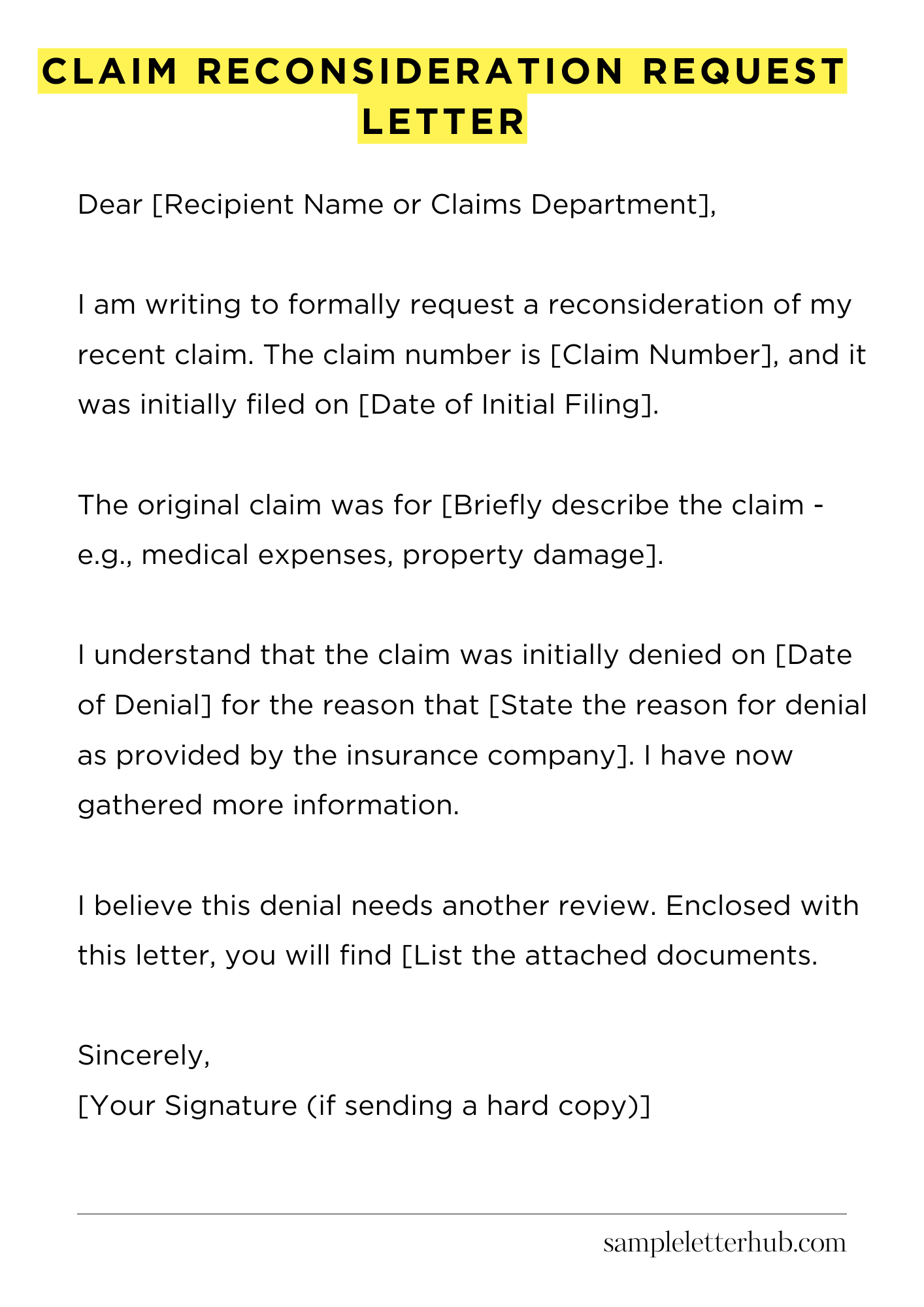
Dear [Recipient Name or Claims Department],
I am writing to formally request a reconsideration of my recent claim. The claim number is [Claim Number], and it was initially filed on [Date of Initial Filing]. I am hoping you will take another look at the details.
The original claim was for [Briefly describe the claim – e.g., medical expenses, property damage]. I understand that the claim was initially denied on [Date of Denial] for the reason that [State the reason for denial as provided by the insurance company]. I have now gathered more information.
I believe this denial needs another review. Enclosed with this letter, you will find [List the attached documents – e.g., additional medical records, receipts, repair estimates].
These documents further support my claim by [Explain how the documents support your claim – e.g., clarifying the extent of my injuries, providing proof of the necessary repairs]. These details have not been previously submitted.
I am confident that this new evidence will demonstrate the validity of my claim. I think it is important to review this again. I ask that you please reconsider the original decision.
Thank you very much for your time and attention to this matter. I am available to answer any questions you may have. You can reach me at the phone number or email address listed above. I look forward to hearing from you soon.
Sincerely,
[Your Signature (if sending a hard copy)]
How to Write Claim Reconsideration Request Letter
Navigating the labyrinthine world of claim denials can be frustrating, to say the least. It’s a reality many of us encounter. But take heart: a well-crafted claim reconsideration request letter can often be your strongest advocate.
Preparing such a document might initially seem daunting, however, a structured approach greatly improves your chances of a favorable outcome. This guide offers a pragmatic framework for producing compelling reconsideration letters.
1. Mastering the Preliminary Stage: Gathering the Prerequisites
Before you even begin to draft your letter, a meticulous pre-writing phase is crucial. First, procure the initial denial notification. Scrutinize it closely. Pay explicit attention to the precise reasons cited for the denial.
Analyze any accompanying documentation. Compile all relevant supporting evidence, like medical records, policy excerpts, and any correspondence related to the original claim. This granular detail forms the bedrock of a persuasive appeal. In this phase, precision and thoroughness are paramount.
2. The Salutation: A Formal and Respectful Beginning
Your letter’s commencement sets the tone. Use a formal salutation. Address the recipient appropriately, using “Dear [Claims Administrator Name/Department]” or a similarly professional greeting.
Maintain a respectful tone throughout the letter, even if you disagree vehemently with the initial denial. Avoid inflammatory language. Impeccable grammar and syntax are non-negotiable; this reflects professionalism and demonstrates that you take the matter seriously.
3. Clearly Articulating the Core Issue: The Introduction’s Significance
The introductory paragraph is where you define the purpose of your letter. Start by concisely stating the claim number, date of service, and the original denial’s date.
Then, and in the first sentences, clearly state that you are requesting a reconsideration of the denial. Identify the specific reason(s) for the denial as stated by the insurer.
Briefly mention the basis for your disagreement without going into excessive detail. Clarity is key: the reader must immediately understand the letter’s intent. Do not bury the lede.
4. The Body: Building a Compelling Case
This section comprises the core of your argument. Address each reason for denial individually. Provide compelling counterarguments, supported by concrete evidence.
Reference specific policy provisions, medical records, or any other pertinent documentation. Explain, in plain language, how the evidence substantiates your claim.
This is where you demonstrate the merits of your case. Be as logically organized as possible, for instance, numbering each point to help organize your thoughts.
5. Presenting Supporting Evidence: The Documentation’s Crucial Role
Evidence is the lifeblood of your reconsideration request. Include copies of all relevant documents. For each piece of evidence, clearly state its relevance to the claim. You can briefly summarize the key information within the letter, but the actual documents must accompany the letter.
Be methodical when attaching documents to the letter. Don’t submit irrelevant documentation. Your supporting documentation significantly strengthens your claim.
6. The Conclusion: A Call to Action and Polished Farewell
Conclude your letter by reiterating your request for reconsideration. State your desired outcome—that the claim be approved. Provide contact information (phone number, email address).
Express your willingness to provide further information if necessary. End with a polite and professional closing, such as “Sincerely” or “Respectfully.” Before sending, meticulously proofread your entire letter for any errors in grammar, spelling, and punctuation. The concluding flourish must be as professional as the opening salutation.
7. Submission and Follow-Up: Ensuring Effective Delivery and Vigilant Monitoring
Send your letter via certified mail with return receipt requested. This provides proof of delivery and ensures a paper trail. Keep a copy of the letter and all supporting documentation for your records.
Check in on the status of your claim; inquire about the timeline. If you don’t receive a response within the stated timeframe (or a reasonable period), follow up with the insurer. If your initial appeal is denied, understand your options for further recourse. Persistence and meticulous record-keeping are your allies.
FAQs about Claim Reconsideration Request Letter
What is a Claim Reconsideration Request Letter?
A Claim Reconsideration Request Letter is a formal document submitted to an insurance company, healthcare provider, or other relevant entity to appeal a denial of a previously filed claim. It outlines the reasons why the initial decision should be reviewed, providing additional information, documentation, or clarification that supports the claimant’s position.
When Should I File a Claim Reconsideration Request Letter?
You should file a Claim Reconsideration Request Letter when your initial claim has been denied, and you believe the denial was incorrect or based on incomplete information. This is appropriate when you have additional supporting evidence, clarifications, or believe there was an error in the initial assessment of your claim.
What Information Should I Include in the Letter?
A well-written Claim Reconsideration Request Letter should include: your personal and claim information, the date of the original denial, a clear explanation of why you disagree with the denial, detailed supporting evidence (e.g., medical records, invoices, photographs).
What is the Timeline for a Response?
The timeline for receiving a response to a Claim Reconsideration Request Letter varies depending on the entity you’re submitting the letter to and their specific procedures.
It is advisable to refer to the original denial letter or the entity’s website for an estimated timeframe. However, responses can sometimes take several weeks or even months.
What Happens if My Reconsideration Request is Denied?
If your claim reconsideration request is denied, you may have further appeal options. These may include filing a second-level appeal, requesting an external review from an independent third party, or pursuing legal action.
The specific avenues available to you will depend on the nature of your claim, the policies of the entity that denied your claim, and applicable laws and regulations.
Related:
Resignation letter due to rude boss
Resignation letter moving to another state
Resignation letter due to illness of family member
Resignation letter due to study