


Dealing with a claim denial can be frustrating. A claim denial appeal letter is your chance to fight back. It’s a formal written request. You ask the insurance company to reconsider their decision. The goal is to get your claim approved.
We understand navigating this can be tricky. That’s why we’re here to help. This article provides you with sample appeal letters. We offer templates. You will find different claim denial letter examples. Use these to guide your writing.
Our goal is to make it easy. We simplify the appeal letter process. You will be able to customize each sample. Adapt them to your specific situation. Write your own powerful denial letter today!
[Your Name]
[Your Address]
[Your Phone Number]
[Your Email Address]
[Date]
[Insurance Company Name]
[Insurance Company Address]
Subject: Appeal for Claim Denial – Policy Number [Your Policy Number] – Claim Number [Your Claim Number]
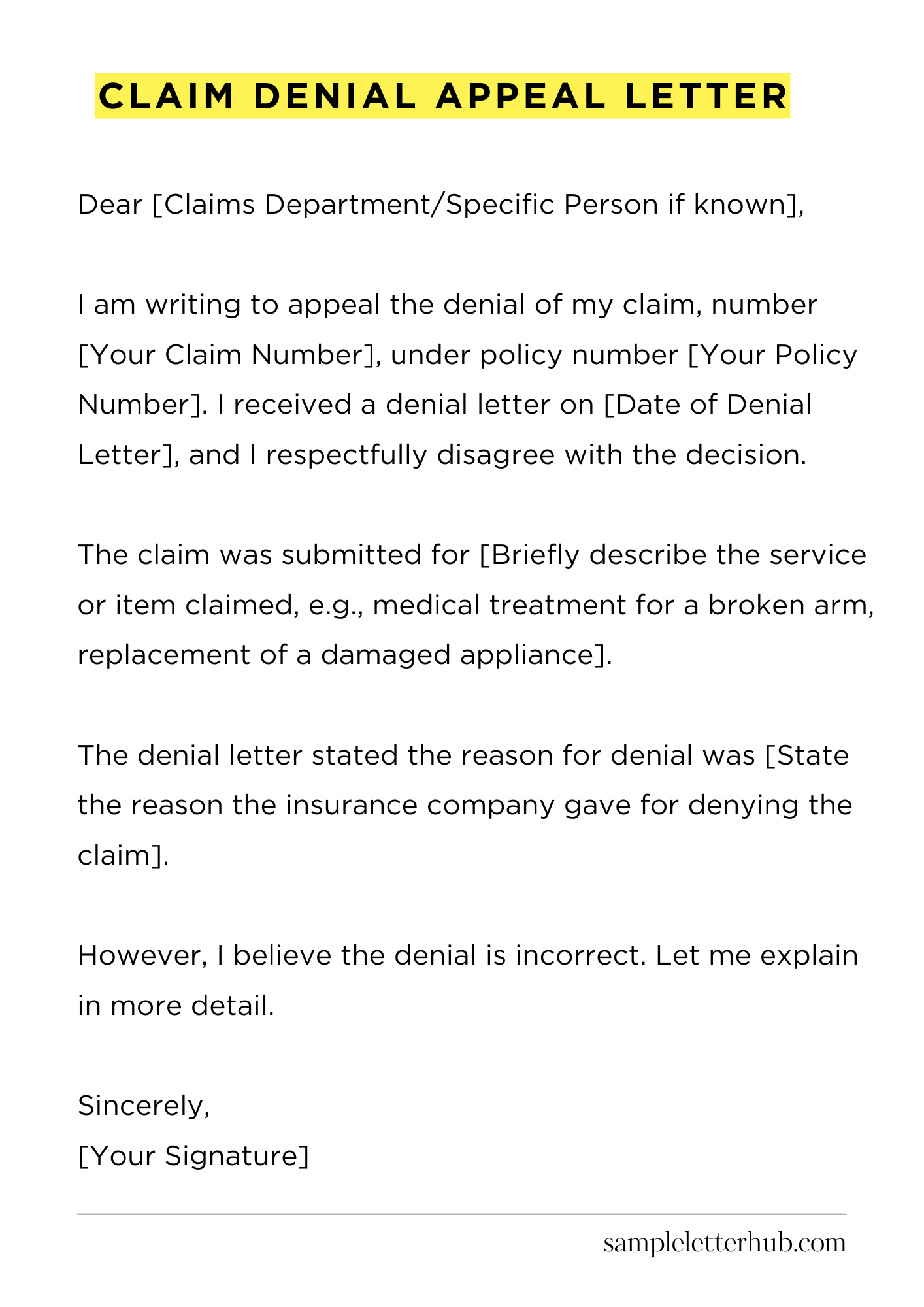
Dear [Claims Department/Specific Person if known],
I am writing to appeal the denial of my claim, number [Your Claim Number], under policy number [Your Policy Number]. I received a denial letter on [Date of Denial Letter], and I respectfully disagree with the decision. It is important to me that this is resolved quickly.
The claim was submitted for [Briefly describe the service or item claimed, e.g., medical treatment for a broken arm, replacement of a damaged appliance]. The denial letter stated the reason for denial was [State the reason the insurance company gave for denying the claim].
However, I believe the denial is incorrect. Let me explain in more detail.
[Clearly and concisely explain why you believe the denial is wrong. Provide evidence to support your claim. This may include medical records, receipts, bills, or any other relevant documentation. Include dates and specific details. Be very straightforward and avoid emotional language.]
For example:
“The denial stated that the treatment was not medically necessary. However, the attached medical report from Dr. [Doctor’s Name], dated [Date], clearly indicates that the treatment was crucial for [explain the medical reason]. Additionally, the treatment followed the recommendations outlined in my policy’s guidelines for [medical condition].”
I have enclosed copies of the following documents to support my appeal:
- [List of documents, e.g., Medical records from Dr. Smith, Receipt for the purchase of the item, etc.]
- [List of documents]
- [List of documents]
I have reviewed my policy documents and believe that this claim should be covered. I kindly request that you reconsider the denial based on the information provided. I am available to provide any further information or clarification that may be needed. I look forward to your positive response and a resolution to this matter.
Thank you for your time and consideration.
Sincerely,
[Your Signature]
How to Write Claim Denial Appeal Letter
Receiving a claim denial is frustrating, to say the least. It’s often a complex situation that requires swift and strategic action. Fortunately, crafting a compelling claim denial appeal letter is the first vital step in overturning the initial decision. This guide meticulously outlines the process to help you successfully navigate this hurdle.
1. Grasping the Grievance: Decoding the Denial
Before putting pen to paper (or fingers to keyboard), thoroughly analyze the denial notice. Dissect the language utilized. Identify the specific reasons cited for the rejection. Scrutinize all documentation furnished by the insurer.
Pinpoint the precise codes, policies, or preclusions that were applied. This is the cornerstone of your appeal; without a deep understanding, your argument will flounder.
2. Assembling Your Arsenal: Gathering Crucial Documentation
An appeal letter without supporting evidence is a forlorn endeavor. Amass all relevant paperwork. This includes, but isn’t limited to: original claim forms, medical records (diagnostic reports, treatment notes, physician’s recommendations), invoices, receipts, and any correspondence related to the denial.
The more substantiating documentation you supply, the stronger your case becomes. Consider incorporating photographic evidence, if pertinent.
3. Structuring the Saga: Crafting the Letter’s Anatomy
Your letter must possess a clear and logical structure. Employ a professional business letter format. Begin with your contact information, the insurance company’s contact information, and the date.
State your policy or claim number prominently. Next, articulate the purpose of your letter – to appeal the claim denial. Now, the body of the letter needs to be persuasive.
4. Articulating Your Axioms: Presenting Your Case with Precision
The core of your letter should lucidly and persuasively present your rationale for the appeal. Clearly state the reasons why you believe the denial is erroneous.
Refer directly to the specific reasons cited in the denial notice and systematically refute each one. Use plain language to explain your medical condition, the treatment you received, and why the care was medically necessary. Refer to evidence that supports your arguments.
5. Evoking the Exoneration: Citing Policy Provisions & Medical Literature
Bolster your arguments by citing specific clauses from your insurance policy that support your claim. Include relevant medical literature, guidelines, or protocols from reputable medical organizations that support your treatment. Medical research and expert opinions can significantly fortify your appeal. Include a clear reference.
6. The Call to Action: Demanding Reconsideration
In the concluding paragraph, succinctly reiterate the purpose of your letter: to request a reconsideration of the claim denial. Explicitly state the desired outcome: the reversal of the denial and the payment of your claim. Be polite yet firm in your request. Provide a timeframe for their response, allowing for a reasonable amount of time for review.
7. The Parting Salutation: Finalizing & Submitting Your Appeal
Conclude your letter with a professional closing, such as “Sincerely” or “Respectfully.” Sign the letter and print your name below. Make a copy of the entire package for your records.
Send the appeal letter and all supporting documentation via certified mail with return receipt requested. This ensures proof of delivery. Following these steps greatly improves your chances of a successful appeal.
FAQs about Claim Denial Appeal Letter
What is a claim denial appeal letter, and why is it important?
A claim denial appeal letter is a formal document you send to an insurance company or healthcare provider to contest their decision to deny your claim for coverage.
It’s crucial because it’s your primary means of challenging the denial and potentially obtaining the benefits or coverage you believe you’re entitled to. Without an appeal, the denial typically stands, meaning you’ll likely be responsible for the associated costs.
What information should I include in a claim denial appeal letter?
Your letter should include your personal information (name, address, policy/claim number), the date, the insurance company’s address, a clear statement of your intent to appeal the denial, the specific reasons for the denial, a detailed explanation of why you disagree with the denial, supporting evidence (medical records, bills, etc.)
What types of evidence are helpful to include in a claim denial appeal letter?
The type of evidence needed depends on the reason for denial. Common examples include medical records from your doctor or other healthcare providers, bills or invoices showing the services rendered, the insurance policy documentation outlining your coverage, any relevant communications with your insurance company.
The more detailed and relevant the evidence, the stronger your appeal.
How long do I have to submit a claim denial appeal letter, and where do I send it?
The timeframe for submitting an appeal varies by insurance company and policy, usually around 60 to 180 days from the date of the denial notice. This information is typically found in your denial letter.
Always adhere to the deadline. Your appeal letter should be sent to the address provided by the insurance company, also found in the denial notice. It’s recommended to send the letter via certified mail with return receipt requested to ensure proof of delivery.
What happens after I submit a claim denial appeal letter?
After you submit the letter, the insurance company will review your appeal and the supporting documentation. They may request additional information from you or your healthcare provider.
After review, they will make a decision, which can be to uphold the denial, reverse it, or offer a compromise.
You will receive a written response. If the appeal is denied, you may have the option to pursue further appeals, such as through an internal review or an external independent review or legal action, depending on the terms of your policy and the laws in your location.
Related:
Resignation letter due to rude boss
Resignation letter moving to another state
Resignation letter due to illness of family member
Resignation letter due to study